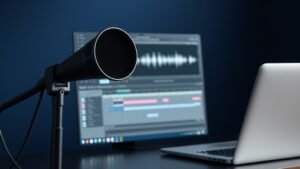
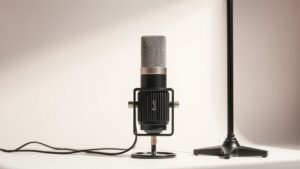
The debate between XLR vs USB microphones strikes at the heart of every crime writer’s recording setup, whether you’re narrating your own audiobooks, conducting author interviews, or recording promotional content. The choice isn’t just about technical specifications—it’s about understanding your workflow, your budget, and the professional demands of your particular corner of the crime fiction market.
Across eighteen series and more than 150 novels, I’ve found that the microphone decision often separates authors who merely dabble in audio content from those who build sustainable recording practices. The wrong choice can derail your entire audio strategy before you’ve recorded a single chapter.
Understanding the Technical Foundation
XLR microphones require an audio interface or mixer to convert their analog signal to digital, while USB microphones plug directly into your computer with built-in analog-to-digital conversion. This fundamental difference shapes everything else about your recording experience. XLR systems offer superior signal quality because they maintain the analog signal longer and typically use higher-quality converters in dedicated audio interfaces. The balanced XLR connection also provides better noise rejection over longer cable runs.
USB microphones sacrifice some technical quality for convenience and cost savings. However, modern USB mics have closed much of the quality gap, especially in the price ranges most authors work within. The real question isn’t which technology is theoretically superior—it’s which serves your actual recording needs. When I began recording promotional content for my police procedural novels, I started with USB specifically because I needed to focus on content creation, not audio engineering.
The Working Author’s Perspective
In my recording setup, I’ve used both systems extensively, and the choice comes down to workflow integration. For quick podcast interviews or social media content about my DCI Isaac Cook series, USB microphones win on pure convenience. I can connect, record, and move on without thinking about gain staging, phantom power, or monitoring levels. This matters when you’re juggling writing deadlines with promotional obligations.
However, when I recorded longer-form content for my DI Tremayne investigations, the limitations of USB became apparent. USB microphones often struggle with consistent gain levels across long sessions, and you’re locked into whatever preamp and converter the manufacturer built into the microphone. With an XLR setup, I can adjust my audio interface settings independently of the microphone choice, giving me much more control over the final sound.
The modularity of XLR systems also provides upgrade flexibility. You can start with a decent dynamic microphone and basic interface, then upgrade components as your needs evolve. USB systems require replacing the entire microphone when you outgrow its capabilities, making them potentially more expensive in the long run for serious audio work.
Cost Analysis Beyond the Purchase Price
The apparent cost advantage of USB microphones disappears when you factor in real-world usage patterns. A quality USB microphone costs roughly the same as an equivalent XLR microphone plus a basic audio interface. However, USB systems often require additional purchases that authors don’t anticipate—dedicated headphone amplifiers for monitoring, USB hubs for connectivity management, and eventually complete system replacements as needs grow.
XLR systems front-load the investment but provide better long-term value. A good audio interface will outlast multiple microphones, and you can experiment with different microphone types without rebuilding your entire signal chain. This modularity proved valuable when I needed different microphone characteristics for various projects—a dynamic mic for noisy environments when discussing my espionage thriller work, and a condenser for quiet studio sessions.
The hidden costs of USB also include computer resource usage. USB microphones draw power from your computer and can create ground loops or interference with other USB devices. I’ve experienced recording sessions interrupted by USB bandwidth issues when running multiple devices simultaneously—something that never happens with a dedicated XLR interface.
Common Mistakes That Sabotage Audio Quality
Authors consistently make the same errors regardless of their microphone choice, but USB systems are less forgiving of these mistakes. The biggest error is focusing solely on the microphone while ignoring room acoustics and recording technique. I’ve heard authors with expensive USB microphones whose recordings sound worse than others using basic XLR setups, simply because they’re recording in untreated rooms or maintaining inconsistent microphone distances.
Another common mistake is assuming USB simplicity eliminates the need to understand basic recording principles. USB microphones still require proper gain staging, and many authors set their levels too high, creating digital distortion that’s impossible to fix in post-production. With XLR systems, you have separate gain controls at the interface and in your recording software, making it easier to optimize your signal chain.
Authors also underestimate the importance of monitoring during recording. Many USB microphones provide direct headphone monitoring, but the quality is often poor and doesn’t accurately represent what’s being recorded. This leads to finished recordings with problems that weren’t apparent during the session. XLR interfaces typically provide superior monitoring capabilities that help you catch issues before they ruin an entire recording session.
Making the Decision for Your Specific Needs
Choose USB microphones if you’re primarily recording short-form content, working in different locations frequently, or just starting with audio content creation. USB makes sense for authors who want to test the waters without significant upfront investment or technical learning curves. They’re also ideal for backup recording situations or travel recording when you can’t bring a full XLR setup.
XLR systems are worth the additional complexity if you’re planning substantial audio content, want maximum flexibility in your recording chain, or need to maintain consistent quality across varied recording conditions. They’re essential if you’re considering self-narrated audiobooks or building a content studio for regular podcast or video production. The learning curve pays dividends in audio quality and system reliability.
The decision also depends on your technical comfort level and available time for audio production learning. XLR systems reward users who invest time in understanding proper recording technique, while USB systems prioritize immediate usability over ultimate performance potential. Consider your current writing workload and whether audio production will complement or compete with your primary writing schedule.
Conclusion
The XLR vs USB microphone choice ultimately reflects your commitment to audio content as part of your author platform. Both can produce professional results in the right hands, but they serve different phases of an author’s audio journey and different types of content creation needs.
About Phillip Strang
Phillip Strang is an Australian crime and thriller novelist. Across eighteen series and more than 150 novels, his work spans London police procedurals (DCI Isaac Cook), UK investigations (DI Tremayne), Australian outback crime (Maya Thorne), FBI thrillers (Alex Harlan), Scottish Highland mysteries (DI Sarah Lynch), and espionage (Steve Case). Learn more about Phillip or browse his complete catalogue on Amazon.
FREE DOWNLOAD
Stop Guessing. Start Buying Smart.
The specs that actually matter, demystified.
Headphones, microphones, the spec sheet jargon you can ignore — all in one quick-reference PDF. Free, instant, no fluff.
Send Me the CheatsheetYou'll also receive occasional new guide notifications. Unsubscribe anytime. No spam, ever.