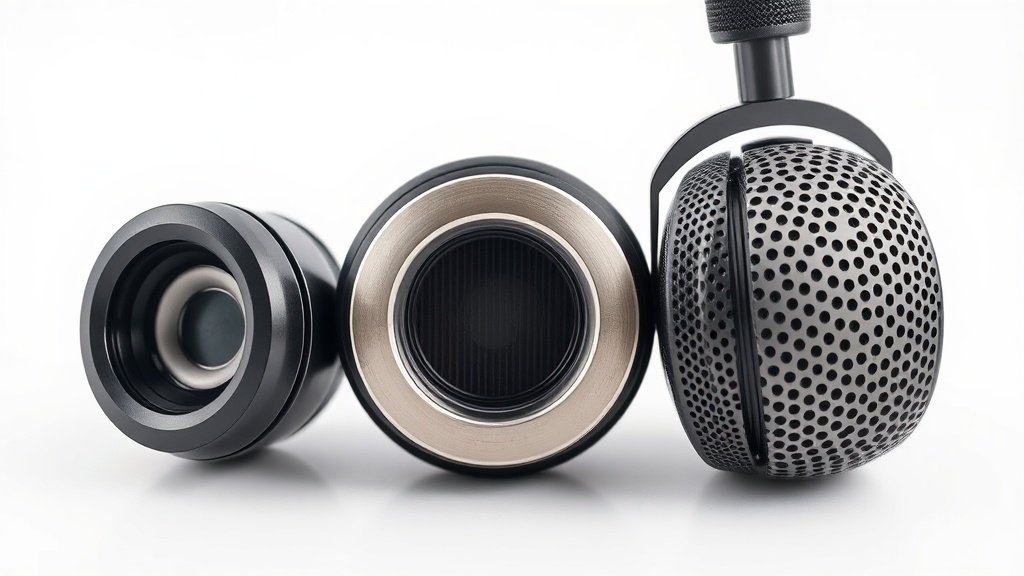
The driver inside your headphones determines more about what you hear than the amplifier, source, or even the recording itself in some cases.
After years of obsessively buying, using and comparing audio gear, I have learned that driver technology creates the fundamental character of any headphone before frequency response curves or build quality enter the equation. The transducer that converts electrical signals into sound waves shapes everything from bass extension to detail retrieval in ways that cannot be corrected downstream.
This guide breaks down the three main driver technologies found in serious headphones today: dynamic drivers that dominate the market, planar magnetic designs that audiophiles chase, and electrostatic systems that represent the technical pinnacle. Understanding how each works helps explain why a Sennheiser HD 800S sounds completely different from an Audeze LCD-X despite similar price points.
Dynamic Drivers: The Workhorse Technology
Dynamic drivers operate on the same electromagnetic principle as traditional loudspeakers, using a voice coil attached to a diaphragm that moves back and forth within a magnetic field. When audio signals flow through the coil, it creates a varying magnetic field that interacts with permanent magnets, causing the diaphragm to vibrate and produce sound waves. The diaphragm typically consists of treated paper, plastic, or metal formed into a cone or dome shape.
Most headphones from budget models to flagship designs use dynamic drivers because they offer excellent efficiency and can be driven easily by portable devices. The Sennheiser HD 650, Beyerdynamic DT 990 Pro, and Audio-Technica ATH-M50x all employ dynamic drivers but sound remarkably different due to variations in diaphragm materials, magnet strength, and acoustic chamber design. Dynamic drivers excel at producing powerful bass response since the relatively large diaphragm can move substantial amounts of air.
The main limitation of dynamic drivers lies in their mass and mechanical complexity. The voice coil adds weight to the moving assembly, which can limit high-frequency response and transient accuracy compared to other technologies. However, modern implementations like those found in the Focal Utopia or Sony MDR-Z1R demonstrate that exceptional dynamic drivers can compete with any technology when engineered properly.
Planar Magnetic Drivers: Precision Through Design
Planar magnetic drivers take a fundamentally different approach by spreading the voice coil across a thin diaphragm as a flat conductor pattern, typically etched or printed directly onto the membrane surface. This diaphragm sits between arrays of magnets arranged in a grid pattern, creating a uniform magnetic field across the entire surface. When current flows through the conductor traces, the entire diaphragm moves as one coherent unit rather than radiating outward from a single point like dynamic drivers.
This design offers several advantages that explain why companies like Audeze, HiFiMAN, and Fostex have built reputations around planar magnetic headphones. The distributed drive force eliminates the breakup modes and resonances that plague cone-shaped diaphragms, resulting in exceptionally clean midrange reproduction and extended frequency response. The low mass of the diaphragm combined with strong magnetic control provides excellent transient response that reveals subtle details in recordings.
However, planar magnetic drivers require powerful amplification due to their low sensitivity and typically low impedance characteristics. The Audeze LCD-2 or HiFiMAN Arya demand far more power than equivalent dynamic headphones to reach the same listening levels. The large magnet arrays also make planar headphones significantly heavier, which affects comfort during extended listening sessions but contributes to their distinctive sound signature.
The driver technology determines the fundamental character of any headphone before frequency response tuning or build quality enter the equation.
Electrostatic Drivers: The Technical Summit
Electrostatic drivers represent the most exotic approach, using an ultra-thin diaphragm charged with static electricity and suspended between two perforated metal plates called stators. High voltage bias supply charges the diaphragm, while audio signals applied to the stators create varying electric fields that attract and repel the membrane. This electrostatic force moves the diaphragm without any physical connection, eliminating mechanical distortions entirely.
The results speak for themselves in models like the Stax SR-009S, Koss ESP-950, or Sennheiser HE 1. Electrostatic headphones deliver unmatched clarity and detail resolution because the massless diaphragm responds instantly to musical transients without overshoot or ringing. The distributed electrostatic force across the entire membrane surface produces coherent wavefronts that create exceptional imaging and soundstage presentation.
The trade-offs are significant enough to keep electrostatics as niche products. They require dedicated amplifiers that generate hundreds of volts bias voltage, making portable use impossible. The delicate diaphragms are sensitive to humidity, dust, and physical damage. Bass extension often suffers compared to dynamic designs because electrostatic force weakens at large excursion levels. These limitations explain why even flagship electrostatics like the Stax SR-X9000 remain specialist tools rather than mainstream products.
Matching Driver Technology to Your Needs
Choosing between driver technologies depends on your listening habits, source equipment, and sonic priorities rather than following audiophile orthodoxy. Dynamic drivers suit most users because they work well with any amplifier and offer reliable performance across all music genres. Models like the Sennheiser HD 600 or Grado SR325x provide excellent sound quality without requiring special equipment or handling considerations.
Planar magnetic headphones reward listeners who prioritise detail and clarity over convenience. If you have adequate amplification and can tolerate the weight penalty, models like the HiFiMAN Edition XS or Audeze MM-500 reveal nuances in recordings that dynamic drivers often mask. They excel with complex orchestral music, dense metal productions, and acoustic recordings where instrument separation matters more than raw impact.
Electrostatic systems serve as reference tools for critical listening when ultimate resolution takes priority over practical concerns. The transparency they provide makes them invaluable for audio production work or analytical listening, but the amplifier requirements and fragility make them unsuitable as daily drivers for most people.
The Engineering Reality Behind the Marketing
Manufacturer claims about driver technology often emphasise theoretical advantages while glossing over real-world trade-offs. Dynamic drivers get dismissed as outdated technology, yet the best implementations outperform mediocre planar or electrostatic designs across every measurable parameter. The Focal Stellia proves that dynamic drivers can achieve extraordinary detail retrieval when engineered without cost constraints.
Similarly, planar magnetic marketing focuses on technical superiority while downplaying power requirements and comfort issues. Many users purchase models like the HiFiMAN Sundara expecting easy amplification, then discover their portable devices cannot drive them properly. The technology advantage only materialises with adequate power delivery and proper system matching.
Electrostatic specifications look impressive until you factor in amplifier costs and reliability concerns. A complete Stax system costs significantly more than the headphone price alone, and the specialised electronics limit upgrade flexibility. Understanding these practical limitations prevents expensive mistakes when choosing your next headphone upgrade.
Assuming planar magnetic headphones work well with portable devices. Most planar designs require desktop amplifiers to perform properly despite moderate impedance specifications. Check power requirements carefully before purchase.
Choosing driver technology based on frequency response graphs alone. Measurements cannot capture the timing and dynamic differences between technologies that affect musical enjoyment. Listening tests reveal characteristics that specifications miss.
Expecting electrostatic headphones to excel at bass-heavy music genres. The physics of electrostatic operation limit low-frequency output compared to dynamic or planar alternatives. Consider your musical preferences before investing in electrostatic systems.
Conclusion
Driver technology provides the foundation for headphone performance, but implementation quality matters more than the underlying principle. Excellent examples exist within each category, from dynamic designs like the Beyerdynamic T1 to planar options like the Audeze LCD-X to electrostatic references like the Stax L300. Match the technology to your equipment, listening environment, and musical priorities rather than chasing theoretical advantages that may not translate to real-world benefits.

FREE DOWNLOAD
Stop Guessing. Start Buying Smart.
The specs that actually matter, demystified.
Headphones, microphones, the spec sheet jargon you can ignore — all in one quick-reference PDF. Free, instant, no fluff.
Send Me the CheatsheetYou'll also receive occasional new guide notifications. Unsubscribe anytime. No spam, ever.