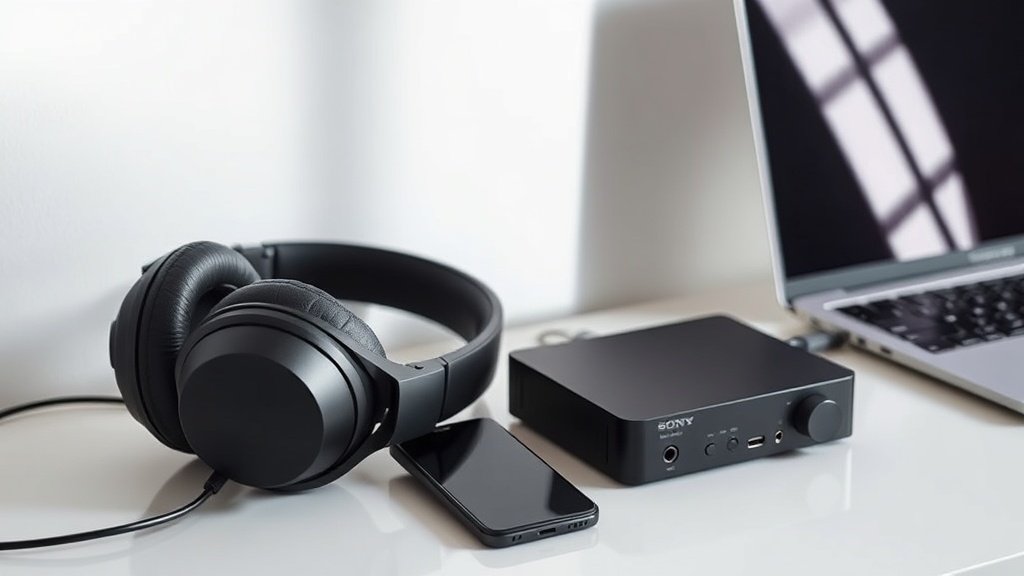
The same pair of headphones can sound bright and articulate from your audio interface yet muffled and compressed from your phone, revealing how dramatically source devices shape what reaches your ears.
After years of obsessively buying, using and comparing audio gear, I have learned that headphones merely translate what they receive. The magic happens upstream in the source device, where digital audio becomes analogue voltage that drives the headphone drivers.
This guide examines why identical headphones produce vastly different sound signatures depending on their source device, covering impedance matching, amplifier design choices, DAC implementation, and the practical steps to optimise any headphone and device pairing.
Impedance Matching Determines Dynamic Response
Headphone impedance creates the foundation for how well a device can control the drivers. Low impedance headphones like the Audio-Technica ATH-M50x at 38 ohms draw more current from the output stage, while high impedance models like the Sennheiser HD 650 at 300 ohms require higher voltage to achieve the same volume levels. The interaction between source output impedance and headphone impedance determines damping factor, which directly affects bass control and overall frequency response.
Most smartphones and laptops feature output impedances between 10 and 47 ohms, creating poor damping factors when paired with low impedance headphones. This results in loose bass response, reduced dynamics, and frequency response deviations that can exceed 3dB in the bass region. Dedicated headphone amplifiers like the Schiit Magni typically maintain output impedances below 1 ohm, providing tight control across the entire frequency spectrum regardless of headphone impedance.
The voltage swing capability of the source device becomes critical with high impedance headphones. While a smartphone might produce adequate volume with 300-ohm headphones at maximum output, the amplifier operates in saturation, introducing distortion and compression that robs the music of dynamic range. Professional interfaces like the RME ADI-2 DAC provide clean power delivery up to 1.5 watts per channel, allowing high impedance headphones to operate within their optimal dynamic range.
Digital-to-Analogue Conversion Quality Shapes Tonal Character
Every digital source device contains a DAC chip that converts digital audio files into analogue voltage, and the implementation quality varies dramatically between devices. Smartphones typically use basic DAC chips optimised for power consumption rather than audio quality, often introducing noise floors around -90dB and showing poor performance with high-resolution audio files above 16-bit/44.1kHz.
Dedicated DACs like the Topping D90 or Chord Mojo implement reference-grade conversion chips with noise floors below -120dB and support for PCM audio up to 32-bit/384kHz. These devices reveal detail and spatial information that remains hidden through lower-quality DAC implementations, making identical headphones sound more open and resolving.
The analogue output stage following the DAC chip contributes significantly to the final sound signature. Budget implementations often use single-ended output stages with limited current delivery, while higher-end devices employ balanced differential outputs or discrete Class A amplification. The Focal Aria 906 headphones sound noticeably more controlled and extended through the balanced output of a professional interface compared to the headphone output of a typical laptop.
The amplifier circuit design determines whether your headphones receive clean power or a compromised signal that masks musical detail.
Amplifier Circuit Topology Affects Sound Character
The amplifier section that drives headphones varies widely between devices, from basic operational amplifier chips in portable devices to discrete transistor designs in dedicated headphone amplifiers. Class AB amplification, common in most devices, provides reasonable efficiency but can introduce crossover distortion at low listening levels where musical detail matters most.
High-end headphone amplifiers often employ Class A operation, where the output transistors remain constantly biased, eliminating crossover distortion entirely. The difference becomes apparent with demanding headphones like the Audeze LCD-X, which reveal the clean, linear response of Class A amplification compared to the slight hardness that Class AB circuits can impart to transient details.
Power supply design within the amplifier section determines dynamic capability and noise performance. Switching power supplies in laptops and phones introduce high-frequency noise that can cause fatigue during extended listening sessions, while linear power supplies in dedicated amplifiers provide clean, stable voltage rails that allow headphones to reproduce subtle musical nuances without electronic interference.
Output Power Requirements Vary by Headphone Design
Headphone sensitivity, measured in dB SPL per milliwatt, determines how much power the drivers need to reach comfortable listening levels. High-sensitivity headphones like the Grado SR60e at 99.8 dB/mW require minimal power and can sound excellent from almost any source, while planar magnetic headphones like the HiFiMAN Sundara at 94 dB/mW demand significantly more current to achieve the same volume levels.
Insufficient power delivery manifests as compressed dynamics, reduced bass extension, and a general sense that the music lacks energy and impact. I have measured smartphone outputs that clip when driving demanding headphones to moderate listening levels, introducing harmonic distortion that makes music sound harsh and fatiguing. Portable headphone amplifiers like the iFi xDSD Gryphon provide clean power delivery that transforms the same headphones from sluggish to engaging.
Peak current capability matters more than steady-state power ratings for realistic music reproduction. Orchestral crescendos and drum transients require instantaneous current delivery that exceeds average power requirements by significant margins. Desktop amplifiers with substantial power supply capacitance handle these musical peaks without compression, allowing headphones to reproduce the full dynamic range of well-recorded source material.
Frequency Response Interactions Create Sonic Signatures
Every component in the audio chain contributes frequency response characteristics that combine to create the final sound signature. Smartphones often implement bass boost and dynamic range compression to compensate for their limited amplifier capabilities and improve perceived sound quality through small speakers. These processing algorithms remain active when using headphones, colouring the sound in ways that mask the true character of the headphone drivers.
Professional audio interfaces typically provide transparent frequency response with minimal processing, allowing headphones to reproduce their intended sound signature. The difference becomes apparent when comparing the same headphones through a smartphone versus a dedicated interface like the Focusrite Scarlett Solo, where the neutral response reveals spatial information and tonal balance that smartphone processing obscures.
High-frequency roll-off in the source device affects perceived detail and air in the music reproduction. Budget DAC implementations often show measurable attenuation above 15kHz, making headphones sound duller and less extended than their specifications suggest. Reference-grade sources maintain flat response well beyond the audible range, ensuring that headphones can reproduce the full harmonic content of acoustic instruments and ambient information in recordings.
Assuming all headphone outputs sound identical because they produce adequate volume. Volume level provides no indication of power quality, distortion performance, or frequency response accuracy. Use dedicated headphone amplifiers for consistent results across different headphones.
Judging headphone quality based on smartphone or laptop performance alone. These devices prioritise battery life and cost reduction over audio quality, often masking the true capabilities of good headphones. Test headphones through multiple high-quality sources before making purchase decisions.
Ignoring impedance matching when selecting source devices for specific headphones. Poor impedance matching creates frequency response deviations and reduced damping factor that compromise sound quality regardless of component cost. Match low output impedance sources with any headphone impedance for optimal results.
Conclusion
Your headphones sound different on various devices because each source component contributes distinct characteristics through impedance interactions, DAC quality, amplifier design, and power delivery capabilities. Understanding these relationships allows you to select appropriate source devices that reveal the true potential of your headphones rather than masking their intended sound signature.

FREE DOWNLOAD
Stop Guessing. Start Buying Smart.
The specs that actually matter, demystified.
Headphones, microphones, the spec sheet jargon you can ignore — all in one quick-reference PDF. Free, instant, no fluff.
Send Me the CheatsheetYou'll also receive occasional new guide notifications. Unsubscribe anytime. No spam, ever.