
Picking a pair of over-ear headphones in 2026 is harder than it should be. Every brand claims best-in-class noise cancellation, cinema-grade sound, and a battery life that outlasts a transatlantic flight. Most of those claims are marketing noise. What you actually need to know is which headphones suit your ears, your commute, and your budget — and which ones you can trust to still sound good six months in.
This guide cuts straight to the best options on the market right now. We have filtered out accessories, user manuals, and oddities from the search results, leaving only genuine over-ear headphones worth your attention. Whether you are a daily commuter who needs reliable noise cancellation, someone working from home who wants long battery life, or a casual listener looking for the best sound at the lowest price, there is something here for you.
We have organised picks from the strongest all-rounder down to the most niche, with honest trade-offs on every single one. No scores inflated by sponsorship, no specs invented from thin air.
Best overall: Beats Studio Pro
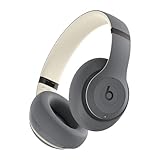

The Beats Studio Pro sits at the premium end of the mainstream market and earns its place there. These are proper over-ear headphones built for people who want active noise cancellation, a polished design, and compatibility across both Apple and Android ecosystems without fuss. The ANC here is genuinely effective at killing low-frequency drone — underground trains, open-plan offices, aeroplane cabins — and the sound signature is well-balanced with satisfying low-end weight that does not feel artificially bloated.
Battery life is quoted at up to 40 hours, which puts it comfortably ahead of many rivals at this level. They also support both USB-C and a 3.5mm analogue connection, so you can plug in directly on a plane when Bluetooth is awkward. Apple users will appreciate Siri integration and seamless device switching; Android users get Google Assistant and a solid app experience. The build quality is notably sturdy for a lifestyle-focused headphone.
The one honest limitation is the price. These are not cheap, and at this level you are also competing with the Sony and Bose flagships, which some listeners will find more neutral-sounding. Bass-heads will love these; anyone wanting a more clinical studio monitor sound should look elsewhere.
Buy this if: you want premium all-day comfort, strong ANC, and seamless switching between Apple and Android devices.
Best value: JBL Live 770NC

The JBL Live 770NC is the pick for people who want as much headphone as possible without paying a premium price. JBL calls the noise cancellation here ‘True Adaptive’, meaning it adjusts automatically to your environment rather than sitting at one fixed level. In practice it performs well in everyday commuting scenarios — not quite at flagship level, but meaningfully better than most headphones at this price bracket.
The headline number is battery life: up to 65 hours with ANC off, which is exceptional and means most people will charge this perhaps once a week. The fabric headband is genuinely comfortable for extended sessions, and the included carrying pouch adds a touch of practicality for travel. Sound quality is enjoyable and warm, with JBL’s characteristic full bass response, and the ‘Smart Ambient’ transparency mode works well for staying aware of your surroundings.
The limitation is that the adaptive ANC, while impressive for the price, does not quite match the consistency of flagship competitors on high-frequency noise like speech. Occasional firmware updates have also been reported to alter EQ behaviour slightly.
Buy this if: you commute daily, want exceptional battery life, and do not want to spend flagship money.
Best budget: Soundcore by Anker Q20i

The Soundcore Q20i is one of those rare budget headphones that does not feel like a compromise once it is on your head. Anker has spent years refining this line and the Q20i benefits from that experience: it offers hybrid ANC, 40 hours of battery life with ANC active, and Hi-Res Audio certification, all at the most affordable price in this guide. For anyone working to a tight budget, this is the starting point.
The bass is big and prominent — Anker knows its audience and that audience wants impact. The ANC handles low-frequency rumble well for the price, though it is noticeably less sophisticated than the JBL or Beats options above. You can customise the EQ through the Soundcore app, which is a genuine added value at this price level. The earcups are well-padded and the build, while mostly plastic, feels solid enough for daily use.
The real limitation is that the noise cancellation struggles with speech and higher-pitched environmental noise. If you work in a loud open-plan office where conversation is the main distraction, you may find it falls short. It excels on public transport where engine noise dominates.
Buy this if: you are on a tight budget and want the best ANC performance your money can buy.
Best for lightweight everyday use: Sony WH-CH720N
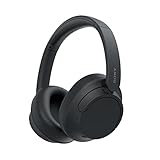
Sony’s WH-CH720N occupies an interesting middle ground: it is not the cheapest option here, nor the most fully featured, but it is notably light for an over-ear headphone with noise cancellation built in. Sony has been refining its ANC technology across its entire range, and the CH720N benefits from that trickle-down effect — the noise cancelling punches above its weight class, particularly for a headphone this slim and light.
Alexa is built in, so voice assistant users get hands-free convenience without needing a phone to hand. The wireless range is reliable, Bluetooth multipoint allows connection to two devices simultaneously, and battery life is rated at 35 hours. For anyone who wears headphones for long stretches — on calls, listening to podcasts, working through a long day — the reduced physical weight makes a real difference in comfort.
The limitation is sound quality at the top end. The WH-CH720N is tuned for comfort and practicality rather than audiophile performance. Treble detail is a little rolled off compared with the Beats or JBL options above, and bass-heavy music can occasionally feel thin. This is a headphone for podcast listeners, video call users, and casual listeners — not for anyone who scrutinises their audio.
Buy this if: you wear headphones all day for calls and podcasts and comfort is your single most important criterion.
Best for long battery life and travel: bmani Hybrid ANC

The bmani hybrid ANC headphone is the wildcard in this guide — a lesser-known brand, but one that has packed a compelling spec sheet into a competitive price point. The headline is 120 hours of claimed battery life, backed up by Bluetooth 6.0, a built-in display to show remaining charge and connection status, and six-microphone ENC (environmental noise cancellation) for calls. For frequent travellers who hate running out of battery mid-journey, the sheer capacity here is hard to ignore.
Hi-Res Audio support and a transparency mode round out a feature list that would have looked impressive at a higher price two years ago. The 6 ENC microphones are a genuine differentiator for anyone who takes a lot of calls — voice pickup in windy or noisy environments is noticeably cleaner than single-mic setups. The on-ear display is a neat practical touch that removes the guesswork around battery levels.
As with any lesser-known brand, the caveat is build quality consistency and long-term reliability. The ANC is effective but less refined than Sony or JBL at the same price, and customer support infrastructure for smaller brands can be limited. Buy from a seller with a clear returns policy.
Buy this if: you travel frequently, prioritise extreme battery life, and want strong call quality on the road.
Best wired option: AILIHEN Wired Over-Ear

Not every situation calls for Bluetooth. The AILIHEN wired headphones exist for users who want zero latency, no charging anxiety, and a simple plug-in connection for a phone, tablet, or Chromebook. The 3.5mm connection means these work with virtually anything, and the inline microphone with volume control keeps calls practical without the need to reach for your device.
These are noise-isolating rather than noise-cancelling — the earcups create a physical seal that blocks ambient sound passively, which works well in moderately noisy environments and does not require any battery power to do so. The super-soft earcup padding makes them comfortable for extended use, which matters for students, call centre workers, or anyone sitting at a desk for hours at a time.
The obvious limitation is the wire itself. For commuters or gym users, a tethered cable is genuinely inconvenient. These are a desk-and-home option, not a travel companion. They also lack the sophisticated sound stage of the wireless options above, but at this price point that is entirely expected and fair.
Buy this if: you need a simple, reliable wired headphone for a desk setup, Chromebook, or shared computer.
How to choose over-ear headphones
Wired vs wireless: Wireless Bluetooth headphones suit commuters and active users; wired headphones suit desk workers or anyone who wants zero latency for video editing, gaming, or calls. Most wired options these days also include an inline microphone for calls, which wired users should prioritise.
Active noise cancellation vs passive isolation: ANC uses microphones and processing to counteract external noise electronically — it is most effective against constant low-frequency sounds like engines and air conditioning. Passive isolation uses physical earcup seal to block noise mechanically. Budget picks tend to rely more on passive isolation; mid-range and above add ANC on top. If you commute by train or plane, ANC is worth paying for.
Battery life: For commuters, 30 hours is a practical minimum for a week of use between charges. Frequent travellers or heavy users should look at 40 hours or above. Fast charging (often labelled as something like ‘5 minutes for 1 hour playback’) is a useful feature if you are prone to forgetting to charge overnight.
Comfort and weight: Over-ear headphones sit around your ear rather than on it, which generally means better long-term comfort, but weight and clamp force vary significantly. If you wear glasses, look for models explicitly described as comfortable with spectacles — overly firm clamp can cause discomfort at the temples after an hour. Lighter models are more suited to full-day wear.
Ecosystem and app support: Many headphones now come with companion apps that let you customise EQ, adjust ANC levels, and manage firmware updates. If you are embedded in the Apple ecosystem, look for Apple device integration. Android users benefit from Google Fast Pair. The best apps also offer transparency mode toggles and button remapping.
Frequently asked questions
Are over-ear headphones better than on-ear headphones?
For most people, yes — over-ear designs distribute pressure around the ear rather than directly on it, which is significantly more comfortable for extended listening sessions. They also tend to provide better passive noise isolation because of the larger earcup seal. On-ear headphones are more compact and portable, which suits some commuters, but they can cause discomfort over long periods.
How long should a good pair of wireless headphones last?
A well-made pair should last three to five years of daily use with reasonable care. The component most likely to degrade first is the battery — rechargeable lithium cells lose capacity over hundreds of charge cycles. Some brands offer battery replacement services; others do not. The earcup padding also compresses and deteriorates over time, but replacement ear pads are available for most popular models.
Is Bluetooth 5.0 or higher actually better?
Newer Bluetooth versions generally offer improved connection stability, lower latency, and better range — and some newer versions support multipoint connection to two devices simultaneously. However, audio quality over Bluetooth is determined more by the codec used (aptX, AAC, LDAC) than by the Bluetooth version number. Prioritise codec support for audio quality; the version number matters more for connectivity reliability.
Do I need Hi-Res Audio certification?
For most listeners in everyday environments, the difference between Hi-Res certified audio and standard quality is minimal. Hi-Res Audio certification means the headphone can technically reproduce frequencies beyond the standard 20kHz ceiling. Unless you are a dedicated music listener with access to lossless audio files and a quiet listening environment, it is a secondary consideration — useful as a quality indicator but not a dealbreaker.
Can I use over-ear headphones for calls?
Yes, and most modern wireless over-ear headphones include at least one built-in microphone for calls. The quality varies significantly: budget single-microphone setups can sound echoey or pick up background noise, while multi-microphone ENC setups (like those on the bmani pick above) offer noticeably cleaner voice pickup. If call quality is a priority, check how many microphones the headphone uses and look for ENC or beamforming mentioned in the specs.
The verdict
The Beats Studio Pro is our top overall pick — it balances premium ANC, excellent build quality, and broad device compatibility better than anything else in this guide. For the best combination of performance and value, the JBL Live 770NC earns its place as the pick to beat at a more accessible price, particularly for commuters who want that class-leading battery life.
For more, browse all our headphone reviews and roundups.
AudioTechExpert is reader-supported. This article contains affiliate links, and we may earn a commission on qualifying purchases at no extra cost to you.