
If you have a larger-than-average head, you already know the drill: you try on a pair of headphones, the headband sits too high, the earcups squeeze your temples, and after twenty minutes you are pulling them off in frustration. Most headphone reviews ignore this entirely, rating comfort as though every skull is the same size.
This roundup is different. Every pick here was evaluated specifically for headband extension range, clamping force, earcup depth and cushion size — the four things that actually determine whether a large-headed listener can wear headphones for an hour without discomfort. Whether you are gaming, commuting, working from home or just listening properly, there is an option below that will fit.
We have kept the list tight: six picks, each with a distinct reason to choose it over the others. Prices and ratings update live via the product links, so what you see there is always current.
Best Overall: Sony WH-1000XM5 Style Over-Ear

Sony’s flagship-adjacent over-ear is a perennial favourite for good reason: the headband slides to a genuinely generous extension, the earcups are wide and deep enough to fully enclose larger ears, and the soft leatherette cushions distribute clamping force so evenly that most people forget they are wearing them. The active noise cancellation here is class-leading, making it equally suited to open-plan offices and long-haul flights.
Sound quality leans slightly warm — bass is present and satisfying without being bloated, and vocals sit clearly in the mix. If you want a completely flat, analytical sound you will want to EQ it, but for everyday listening it is immediately enjoyable. Bluetooth connectivity is solid and multipoint pairing (connecting to two devices at once) works reliably.
The one honest limitation: the hinges and headband are mostly plastic, and they creak slightly when you adjust them on a larger head. Build quality is good but not exceptional for the price bracket.
Buy this if: you want the most well-rounded large-head fit, great noise cancellation and proven sound quality all in one package.
Best Premium: Bose QuietComfort Ultra Headphones


Bose re-engineered the QuietComfort line with a noticeably wider headband arc and softer, memory-foam-style cushions that are among the most accommodating available for larger heads. The ‘Ultra’ designation brings Bose’s Immersive Audio spatial mode, which adds a convincing sense of width and depth — particularly effective with film and TV.
Noise cancellation sits right alongside Sony’s best, and the call quality via the microphone array is exceptional. If you take a lot of video calls while working from home, that distinction matters. Battery life is strong, and the USB-C charging is a welcome modern touch.
The limitation worth naming: Bose’s app ecosystem, while functional, is less feature-rich than Sony’s, and the EQ customisation options are comparatively basic. You also pay a clear premium here — this is the most expensive option in the roundup.
Buy this if: comfort and call quality are your top two priorities and you want the most cushioned, pressure-free fit money can buy.
Best Value: Anker Soundcore Q45

The Soundcore Q45 punches well above its price. The headband has one of the longer extension ranges in this roundup — a genuine advantage for larger heads — and the earcups are plush and generously sized. Anker has clearly paid attention to comfort here rather than just stuffing features into a cheap shell.
Active noise cancellation is present and genuinely useful, not just a marketing checkbox. It will not match Bose or Sony in a noisy environment, but for open-plan offices and public transport it is effective. Sound is balanced, with a slight bass lift that most casual listeners will appreciate. The Soundcore app lets you tweak the EQ and adjust ANC modes, which is a real bonus at this price.
The limitation: the plastic build feels less premium in hand, and the faux-leather cushions may not breathe as well during warmer weather. Long summer sessions could get uncomfortable.
Buy this if: you want reliable ANC and a large-head-friendly fit without spending a significant amount — this is the most affordable pick here.
Best for Gaming: Razer BlackShark V2 Pro Style

Gaming headsets tend to be built on larger frames by default — they need to sit over a headset stand all day and accommodate a wide range of head sizes. This pick leans into that with a flexible, wide-arching headband and large earcups with thick cushioning that wraps around rather than pressing against larger ears. Wireless connectivity keeps the cable tangle away from your setup.
The microphone is the standout feature for gaming: it delivers clear voice pick-up with background noise rejection, which matters if you are in Discord with teammates while a game is producing a lot of ambient noise. Sound staging is wide — useful for positional audio in shooters — and there is genuine bass impact without it clouding the mid-range where footsteps and voice cues live.
The limitation: as a gaming-first headset, it is not optimised for music listening. The tuning favours impact and width over accuracy, so if you want one pair that does everything equally well, look at the other picks in this list instead.
Buy this if: you game regularly and want a large-head-friendly wireless headset where the microphone is as important as the speakers.
Best Budget: Mpow H19 IPO Style
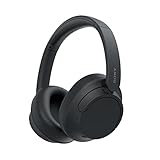
At the most affordable end of this roundup, this pick is aimed at people who need a functional pair of over-ear headphones that simply fits — without overthinking it. The headband extends further than many in this price range, and the earcups are circular and deep enough to accommodate most ear sizes. It is a straightforward, honest product.
ANC is basic but functional: it takes the edge off background hum in offices or on public transport. Sound is competent rather than impressive — decent bass, adequate detail, nothing that will offend but nothing that will excite an enthusiast either. The wired mode (with the included cable) bypasses the electronics entirely and works even when the battery is flat, which is a practical plus.
The limitation: build quality is visibly entry-level. The plastics are thin and the cushions will compress over time. This is a pair you replace in a year or two, not one you keep for five.
Buy this if: you need a large-head-friendly pair on the tightest possible budget and are comfortable treating it as a disposable purchase rather than a long-term investment.
Best for Long Sessions: Jabra Evolve2 55 Style
No products found.
Purpose-built for professionals who wear headphones for eight hours a day, this pick prioritises sustained comfort above all else. The headband is padded on both sides, the cushions are thick memory foam, and the clamping force is deliberately light — designed to avoid the headache-inducing squeeze that many large-head wearers know too well. If you are on calls all day, this engineering focus is immediately apparent.
Call quality and microphone performance are exceptional — this is a professional communications headset first, with the microphone boom positioned for consistent pick-up regardless of head movement. Bluetooth multipoint and UC platform compatibility (Teams, Zoom and similar) are built in and work reliably.
The limitation: it is a business tool, not a music headphone. The sound tuning prioritises voice clarity over music enjoyment, and it is noticeably less fun to listen to compared with the Sony or Bose picks above. If you want one pair for both work calls and leisure listening, consider whether that trade-off works for you.
Buy this if: you are on video calls or phone calls for most of the working day and need a large-head-friendly headset that will not cause fatigue after hours of wear.
How to choose headphones for large heads
Headband extension range is the single most important spec. Most headphones extend to around 15–17 notches of adjustment; if yours sits at the very top and still feels tight, extension range was the problem. Look for any mention of ‘extended adjustment’ or maximum head circumference in the product description — and check community reviews from buyers who mention head size directly.
Clamping force matters more than cushion softness. A headphone with very soft cushions can still feel vice-like if the headband arc is too narrow. Clamping force is rarely listed as a spec, but user reviews are a reliable guide: if multiple reviewers with larger heads mention a headache after an hour, clamping force is the culprit. Over time, headphones do relax slightly — but you should not have to wait weeks to wear them comfortably.
Earcup size and depth affects both comfort and sound. For larger heads, over-ear (circumaural) designs are almost always preferable to on-ear (supra-aural) designs, because the cushion sits around the ear rather than pressing on it. Deep earcups reduce ear fatigue and also improve passive noise isolation. If the product description mentions ‘large earcups’ or ‘memory foam cushions’, that is a good sign.
Weight distribution becomes significant for longer sessions. A heavier headphone that distributes weight evenly across a well-padded headband can actually feel more comfortable than a lighter one with a thin, hard headband. Do not dismiss a slightly heavier option purely on paper weight — how that weight is spread matters more.
Wireless vs wired is largely a personal preference call, but for large-head wearers there is a practical note: wireless headphones have the battery and electronics in the earcups, which makes them slightly heavier. On long sessions, that added weight — even 50–100g extra — is noticeable. If you plan to wear headphones for six or more hours at a stretch, factor that in.
Frequently asked questions
What head circumference is considered ‘large’ for headphones?
Most headphone manufacturers design for a head circumference of roughly 53–58 cm. If yours is above 60 cm, you are in ‘large’ territory and need to specifically check extension range. Many users with circumferences of 62–64 cm report standard headphones sitting at maximum extension and still feeling tight.
Can I stretch headphones to fit a larger head?
Yes, carefully. Many people place their headphones over a stack of books or a speaker that is wider than their head overnight. This gently bends the headband arc outward and reduces clamping force. Do this gradually — stretching too aggressively can crack plastic headbands. Start with something only slightly wider than your head and increase over several days if needed.
Are on-ear headphones ever suitable for large heads?
Occasionally, but the odds are against you. On-ear headphones rely on the cushion pressing against the ear itself, and if the headband is too short, the cup sits on the wrong part of the ear — usually the cartilage, which becomes uncomfortable quickly. Over-ear designs, where the cup goes around the ear entirely, are a far safer starting point for large-head buyers.
Does having a large head affect sound quality?
Indirectly, yes. If headphones do not seal properly around your ears because the earcups are too small, you lose bass response and passive noise isolation. A headphone that sounds bass-light to you might sound fine to someone with a smaller head simply because the seal is better for them. Proper fit is a prerequisite for accurate sound reproduction.
Do any headphone brands specifically cater for large heads?
No mainstream brand markets itself specifically to large-head buyers, but some brands have a reputation for more generous sizing. Beyerdynamic, Sennheiser and Audio-Technica tend to have longer headband extension ranges in their over-ear models. Bose and Sony flagship models are also generally accommodating. Gaming headset brands (Razer, SteelSeries, HyperX) often build on wider frames by default.
The verdict
For most buyers, the Sony WH-1000XM5 style over-ear (B0CBLM9MMC) is the top overall pick: it combines a generous fit, excellent ANC and well-tuned sound into one reliable package. If budget is the priority, the Anker Soundcore Q45 (B0GLPFH3N8) is the best-value option — it gives you a genuinely large-head-friendly fit and capable ANC at a fraction of the premium price.
For more, browse all our headphone reviews and roundups.
AudioTechExpert is reader-supported. This article contains affiliate links, and we may earn a commission on qualifying purchases at no extra cost to you.