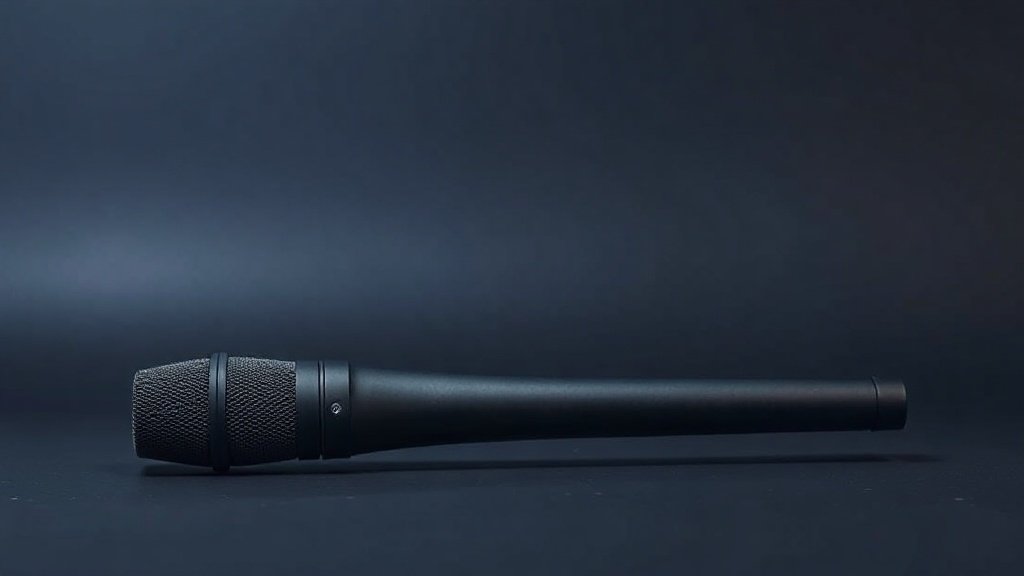
Getting clean, directional audio on a camera is one of the most frustrating problems for anyone who makes video. Built-in camera mics pick up everything — camera noise, ambient rumble, the hum of your fridge — and the result sounds exactly as bad as it looks. A shotgun microphone solves this by focusing its pickup pattern in a tight beam in front of the capsule, pulling in your subject and rejecting the rubbish around it.
This guide covers the best shotgun microphones available right now, chosen from a shortlist of real, currently available products. Whether you are shooting documentary footage with a proper XLR rig, mounting something compact to a mirrorless camera for YouTube, or plugging straight into a smartphone, there is a pick here that fits. We have kept the list tight — six solid options — and ranked them from the most well-rounded choice down to more specialised picks.
This article is for videographers, filmmakers, content creators and journalists who want noticeably better audio without a PhD in acoustics. Every pick gets an honest look at its strengths and a real limitation, because nothing here is perfect for everyone.
Best overall: RØDE VideoMic Pro+
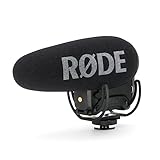
The RØDE VideoMic Pro+ is one of the most complete on-camera shotgun microphones you can buy for filmmaking and location recording, and its supplied title tells you exactly why: it comes loaded with a high-pass filter, high-frequency boost, pad, and a safety channel. That last feature is a genuine standout — the safety channel records a quieter parallel track so that if your main signal clips during an unexpected loud moment, you have a backup. For run-and-gun shooters and solo filmmakers, that peace of mind is worth a great deal.
The VideoMic Pro+ mounts directly on a camera’s hot shoe and is aimed squarely at professional content creation and location recording. Its supercardioid polar pattern keeps focus tight on whatever is in front of the lens, and the onboard controls let you tailor the sound to the environment without touching your camera settings. Build quality is solid and it has earned a strong reputation among working video professionals.
The limitation is size and price: this is a step up in both cost and physical footprint compared to the more compact options here. If you are shooting on a gimbal or want something ultralight, it may feel front-heavy. But for straightforward camera-mount use, nothing else on this list matches its combination of features and pedigree.
Buy this if: You are a filmmaker or serious content creator who wants pro-level onboard controls and the security of a safety channel.
Best premium XLR option: Sennheiser MKE 600 Bundle

The Sennheiser MKE 600 is a professional-grade shotgun microphone built for camera use, ENG work, and location recording where you need reliable, consistent directional audio. What makes this particular listing especially good value is that it comes bundled with a universal shockmount, a 20-foot XLR cable, and a microfibre cleaning cloth — everything you need to get up and running with an XLR-based camera rig is in the box.
The MKE 600 is a well-regarded long-form shotgun from a brand that has been making professional microphones for decades. Its narrow pickup pattern makes it highly effective at rejecting off-axis noise, which is exactly what you want when recording dialogue on a busy set or in an uncontrolled outdoor environment. The included shockmount helps isolate the capsule from handling vibration and camera noise.
The honest trade-off is that the MKE 600 requires phantom power or batteries and an XLR input, meaning you will need a camera with XLR inputs or a separate audio recorder to get the most from it. It is not the right choice if you are plugging directly into a DSLR’s 3.5mm jack without an adapter. But for anyone working with proper audio gear, this bundle represents a strong, professional package from one of the most trusted names in the business.
Buy this if: You work with an XLR-based audio setup and want a serious Sennheiser shotgun mic with all the essential accessories included.
Best for Sony cameras: Sony ECM-M1


The Sony ECM-M1 is a digital shotgun microphone that mounts directly to Sony’s multi-interface MI shoe, allowing it to pass digital audio straight into compatible Sony cameras without any analogue signal chain or extra cables. If you shoot primarily on Sony mirrorless or camcorder bodies, this is a clean, integrated solution that sidesteps a lot of the noise and interference issues that can plague 3.5mm connections.
The digital connection is the headline feature here, but the microphone also functions as a solid general-purpose shotgun for on-camera use. The MI shoe connection means no battery management on the mic itself — it draws power from the camera — and the whole setup feels genuinely streamlined compared to bolting on a separate mic with its own power source.
The limitation is obvious: this microphone is at its best inside the Sony ecosystem. If you switch to a Canon, Nikon, or another brand’s body, the MI shoe advantage disappears and you would be better served by one of the more universal options on this list. But for dedicated Sony shooters, it is a very tidy, capable choice.
Buy this if: You shoot primarily on Sony cameras and want a clean digital connection with no extra cables or batteries to manage.
Best compact upgrade: RØDE VideoMic GO II Helix

The RØDE VideoMic GO II Helix is described as ultra-compact, and that is genuinely its defining characteristic. It is a third-generation on-camera shotgun microphone that offers both a 3.5mm output and a USB output, making it unusually flexible — you can plug it into a DSLR’s headphone jack, connect it to a smartphone, or run it directly into a computer for video calls and podcasting. That dual-output design covers a wide range of shooting scenarios with a single microphone.
For filmmakers and content creators who want something genuinely small and lightweight without sacrificing the directional advantage of a shotgun capsule, the VideoMic GO II Helix is a compelling option. It is particularly well suited to gimbal work, travel shooting, or any situation where keeping the rig light matters. RØDE’s build quality is reliable, and the brand’s reputation for accessible, camera-friendly audio gear is well established.
The trade-off for the compact form factor is that you will not get the same depth of onboard controls as the VideoMic Pro+. There is no safety channel, no pad, and no high-frequency boost switch. For shooters who need to dial in settings on the fly, the larger sibling is the better tool. But if simplicity and portability are your priorities, the VideoMic GO II Helix earns its place.
Buy this if: You want a lightweight, dual-output shotgun mic that works across cameras, smartphones, and computers without bulk.
Best budget pick: Movo VXR10

The Movo VXR10 is a universal on-camera shotgun microphone that works with DSLR cameras including Canon EOS, Nikon, and Sony bodies, as well as iPhones and Android smartphones. That broad compatibility makes it one of the most accessible starting points on this list. If you are moving from built-in camera audio for the first time and want a meaningful improvement without a significant outlay, the VXR10 is where to start.
The VXR10 connects via 3.5mm and is designed to sit in a camera’s hot shoe, making installation straightforward. It is aimed at videographers and content creators who want professional-sounding video audio without the complexity of an XLR rig or a dedicated recorder. The ‘professional video microphone’ label in its title signals that it is targeted at the serious hobbyist and aspiring professional rather than the casual snapshooter.
The honest limitation is that as the most affordable pick here, it does not offer the advanced features — safety channels, onboard filtering, digital connections — of the pricier options. You are getting directional audio improvement over a built-in mic, not a broadcast-quality recording chain. For what it costs and what it does, that is a fair exchange.
Buy this if: You are new to external microphones and want a genuinely affordable upgrade that works with cameras and smartphones straight out of the box.
Best for ENG and film: BOYA BY-BM6060
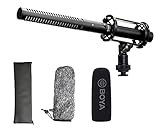
The BOYA BY-BM6060 is a proper XLR condenser shotgun microphone aimed at professional video, interview, ENG, and film work. It comes with a shockmount and windscreen included, which are essential accessories for location recording, and the supplied title specifically names ENG (electronic news gathering) and film as its target applications. That positions it firmly in the working professional category rather than the prosumer camera-mount world.
XLR condenser microphones like the BY-BM6060 are the standard tool for boom operators and professional sound recordists. The external condenser design means the capsule is sensitive and captures natural, detailed audio. The included shockmount and windscreen mean you can take it outdoors and handle it on a boom pole without handling noise or wind ruining your takes.
The limitation is the same as any XLR shotgun: you need phantom power and an XLR input to use it, which means a camera with XLR inputs, a dedicated audio recorder, or an XLR-to-camera adapter. This is not a plug-and-play hot-shoe microphone. But for anyone already working with that kind of setup — or building towards it — the BOYA BY-BM6060 offers a professionally equipped package at a competitive price point relative to the Sennheiser option.
Buy this if: You are a working videographer, journalist, or boom operator who needs a proper XLR condenser shotgun with mounting and wind protection already sorted.
How to choose your shotgun microphone
Connection type matters more than anything else. The single most important decision is whether you need a 3.5mm (TRS or TRRS) connection, an XLR connection, a USB output, or a proprietary digital shoe connection like Sony’s MI shoe. If you are plugging directly into a camera or smartphone, 3.5mm or a matched digital shoe is the right choice. If you are running into an audio recorder or a professional camera with XLR inputs, get an XLR microphone — the signal quality will be better and you will have proper phantom power available.
Size and weight affect your whole rig. A large XLR shotgun is brilliant on a boom pole or a large cinema camera, but it will unbalance a lightweight mirrorless body and make gimbal work miserable. Match the physical scale of the microphone to the camera and shooting style you actually use. Compact options like the VideoMic GO II Helix exist precisely because small cameras need small microphones.
Onboard controls are not a gimmick. Filters, pads, and safety channels save footage in real situations. A high-pass filter cuts low-end rumble from traffic and wind. A pad prevents clipping when something unexpectedly loud happens. A safety channel is a backup recording at lower volume running in parallel. If you shoot in unpredictable environments, these features earn their keep.
Consider the accessories already in the box. Shockmounts, windscreens, and cables add up quickly. A bundle like the Sennheiser MKE 600 package that includes all three can represent better overall value than a bare microphone at a lower headline price, once you price up buying everything separately.
Brand ecosystem compatibility is real. Sony’s digital MI shoe microphones offer a tighter, cleaner integration for Sony shooters. If you are committed to one camera brand, check whether that brand offers a proprietary digital connection before defaulting to a generic 3.5mm option.
Frequently asked questions
What is a shotgun microphone and why does it sound better than a built-in mic?
A shotgun microphone uses an interference tube design to create a narrow, highly directional pickup pattern. It captures sound strongly from in front of the capsule while rejecting sound coming in from the sides and rear. Built-in camera microphones pick up sound from all directions equally, which is why they sound hollow and full of room noise. A shotgun mic fixes this by focusing on the subject rather than the entire space.
Do I need phantom power for a shotgun microphone?
Only for XLR condenser models. XLR shotgun microphones like the Sennheiser MKE 600 and the BOYA BY-BM6060 require either 48V phantom power from a mixer or recorder, or in some cases an internal battery. Compact 3.5mm shotguns like the Movo VXR10 and RØDE VideoMic GO II Helix draw power from the camera itself or have their own internal battery, so no phantom power source is needed.
Can I use a shotgun microphone with a smartphone?
Yes, several models on this list are explicitly designed for smartphone use. The Movo VXR10 names iPhone and Android compatibility in its title. The Movo X1-Mini and the RØDE VideoMic GO II Helix also support smartphones. Check whether the microphone uses a TRS or TRRS 3.5mm connector, and whether your phone has a headphone jack — many modern smartphones require a USB-C or Lightning adapter.
What is the difference between a ‘on-camera’ shotgun and a boom shotgun?
An on-camera shotgun is designed to sit in a camera’s hot shoe and capture audio from the camera operator’s perspective. A boom shotgun is longer, more directional, and designed to be mounted on a boom pole and positioned above or below the subject — closer to the mouth and further from the camera. For narrative film work, boom placement always sounds better. For solo run-and-gun or vlogging, an on-camera shotgun is the practical choice.
Is an XLR shotgun mic worth it for a beginner?
Not unless you already have an audio recorder or a camera with XLR inputs. XLR microphones produce excellent audio, but they require additional hardware and knowledge to use properly. If you are just starting out, a 3.5mm hot-shoe microphone like the Movo VXR10 or the RØDE VideoMic GO II Helix will deliver a dramatic improvement over built-in audio with zero extra equipment and minimal setup complexity.
The verdict
The RØDE VideoMic Pro+ is the top overall pick: its combination of onboard controls, safety channel, and reliable performance makes it the most capable all-rounder on this list for serious filmmaking and content creation. For the best value — strong directional performance at the most accessible price — the Movo VXR10 delivers a genuine step up from built-in audio for a wide range of cameras and smartphones without requiring any extra gear.
For more, browse all our reviews and roundups.
AudioTechExpert is reader-supported. This article contains affiliate links, and we may earn a commission on qualifying purchases at no extra cost to you.