Finding headphones that are genuinely safe for children is harder than it sounds. Most adult headphones can hit dangerously loud volumes, and kids have a habit of cranking things up without realising the damage they’re doing. A good pair of kids’ headphones should cap the volume at a safe level, fit smaller heads comfortably, and survive the inevitable drops, tangles, and stuffing-into-a-bag moments that come with child ownership.
This guide covers six carefully chosen picks from wired budget options to wireless Bluetooth models with impressive battery life. Whether you’re kitting out a toddler for tablet time, a school-age child for classroom learning, or a frequent young traveller, there’s a solid option here. Every pick features some form of volume limiting, because that’s non-negotiable for children’s hearing health.
We’ve focused on real-world usability: how well the headphones fold for a school bag, whether they have a built-in mic for video calls, and how long the battery lasts on wireless models. Here’s what we recommend.
Best overall: Acer Kids Bluetooth Headphones (OHR668, Blue Green)

The Acer Kids Bluetooth Headphones in Blue Green are a strong all-rounder for children who need wireless freedom without compromising on safety. They connect via Bluetooth 6.0, which is the newest standard in this category and should offer a more stable, efficient connection than older versions. The 85dBA volume cap protects young ears during everyday use, and the USB-C fast charging means you’re not hunting for a legacy cable when the battery runs low.
The standout feature here is the playtime figure of 75 hours, which is exceptional for a kids’ headphone and means a week or more of daily school use on a single charge. There’s a built-in mic, so they work for video calls and online lessons, and the over-ear design means passive noise isolation helps children focus. The Blue Green colourway is genuinely appealing to younger kids without being garish.
The limitation worth noting is that over-ear designs can feel bulky on very small toddler heads, so these are best suited to children aged four and up rather than the very youngest users. If your child is still in the toddler stage, consider a lighter wired option first.
Buy this if: you want a future-proof wireless headphone with long battery life and USB-C charging for a school-age child.
Best wireless value: iClever BTH12
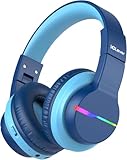
The iClever BTH12 is a Bluetooth kids’ headphone that leans into fun with colourful LED lights, making it an easy sell to children who want something that looks exciting. Beyond the visual appeal, it’s a technically solid choice with Bluetooth 5.2, a dual-level safe volume limit of 74 and 85dBA, and a claimed playtime of 85 hours — which is one of the longest figures in this entire category.
The over-ear fit, built-in mic, and fast charging round out a genuinely well-specified package at what amounts to a mid-range price point. The LED lighting does consume some battery, so if your child has it enabled constantly, expect real-world battery life to sit below the maximum figure. That’s a minor but honest caveat worth flagging.
It connects to iPads, tablets, and airplane entertainment systems without fuss, and the foldable design means it fits into a school bag or travel pouch without drama. The two-level volume limit is a thoughtful touch — the lower 74dBA setting is reassuringly quiet for smaller children, while the 85dBA setting suits older kids who want a little more presence.
Buy this if: your child loves gadgets with a bit of visual flair and you want maximum battery life in a Bluetooth headphone.
Best for toddlers: JoySpark Kids Bluetooth Headphones

The JoySpark Kids Bluetooth Headphones are a lightweight wireless option aimed squarely at younger children, including toddlers. The lightweight design is the key selling point here — heavy headphones slip off small heads and frustrate young children quickly, so the emphasis on low weight is a genuine practical benefit. Bluetooth 5.3 provides a reliable wireless connection, and the dual-level 85 and 94dBA volume limiter gives parents the choice of a stricter or more relaxed cap depending on the listening environment.
With 60 hours of claimed playtime and a built-in mic, these cover the basics for video calls and tablet streaming comfortably. The over-ear design on a younger child’s head means the cups may be proportionally larger, but the lightweight build helps offset any awkwardness in fit.
The limitation is that the 94dBA upper limit, while useful in noisier environments, is higher than many audiologists recommend for prolonged listening in young children. For most everyday use the 85dBA setting is the wiser choice, and it’s good that both options are available. The Purple colourway is popular with younger girls but the design is gender-neutral enough for any child.
Buy this if: you have a toddler or young child who needs a lightweight wireless headphone that won’t weigh down small ears.
Best wired pick: iClever HS19

The iClever HS19 takes the wired route, and for school use that’s often the smarter call. No battery to charge, no Bluetooth pairing to troubleshoot, and a 3.5mm jack that works with school tablets, Kindles, and classroom computers straight out of the box. The volume is limited to a safe level, and there’s a built-in HD mic for online learning sessions, video calls, and interactive apps.
The FunShare feature is a notable addition — it allows two sets of headphones to be daisy-chained together so two children can listen to the same device simultaneously. That’s a genuinely useful feature for siblings sharing a tablet or for paired reading activities. The foldable design keeps things compact for a school bag.
The obvious limitation of a wired headphone is the cable itself. Children are hard on cables, and a determined youngster can stress a 3.5mm connection over time. The foldable design helps reduce tangling, but it’s worth handling the cable with some care. That said, wired headphones are inherently more reliable day-to-day than wireless alternatives in a classroom setting.
Buy this if: you want a no-fuss wired headphone for school use with a useful two-listener sharing feature.
Best budget wired: noot products K11

The noot products K11 is the most straightforward pick in this roundup: a simple, foldable, wired on-ear headphone with a tangle-free 3.5mm cord designed for children and teens. There are no extra features to explain or batteries to charge — it’s a plug-and-play headphone that works wherever there’s a 3.5mm socket.
The tangle-free cord design is a thoughtful detail that anyone who has ever unpacked a child’s bag will appreciate. The foldable build keeps it compact, and the Navy and Teal colourway is understated enough to suit older children and teens who might find brighter colours a bit young-looking. It’s the most affordable option here, making it an easy first headphone purchase or a low-risk spare set.
The limitation is that the K11 is an on-ear rather than over-ear design, which means less passive noise isolation and potentially less comfort during long listening sessions. For short bursts of use — a flight, a car journey, or a classroom period — this is fine. For hours of daily use, an over-ear design may be more comfortable.
Buy this if: you want the most affordable, reliable, no-nonsense wired headphone for occasional travel or school use.
Best premium pick: Belkin SoundForm Mini
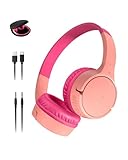

The Belkin SoundForm Mini is the premium choice in this roundup, pairing a trusted brand name with a thoughtful design that includes a protective case — a rare inclusion at any price point for kids’ headphones. It’s a wireless Bluetooth on-ear headphone with a 30-hour battery life, an 85dB safe volume limit, and a built-in microphone, wrapped in a Pink colourway that will appeal to many younger children.
Belkin’s reputation for build quality means this headphone is designed to last, and the bundled case is a genuinely practical addition for families who travel frequently or want to protect their investment in a school bag. It connects reliably to iPhones, iPads, and other Bluetooth devices, and the safe volume limit is set at the standard 85dB level.
The trade-off is battery life: at 30 hours, it’s lower than several other wireless picks in this list. For most children that’s still several days of use between charges, but if your child is a heavy daily listener, other options offer significantly more runtime. The on-ear design also provides less passive isolation than over-ear alternatives, which can be a consideration in noisy environments.
Buy this if: you want a premium, brand-name wireless headphone with a protective case included, built for longevity.
How to choose your kids’ headphones
Volume limiting is essential. Children’s hearing is more sensitive than adults’, and prolonged exposure to loud audio can cause permanent damage. Look for headphones that cap output at 85dBA for everyday use. Some models offer a secondary higher limit — useful in genuinely noisy environments — but the 85dBA setting should be the default for home and school use.
Wired vs wireless depends on the context. Wired headphones are simpler, cheaper, and never run out of battery. They’re ideal for school and classroom use. Wireless Bluetooth headphones are better for home, travel, and active children who don’t want a cable getting in the way. If your child is under five, wired is usually the more reliable choice.
Fit and comfort matter more than sound quality. A child who finds headphones uncomfortable will simply not wear them. Over-ear designs offer more comfort and better passive noise isolation but can feel heavy on very small heads. On-ear designs are lighter but may cause discomfort over long sessions. Foldable designs pack down easily into school bags and travel cases.
Battery life for wireless models varies significantly. The difference between 30 hours and 85 hours of claimed playtime is meaningful for a busy family. A longer battery life means fewer charges and less chance of the headphones dying mid-flight or mid-lesson. USB-C charging is a practical bonus if the rest of your household has moved on from Micro-USB.
A built-in mic is worth having. Even if your child only uses the headphones for listening today, a microphone opens up video calls, online learning, and interactive apps. Most modern kids’ headphones include one, but it’s worth confirming before purchase.
Frequently asked questions
What volume limit is safe for children’s headphones?
Most child safety guidelines recommend a maximum of 85dBA for children’s listening devices. Some headphones offer a dual-level limit with a higher setting for noisy environments, but 85dBA should be the default for everyday use at home or school. Prolonged exposure above this level risks gradual hearing damage.
Are Bluetooth headphones safe for young children?
Bluetooth operates at very low power levels and is considered safe for children. The more important safety consideration is the volume limit, which applies equally to wired and wireless models. For very young toddlers, a wired model is sometimes easier to manage practically, but Bluetooth headphones are not inherently unsafe.
What age are kids’ headphones suitable for?
Most kids’ headphones are designed for children from around three years old upwards. Toddler-specific models emphasise lightweight builds and smaller-fitting cups. Over-ear designs may feel large on very young heads, so check whether the product is positioned as suitable for toddlers or for older children and school-age kids.
Should I choose on-ear or over-ear headphones for my child?
Over-ear headphones enclose the ear completely, offering better passive noise isolation and often more comfort during longer sessions. On-ear headphones sit on top of the ear, are lighter, and are better for shorter periods of use. For school or travel, either can work well; for long daily sessions, over-ear tends to be more comfortable.
Do kids’ headphones work with school tablets and Kindles?
Wired headphones with a standard 3.5mm jack will connect to virtually any tablet, Kindle, or computer. Wireless Bluetooth headphones also work with most modern school tablets, though some older classroom devices may not support Bluetooth pairing. If in doubt, a wired headphone is the safest guarantee of compatibility.
The verdict
For most families, the Acer Kids Bluetooth Headphones (Blue Green) is the best overall pick: Bluetooth 6.0, exceptional battery life, USB-C charging, and a solid 85dBA volume limit make it the most complete package here. If you want the best value in a wired headphone for school use, the iClever HS19 delivers reliable performance, a built-in mic, and the clever FunShare daisy-chain feature at a genuinely accessible price.
For more, browse all our reviews and roundups.
AudioTechExpert is reader-supported. This article contains affiliate links, and we may earn a commission on qualifying purchases at no extra cost to you.