If you are setting up a home studio, podcast booth, or streaming desk, there is a good chance you have already narrowed your shortlist down to two mics: the Shure SM7B and the Shure SM7dB. They look almost identical, carry the same legendary name, and share a clear family resemblance — yet they are aimed at subtly different kinds of buyers. Choosing the wrong one could mean spending extra money on gear you do not need, or skimping and ending up frustrated with noisy recordings.
This comparison looks at both microphones honestly, side by side. We cover build and design, how each handles gain, what kind of interface or preamp chain you will need, and which type of creator will get the most from each option. We are not here to declare one mic universally superior — both are genuinely excellent tools — but to help you spend your money wisely.
Quick answer: for most people the SM7dB is the easier pick — it’s the same legendary SM7B capsule with a built-in preamp (+18/+28 dB), so it sounds clean even on interfaces that are short on gain, with no Cloudlifter required. Choose the SM7B if you already own a high-gain, low-noise preamp and want to spend a little less.
| Feature | Shure SM7B | Shure SM7dB Our pick |
|---|---|---|
| Price | $429.00 | $549.00 |
| Type | Dynamic (cardioid) | Dynamic (cardioid) |
| Connection | XLR | XLR |
| Polar pattern | Cardioid | Cardioid |
| Frequency response | 50 Hz – 20 kHz | 50 Hz – 20 kHz |
| Built-in preamp | No | Yes — +18 / +28 dB |
| Gain needed | High (~60 dB — often needs a Cloudlifter) | Low — the preamp handles it |
| Phantom power | Not required (dynamic) | Required (48 V, for the preamp) |
| Onboard switches | Bass roll-off + presence boost | Bass roll-off + presence boost |
| Best for | Studios with a strong, clean preamp | Plug-and-play; interfaces short on gain |
| Verdict | Best if you already have plenty of clean gain | Our pick for most: built-in preamp, no Cloudlifter |
| Check price | View on Amazon | View on Amazon |
The SM7B is the established classic that has earned its reputation across decades of professional use. The SM7dB is Shure’s answer to the single question every SM7B owner has asked at some point: ‘what if the preamp was already built in?’ Read on to find out which one belongs on your desk.
Shure SM7B: the battle-tested broadcast classic
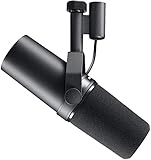
The Shure SM7B is a large-diaphragm dynamic microphone with a cardioid polar pattern, a flat wide-range frequency response, and internal air suspension shock isolation. It has been a fixture in broadcast studios, recording booths, and podcasting setups for many years, and its reputation is built on one consistent strength: it sounds rich, controlled, and natural on the human voice. The SM7B captures a warm, present sound that flatters spoken word and vocals alike, with built-in switchable bass roll-off and mid-range emphasis settings to let you shape the tone to your voice.
It is a passive microphone, which means it produces a relatively low output signal. That is the SM7B’s defining characteristic and its most important practical implication — you will need a capable preamp or audio interface that can supply plenty of clean gain to bring the signal up to a usable level. Many entry-level interfaces struggle here, and users who are new to the SM7B sometimes find themselves reaching for a dedicated inline preamp booster to make things work cleanly. That said, once it is properly driven, the SM7B rewards the investment with remarkably consistent, professional-sounding results.
The honest limitation of the SM7B is precisely that gain requirement. If your current interface cannot deliver enough headroom, you are adding cost and complexity to your chain. For anyone who already has a high-quality preamp in their setup, or who is deliberately building around one, that is not a problem at all. But for those starting from scratch, it is worth factoring into your total budget before committing.
Shure SM7dB: the SM7B with a built-in active preamp


The Shure SM7dB takes the same trusted capsule and acoustic architecture as the SM7B and adds an integrated active dynamic amplifier directly inside the body of the microphone. The result is a mic that can deliver significantly more output gain on its own, without any additional inline booster needed. Shure designed the SM7dB specifically to address the one consistent complaint about the SM7B — that you need a lot of external gain — and in that regard it does exactly what it promises. You can select between two gain settings using an onboard switch, giving you flexibility depending on your voice and environment.
Because the SM7dB can drive itself to a healthy signal level, it works reliably with a much wider range of audio interfaces, including many of the compact, budget-friendly options popular with streamers and home podcasters. That lowers the barrier to entry meaningfully. The mic still has the same cardioid pattern, the same bass roll-off and presence boost switches, and the same rugged steel construction as its sibling. From a purely tactile and visual perspective, the two mics are nearly impossible to tell apart — which underscores just how targeted this upgrade is.
The trade-off is that the SM7dB sits at a higher price point than the SM7B. If you already own a preamp or interface capable of properly driving the passive SM7B, paying the premium for the built-in amplifier is redundant — you would be buying a feature you already have covered elsewhere in your chain. The SM7dB makes the most sense for those building a leaner, simpler signal path.
Head-to-head: SM7B vs SM7dB
Sound character: Both microphones use the same capsule and share the same fundamental sonic signature — warm, controlled, and flattering on the human voice. Side by side in a properly driven chain, the two mics are extremely close in character. Neither has a significant acoustic advantage over the other; this matchup is almost entirely about signal chain practicalities rather than tonal differences.
Gain and output level: This is where the two mics genuinely diverge. The SM7B is a passive dynamic mic with a low native output, meaning it demands clean, high-gain preamplification from your interface or an outboard solution. The SM7dB solves this at the source with its built-in active preamp, delivering a stronger, more usable signal without any additional hardware. For anyone whose current interface is borderline, the SM7dB is the clear winner here.
Signal chain simplicity: The SM7dB wins for simplicity. Plug it into almost any interface with a standard XLR input and phantom power and you will get a clean, strong signal. The SM7B, by contrast, may require a careful assessment of your interface’s gain capability, and in some setups will need an additional inline preamp stage. The SM7B rewards planning; the SM7dB rewards plug-and-play convenience.
Build and design: Both mics are built to Shure’s professional broadcast standard — heavy, solid steel bodies with the same yoke mounting system, the same detachable windscreen, and the same internal shock isolation. They are visually near-identical. Neither has an advantage here; both feel like serious, long-term investments.
Onboard controls: The SM7B offers a bass roll-off switch and a mid-range presence boost switch. The SM7dB carries those same controls and adds a switchable gain level selector, giving it a modest edge in onboard flexibility. That extra switch will matter most to users who record in varied environments or with a range of voices.
Value for money: The SM7B is the more affordable option, and if your setup already includes a capable preamp, it represents outstanding value — you are getting the full sonic experience without paying for a feature you do not need. The SM7dB is the pricier of the two, and its premium is justified only if the built-in gain stage genuinely simplifies or improves your chain. Buy based on what your setup actually requires, not on which number is higher.
Frequently asked questions
Which sounds better — the SM7B or the SM7dB?
In a properly matched signal chain, both mics sound virtually identical. They share the same capsule and acoustic design. The SM7dB’s built-in preamp adds gain, not a different sound. If you are choosing based purely on audio character, either will serve you equally well.
Do I need an extra preamp booster with the SM7dB?
No — that is the point of the SM7dB’s built-in active amplifier. It is designed to deliver a strong, clean signal to most standard interfaces without any additional inline stage. The SM7B, by contrast, often benefits from or outright requires a dedicated preamp booster if your interface’s gain headroom is limited.
Is the SM7dB worth the extra cost over the SM7B?
It depends entirely on your setup. If you already own a high-quality interface or outboard preamp that drives the SM7B cleanly, the SM7dB’s built-in gain stage offers no meaningful benefit and the extra spend is hard to justify. If you are working with a modest interface or want a simpler chain, the SM7dB earns its premium by removing a real obstacle.
Which mic is better for streaming — the SM7B or the SM7dB?
For streamers using compact, budget-friendly interfaces — which is most streamers — the SM7dB is often the more practical choice, since it delivers a strong signal without additional hardware. The SM7B works brilliantly for streaming too, but only when paired with an interface that can supply adequate clean gain.
Can I use either mic with phantom power from my interface?
The SM7B is a passive dynamic microphone and does not require phantom power, though it tolerates it safely. The SM7dB’s built-in active preamp does require phantom power to operate, so you will need an interface that supplies it — which the vast majority of modern interfaces do as standard.
The verdict
Choose the SM7B if you already have a quality interface or outboard preamp that can drive a passive dynamic mic without straining. In that context, the SM7B is the sharper value proposition — you get the same iconic capsule, the same professional build, and the same warm broadcast sound, without paying for a feature your chain already provides. It also suits anyone who enjoys the ritual of fine-tuning a signal chain and understanding every component in it.
Choose the SM7dB if you want a cleaner, simpler setup, or if your interface sits on the lower end of the gain spectrum. The built-in active preamp is a genuinely practical upgrade for home podcasters, streamers, and content creators who would rather focus on their content than troubleshoot headroom issues. The premium is real, but so is the convenience it buys.
If your interface is already capable and your budget is tight, the SM7B is the sensible choice and you will not feel like you are missing out. If simplicity and compatibility matter most, the SM7dB justifies every penny of its higher price for the right buyer. Either way, you are getting one of the most respected dynamic microphones available — the decision is really about your chain, not the mic itself.
For more, browse all our reviews and roundups.
AudioTechExpert is reader-supported. This article contains affiliate links, and we may earn a commission on qualifying purchases at no extra cost to you.