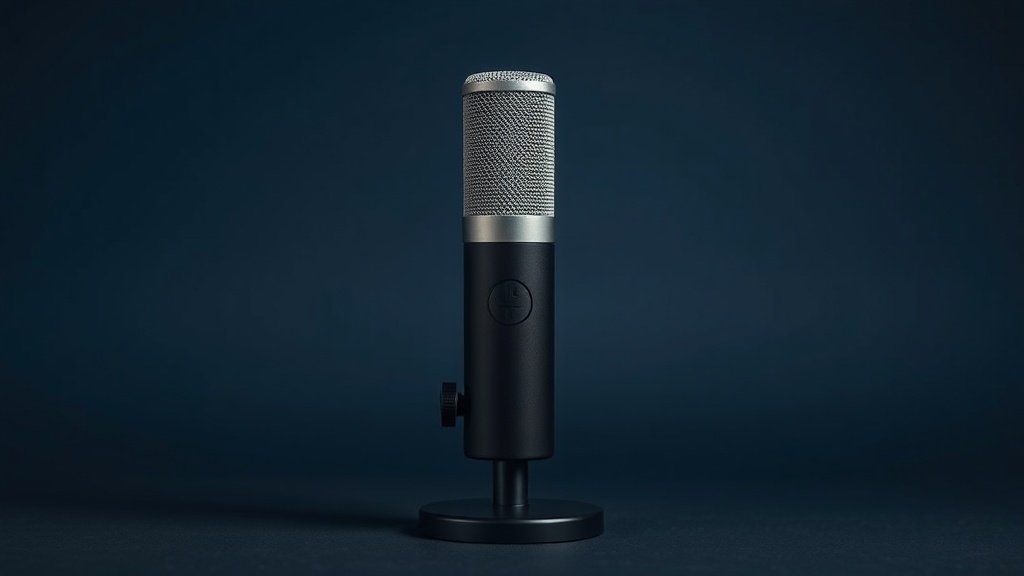
If you’re setting up a home or project studio and you’ve narrowed your search to Audio-Technica, you’ve almost certainly landed on the same crossroads: the AT2020 or the AT4040. Both are cardioid condenser microphones from the same brand, both connect via XLR, and both have earned genuine respect among home recordists and professionals alike. The question is whether the gap between them — in price and in capability — justifies moving up the range.
This comparison covers both microphones in detail: what each one does well, where each one has limitations, and which kind of buyer is best served by which. We’re not here to declare one mic universally ‘better’; we’re here to help you spend your money wisely on the right tool for your situation.
Quick answer: for most people starting out, the AT2020 is the smart-value pick — it captures clean, professional vocals for a third of the price. Step up to the AT4040 if you want noticeably lower self-noise, a more refined sound and onboard pad and high-pass switches for serious recording.
| Feature | Audio-Technica AT2020 Our pick |
Audio-Technica AT4040 |
|---|---|---|
| Price | $119.00 | $329.00 |
| Type | Large-diaphragm condenser | Large-diaphragm condenser |
| Connection | XLR | XLR |
| Polar pattern | Cardioid (fixed) | Cardioid (fixed) |
| Frequency response | 20 Hz – 20 kHz | 20 Hz – 20 kHz |
| Self-noise | 20 dBA | 12 dBA (much quieter) |
| Max SPL | 144 dB | 145 dB (155 dB with pad) |
| Onboard switches | None | 10 dB pad + 80 Hz high-pass |
| Phantom power | 48 V required | 48 V required |
| Best for | Budget starter, podcasts, streaming | Cleaner pro recordings, vocals & instruments |
| Verdict | Our pick for value — does 90% for a third of the price | The upgrade: quieter, switches, more refined |
| Check price | View on Amazon | View on Amazon |
The AT2020 is Audio-Technica’s entry point into serious studio condenser territory — a capable, no-nonsense mic that’s become a go-to for beginners and budget-conscious home producers. The AT4040 sits in the brand’s professional tier, promising a more refined sonic performance for those who’ve outgrown the basics. Let’s dig into what actually separates them.
Audio-Technica AT2020: the dependable entry-level studio workhorse
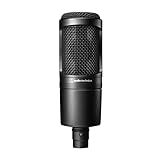
The Audio-Technica AT2020 is a cardioid condenser microphone designed specifically with home and project studio use in mind. It’s built around a large diaphragm capsule, connects via a standard XLR output, and has been a staple recommendation for new recordists for well over a decade. It’s not a mic trying to be something it isn’t — it does the fundamentals reliably and at an accessible price point.
The AT2020’s standout strength is its consistency. It handles vocals, acoustic instruments, podcasting, and voiceover work with a clean, honest sound that flatters without over-colouring. The cardioid polar pattern keeps off-axis noise at bay, which matters a great deal in less-than-perfect recording environments. The build quality is solid for its price bracket, and the mic feels reassuringly substantial in the hand.
Its honest limitation is headroom. In more demanding recording situations — capturing very dynamic vocalists, loud acoustic sources, or anything requiring a particularly fine level of nuance — the AT2020 can feel like it’s working at the edge of its capabilities. It’s an excellent starting point, but ambitious recordists may eventually feel the ceiling.
Audio-Technica AT4040: the refined professional-tier condenser
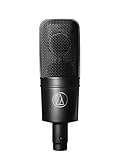
The Audio-Technica AT4040 is positioned firmly in Audio-Technica’s professional condenser range. Like the AT2020, it’s a cardioid condenser with an XLR connection, but it’s built to a noticeably higher specification and is aimed at engineers and serious home studio owners who want results closer to what you’d expect from a commercial recording environment.
Where the AT4040 distinguishes itself is in the finer details of its sonic performance. It offers a more open, airy top end and a greater sense of depth and three-dimensionality compared to its more affordable sibling. It handles transients with greater precision, and vocalists in particular tend to notice the difference immediately. The construction is robust and purposeful, befitting a microphone at this level.
The limitation is straightforward: the AT4040 costs considerably more than the AT2020, and to hear it at its best, you’ll need a quality preamp and a well-treated recording space. Drop it into a poor acoustic environment with a budget interface and you won’t be getting close to what it’s capable of. The mic demands investment not just in itself, but in everything around it.
Head-to-head: AT2020 vs AT4040
Sound character: Both microphones share Audio-Technica’s generally neutral, accurate house sound, but the AT4040 takes this noticeably further. It offers greater transparency and a more refined top end, producing recordings that feel more detailed and spacious. The AT2020 sounds clean and capable, but beside the AT4040 it can come across as slightly flatter in the upper frequencies. For casual recording, the AT2020 is more than adequate; for critical listening applications, the AT4040’s edge becomes meaningful.
Build and construction: Both mics are well-built by the standards of their respective price points. The AT2020 is solid and dependable without feeling luxurious. The AT4040 steps up in terms of fit and finish — it’s a heavier, more substantial microphone with the kind of reassuring quality that justifies its professional positioning. Neither mic feels fragile, but the AT4040 feels like it’s built to last in a professional workflow.
Handling dynamics and loud sources: The AT4040 handles a wider range of dynamic material more gracefully. If you’re recording vocalists with a broad range, or sources that vary significantly in volume, the AT4040 copes with more composure. The AT2020 performs well under typical conditions but is more likely to show strain at the extremes. For controlled, predictable sources the difference may be minor; for demanding material it can be more pronounced.
Versatility: Both microphones use a cardioid polar pattern and connect via XLR, so in terms of compatibility with interfaces and recording setups they’re broadly equivalent. Neither requires external power beyond standard phantom power. The AT4040’s superior sonic performance does make it more versatile in the sense that it’ll serve you well across a broader range of professional contexts, whereas the AT2020 is best understood as a home and project studio tool.
Value proposition: The AT2020 is one of the most competitive microphones in its price bracket — it delivers genuine studio-quality results without a studio-level price tag. The AT4040 is the pricier of the two, and it earns that price difference for buyers who will genuinely make use of its additional capabilities. For someone just starting out, the AT2020 represents exceptional value. For someone who has outgrown entry-level gear and wants to invest in something that will serve them long-term, the AT4040 makes a strong case for itself.
Frequently asked questions
Which sounds better for vocals — the AT2020 or the AT4040?
For most vocalists, the AT4040 will produce a more detailed, open-sounding result. Its greater transparency and refined top end tend to flatter voices more convincingly, particularly when paired with good preamps. That said, the AT2020 sounds very capable on vocals in its own right — the difference is most apparent when you place them side by side in a well-treated space.
Is the AT4040 worth more than the AT2020 for home studio use?
It depends on your setup and ambitions. If your recording environment is untreated and your interface is modest, the AT4040’s advantages may not fully translate — you’d be paying for a level of performance your chain can’t fully reveal. If you have a decent acoustic space and a quality interface, the AT4040 is worth the premium. The AT2020 remains the smarter buy if you’re still building your studio foundation.
Which microphone is better for podcasting — the AT2020 or the AT4040?
Both are entirely capable for podcasting. The AT2020 is arguably the more practical choice here — it delivers clean, intelligible voice recordings at a lower cost, and podcasting rarely demands the kind of sonic precision that separates the two mics. The AT4040 would certainly do the job well, but it’s likely more microphone than most podcasters need.
Do both mics require phantom power?
Yes. Both the AT2020 and the AT4040 are condenser microphones and require phantom power, typically supplied by an audio interface or mixing desk. Neither will function without it, so make sure your recording setup provides this before purchasing either mic.
Is the AT2020 a good stepping stone before upgrading to the AT4040?
Many recordists follow exactly this path. The AT2020 is an excellent way to learn what you need from a large-diaphragm condenser without committing a large sum, and the skills and habits you build with it transfer directly to working with the AT4040 later. If budget is a concern now, starting with the AT2020 and upgrading when your setup and skills have grown is a sensible approach.
The verdict
Choose the AT2020 if you’re new to studio recording, building a home setup on a careful budget, or primarily recording for podcasts, voiceover, and casual music production. It’s a genuinely accomplished microphone that will serve you well without demanding that everything around it be equally high-spec. It’s also the right call if you’re not yet sure how serious you’ll get about recording — no sense over-investing before you know what you need.
Choose the AT4040 if you’re a more experienced recordist who has already invested in a decent interface and a treated recording space, and you want a microphone that will match that level of commitment. Vocalists who care deeply about the nuance of their recordings, producers working on professional or semi-professional projects, and anyone who has already felt the ceiling of entry-level gear will find the AT4040 a meaningful and lasting upgrade.
Either way, both mics share Audio-Technica’s reliable build quality and honest sound character — someone who lands on either of these two won’t be disappointed. The decision really comes down to where you are in your recording journey and what you’re asking your microphone to do.
For more, browse all our reviews and roundups.
AudioTechExpert is reader-supported. This article contains affiliate links, and we may earn a commission on qualifying purchases at no extra cost to you.