
Finding a decent pair of headphones without spending a fortune used to mean settling for muddy bass, flimsy plastic, or a battery that died mid-commute. That’s no longer the case. The sub-$100 bracket has quietly become one of the most competitive spaces in consumer audio, with genuine active noise cancellation, long battery life, and respectable sound quality all available at prices that won’t make you wince.
This guide cuts through the noise — figuratively and literally. We’ve selected six headphones from a wider pool, filtered out the filler, and ranked them by how well they serve real listening needs: travel, home office work, casual listening, and studio-adjacent monitoring. Whether you’re after the strongest all-rounder or the leanest spend for a decent pair of cans, there’s a pick here for you.
A note on who this is for: if you’re a first-time buyer, someone replacing a broken pair, or a parent buying for a teenager, you’re in exactly the right place. If you’re chasing the last 2% of audiophile performance, you’ll need to look at a higher price bracket — but honestly, you might be surprised what’s here.
Best overall: Soundcore Q20i by Anker

The Soundcore Q20i is the pick we’d hand to most people without hesitation. It’s built by Anker’s audio sub-brand, which has a strong track record of squeezing genuine performance from budget price points, and the Q20i continues that tradition. Hybrid active noise cancellation is the headline feature — it uses both inward- and outward-facing microphones to tackle ambient noise from two directions at once, which is meaningfully better than single-mic ANC systems found on cheaper rivals.
Battery life sits at a very comfortable 40 hours with ANC switched on — enough to cover a week of daily commutes without thinking about charging. Hi-Res Audio certification means the drivers are capable of reproducing frequencies beyond standard Bluetooth’s default ceiling, though you’ll get the most from that over a wired connection. The companion app lets you customise the EQ and toggle between listening modes, which is a level of flexibility you rarely see at this price.
The limitation worth knowing: the earcup padding is adequate rather than plush. On very long sessions — three hours-plus — some listeners notice a little warmth building up. It’s not a dealbreaker, but if you plan to wear these all day at a desk, give your ears a short break every couple of hours.
Buy this if: you want the most capable all-round headphone in this price range and value a polished app experience alongside solid ANC.
Best value: Soundcore Q30 by Anker

The Q30 is the Q20i’s slightly older sibling, and it remains one of the best-reviewed headphones in this entire price bracket. It shares the same hybrid ANC architecture and Hi-Res Audio credentials, but adds multipoint connection — meaning it can stay paired to two devices simultaneously. Switching from your laptop to your phone without fumbling through Bluetooth menus is a genuine quality-of-life improvement that many pricier competitors still don’t offer.
The 50-hour playtime with ANC on is also a step above the Q20i, which makes this a particularly strong pick for frequent travellers or anyone who tends to forget to charge their devices. Three listening modes — Normal, Transport, and Indoor — let you dial in how much of the outside world you want to hear, which is a thoughtful touch for office environments where you still need to catch a colleague’s ‘quick question’.
The honest trade-off: the Q30 is a generation older, and it shows in Bluetooth version. Call quality is decent but not exceptional by current standards. If making lots of voice calls is your primary use case, the newer options with dedicated ENC microphone arrays may edge it out.
Buy this if: you want the highest review-count, proven reliability, and multipoint Bluetooth at a price that feels almost unfairly low.
Best for studio and DJ use: OneOdio A70

The OneOdio A70 takes a noticeably different approach from everything else on this list. It’s aimed squarely at bedroom producers, guitarists, and DJ beginners who need a headphone that works both wirelessly and as a proper wired monitor. The inclusion of both a 3.5mm and a 6.35mm (quarter-inch) jack is the killer feature — you can plug it directly into an audio interface, a guitar amp, or a mixing desk without an adaptor rattling around in your bag.
Sound tuning here is flatter and more analytical than the bass-forward signatures you’ll find on the other picks. That’s deliberate: when you’re trying to judge a mix, exaggerated bass is your enemy. The 72-hour wireless playtime is class-leading in this field, and build quality feels robust enough to survive a live venue environment.
The limitation is straightforward: there’s no active noise cancellation whatsoever. If your main goal is blocking out a noisy commute or an open-plan office, this isn’t the right tool. The A70 rewards those who know exactly what they need it for.
Buy this if: you make music, play guitar, or DJ, and need a headphone that connects properly to pro-audio equipment as well as your phone.
Best budget: BERIBES Bluetooth Headphones
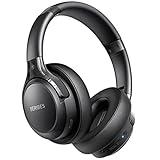
The BERIBES is the leanest spend on this list, and it earns its place by doing the basics very well. Sixty-five hours of playtime is genuinely excellent at any price, let alone here. Six switchable EQ presets give casual listeners a quick way to adjust the sound without needing an app — handy if you share the headphones between family members with different tastes, or if you simply can’t be bothered with software.
Build quality is lightweight and foldable, which makes it easy to toss in a bag. The HiFi Stereo tuning prioritises a warm, bass-leaning sound that suits pop, hip-hop, and podcasts well. The microphone is functional for calls without being outstanding.
The key limitation: there’s no active noise cancellation here. Passive isolation from the earcup seal is reasonable but won’t compete with the ANC models above in a loud environment. This is a headphone for quieter settings — home listening, a private office, or a relaxed commute rather than a busy tube carriage.
Buy this if: you want the most playtime for the least money and mostly listen at home or in low-noise environments.
Best for travel: TAGRY Hybrid ANC Headphones

The TAGRY arrives with a headline-grabbing specification sheet: Bluetooth 6.0, 120 hours of playtime, and a six-microphone ENC array for calls. That last point is worth pausing on — Environmental Noise Cancellation (ENC) on calls is distinct from ANC for listening. It means the people you’re speaking to hear less of your surroundings, which matters enormously on a train platform or in a busy café.
Transparency mode is included, letting you pipe in ambient sound when you need to stay aware — useful at an airport gate or when crossing a road. Memory foam earcups are a genuine comfort upgrade over standard foam, reducing pressure on the ears during long-haul journeys. Hi-Res Audio and 360-degree spatial audio processing round out a feature set that punches well above what you might expect.
The limitation to flag: TAGRY is a newer and less established brand than Anker or JBL. Long-term reliability data is thinner, and customer support infrastructure is less proven. The specs are impressive, but you’re taking slightly more of a punt on build longevity than you would with a better-known name.
Buy this if: you travel frequently, prioritise call clarity and comfort on long flights, and are comfortable with a newer brand in exchange for a stronger feature list.
Best for casual listeners: JBL Tune 520BT


JBL is one of the most recognised names in consumer audio, and the Tune 520BT is the brand’s straightforward, no-fuss entry point. It’s an on-ear design rather than over-ear, which makes it lighter and more portable — the folding mechanism is genuinely compact, and the overall weight won’t cause neck fatigue on a school run or short commute. Speed Charge is a practical feature: a few minutes on the cable gives you enough juice for several more hours of listening when you’ve forgotten to top up overnight.
Sound character is classic JBL: punchy, upfront bass with a lively presentation that suits mainstream genres. Hands-free calling works reliably, and the Voice Aware feature lets your own voice come through the earcups during calls so you don’t end up shouting without realising it. Fifty-seven hours of rated battery life is strong for an on-ear design.
The honest limitation: on-ear designs rest on the ear rather than around it, which some people find less comfortable than over-ear cups over extended wear. Passive noise isolation is also more limited as a result. And there’s no ANC — this is a clean, simple wireless headphone, not a noise-fighting tool.
Buy this if: you want a light, portable daily driver from a trusted brand and don’t need active noise cancellation.
How to choose headphones under $100
Over-ear vs on-ear: Over-ear cups fully enclose your ear, which generally means better passive isolation and longer comfort during extended wear. On-ear cups sit on the ear itself — lighter and more portable, but can cause discomfort on longer sessions and let in more ambient sound. Neither is objectively better; it depends on how long you wear them and whether portability matters.
Active noise cancellation — do you actually need it? ANC is a genuine technology with a real cost. It uses microphones and processing to actively counter background noise, and it works best against consistent low-frequency sounds like aircraft engines or air conditioning. In the sub-$100 bracket, ANC quality varies significantly — hybrid systems (like those in the Q20i and Q30) are measurably better than single-mic implementations. If you’re mostly listening at home in a quiet room, ANC may not be worth paying a premium for.
Battery life: Quoted battery figures are tested at moderate volume without ANC. Real-world usage will vary. As a practical guide, 40 hours is plenty for most people. Anything beyond 60 hours starts to be marketing rather than meaningful, unless you genuinely travel for weeks without access to a charger.
Call quality: Standard microphones on wireless headphones are adequate for occasional calls. If you’re on video meetings for several hours a day, look specifically for models that mention ENC (Environmental Noise Cancellation) or multiple microphone arrays — this affects how you sound to others, not just how you hear them.
Brand vs spec sheet: Established brands like Anker, JBL, and OneOdio have proven track records and accessible customer support. Newer brands sometimes offer more features per pound, but long-term durability is less proven. If you’re buying for yourself and comfortable taking a small risk, the newer options can be excellent value. If you’re buying as a gift or for a child, stick with a recognised name.
Frequently asked questions
Is active noise cancellation worth it on headphones under $100?
Yes, if you use them in genuinely noisy environments — on public transport, in open-plan offices, or on flights. Hybrid ANC systems in this price range can make a real difference to low-frequency background noise. If you mostly listen at home or in quiet spaces, the extra complexity isn’t necessary and the money is better spent on sound quality or build.
What does ‘Hi-Res Audio’ actually mean on a budget headphone?
Hi-Res Audio certification indicates the drivers are capable of reproducing frequencies up to 40kHz, well beyond the 20kHz upper limit of human hearing. In practice, the label is a rough quality indicator rather than a guarantee. You’ll only notice the difference over a high-bitrate wired connection — Bluetooth compression limits what arrives at the driver regardless of the hardware’s capability. It’s a useful signal, but don’t make it the sole deciding factor.
Can I use wireless headphones for video calls and meetings?
Yes. All the picks here include a built-in microphone suitable for calls. For intensive daily meeting use, prioritise models that specifically mention ENC call microphones (such as the TAGRY), as these reduce background noise for your callers. Standard mics are fine for occasional calls but can pick up more ambient noise in busy environments.
How long should headphones under $100 last?
With reasonable care, a quality pair should last two to three years of daily use. Battery capacity degrades over charge cycles — most Lithium-ion batteries retain around 80% capacity after 300-500 full cycles. Hinges and headbands are common failure points on budget models; foldable designs with more moving parts carry slightly higher risk. Avoid leaving them in very hot environments (such as a car in summer).
Do wired and wireless modes sound different on the same headphone?
Often, yes. Bluetooth audio is compressed before transmission, which introduces minor quality loss compared to a direct analogue wired connection. On headphones with Hi-Res Audio wired support — like the OneOdio A70 — the wired connection can sound noticeably cleaner and more detailed. For casual listening the difference is subtle, but for critical music work or monitoring, the wired connection is preferable.
The verdict
Best overall: the Soundcore Q20i delivers hybrid ANC, app control, and genuinely reliable performance in a package that suits most buyers — it’s the one we’d recommend without needing to know much more about you.
Best value: the Soundcore Q30 has arguably the strongest real-world track record of any headphone in this price bracket, with multipoint Bluetooth and 50-hour ANC playtime making it hard to argue against at its current price.
For more, browse all our headphone reviews and roundups.
AudioTechExpert is reader-supported. This article contains affiliate links, and we may earn a commission on qualifying purchases at no extra cost to you.