Running sound for a church service is a different challenge from a concert or podcast studio. You need reliability above everything else — a dropout mid-sermon or a feedback squeal during worship is not just embarrassing, it breaks the moment entirely. Congregation members at the back need to hear just as clearly as those in the front row, and your volunteers need gear they can set up without a sound-engineering degree.
This guide cuts through the noise and focuses on wireless microphone systems that genuinely suit a church or worship environment. We have looked at range, ease of setup, the mix of microphone types on offer, and overall dependability. Whether you are outfitting a small chapel or a mid-sized auditorium, there is an option here for you.
Every system on this list is a real wireless package — receiver, transmitter, and at least one microphone included — so you are not hunting for missing pieces. We have kept things practical, named honest limitations for each pick, and pointed you towards the right choice for your specific situation.
Best overall: Phenyx Pro PTU-71-1H1B

The Phenyx Pro PTU-71-1H1B is a dual-channel UHF wireless system that ships with both a handheld microphone and a bodypack transmitter paired with a lapel mic — making it immediately useful for two very different worship roles at once. A lead vocalist can grab the handheld while a pastor clips on the lavalier, and both signals feed into a single metal receiver that sits neatly in your rack or on your mixing desk.
The all-metal receiver is a genuine selling point in a church context, where gear tends to get moved around for midweek events and Sunday services alike. The auto-scan feature means your audio volunteer can lock onto a clean frequency without needing to understand UHF channel planning, and the stated 328-foot range comfortably covers most sanctuary layouts. This combo approach — handheld plus bodypack in one box — is exactly what a growing church needs when it wants one system that handles both preaching and singing.
The limitation to be aware of is that you are limited to two simultaneous channels. If your worship team runs four or more performers at once, you will need a second system. For a smaller congregation or a church just building out its audio rig, though, this is a strong, versatile starting point.
Buy this if: you want one system that handles both a roving pastor and a lead vocalist without buying two separate rigs.
Best for dual bodypack use: Phenyx Pro PTU-52-2B

Where the PTU-71-1H1B is a handheld-plus-bodypack combo, the Phenyx Pro PTU-52-2B takes a different approach: it ships with two bodypack transmitters, each paired with a headset or lapel microphone. That makes it the natural pick for a church where the primary need is hands-free mic coverage — think worship leaders who play guitar and sing, or a speaking team where nobody needs a handheld.
The system offers 2×30 tunable UHF frequencies, giving your sound team real flexibility to dodge interference from other wireless devices or neighbouring venues. The stated 200-foot range is sufficient for most church stages, and the all-metal construction mirrors the build quality Phenyx Pro is known for across their range. Having two beltpacks straight out of the box means you can mic two performers simultaneously from day one.
The trade-off compared to the PTU-71-1H1B is the absence of a handheld option in the box. If your church also hosts guest speakers who prefer a traditional stick mic, you would need to add one separately. For a settled worship team with consistent performers, however, this is a very practical dual-channel solution.
Buy this if: your worship team primarily needs hands-free microphones for singers and instrument players rather than a traditional handheld.
Best for larger teams: Pyle 4-Channel UHF System
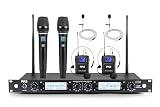

The Pyle 4-channel UHF wireless system is built for churches that have outgrown a two-channel setup. It includes two handheld microphones, two lavalier mics, two headset mics, and four beltpack transmitters — all feeding into a rack-mountable receiver. That is a comprehensive package for a team that needs to mic multiple speakers, worship leaders, and perhaps a youth pastor all in one service.
The rack-mount receiver is a significant practical advantage in an established church audio setup. It slots into a standard equipment rack alongside your mixer and other gear, keeping the tech area tidy and reducing the chance of kit being knocked or misplaced between services. The stated 300-foot range means you have good coverage even in a larger auditorium, and the variety of included microphone types means different performers can choose whatever suits them best.
The honest limitation here is complexity. Four channels, multiple transmitter types, and more devices to charge and track is a bigger commitment for volunteer audio teams. Setup and frequency coordination take more time than a two-channel system, and the more gear you have on the go, the more chances for something to go wrong on a Sunday morning. This is a system that rewards having a dedicated, experienced sound volunteer.
Buy this if: your church regularly needs to mic four or more people simultaneously and you have a confident audio team to manage the extra complexity.
Best plug-and-play option: Xvive M5
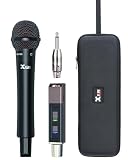
The Xvive M5 is a 5.8GHz wireless microphone system built around simplicity. The receiver plugs directly into an XLR input on your mixer or PA, and the handheld transmitter pairs automatically — making it as close to plug-and-play as wireless audio gets. For a church that does not have a dedicated sound engineer and relies on willing volunteers, that kind of friction-free setup is worth its weight in gold.
Operating on 5.8GHz rather than the more crowded UHF band means the M5 sidesteps a lot of the radio interference that can cause dropouts in venues where multiple wireless systems or Wi-Fi networks are in use. The auto channel scan handles frequency selection for you, and the 24-bit/48kHz audio quality specification — one of the few concrete specs in the product title — suggests clean, broadcast-grade sound for spoken word and live vocals alike.
The limitation is that this is a single-channel handheld system. There is one microphone, one receiver, and no bodypack or lavalier option in the box. Churches that need to mic multiple people at once will need to buy multiple units. It is also worth noting that the compact receiver is designed for direct XLR connection, so it suits a setup where the mixer is physically accessible rather than a remotely located rack.
Buy this if: you want the simplest possible wireless setup for a single speaker or lead vocalist, with minimum fuss for volunteer operators.
How to choose your church microphone system
Work out how many people need to be mic’d at once. This is the first and most important question. A pastor who preaches alone needs one channel. A worship team with a leader, a guitarist, and a guest speaker needs three or more. Match the number of channels in your system to your realistic maximum — not your minimum.
Think about who will be operating the system. A complex four-channel rack-mount setup is brilliant when you have a trained sound volunteer. If your sound desk is staffed by enthusiastic but inexperienced helpers, a simpler auto-scan system with fewer moving parts will serve you better and cause fewer Sunday morning panics.
Consider the microphone types your performers prefer. Preachers who move around and gesture tend to prefer lapel or headset mics that leave their hands free. Vocalists often prefer handhelds. Many worship leaders who play guitar need a bodypack and headset combination. Check that the system you choose ships with the type of microphone your people will actually use.
Range and building layout matter. A small chapel may only need 100 feet of coverage. A larger auditorium, or a church where the performer might walk into side aisles during a sermon, needs 200 feet or more. Check the stated range against your real-world layout — and remember that walls, metal structures, and other wireless devices can all reduce effective range.
Think about your frequency environment. UHF systems are excellent but the band is busy in many urban areas. Systems with auto-scan or tunable frequencies — like the Phenyx Pro options on this list — give you more options when interference crops up. The Xvive M5, operating on 5.8GHz, avoids the UHF crowd entirely and is worth considering if your venue already has a dense wireless setup.
Frequently asked questions
Do I need UHF or VHF for a church?
UHF (Ultra High Frequency) is generally preferred for church environments because it offers better range, more available channels, and greater resistance to interference than older VHF systems. All of the UHF systems on this list are solid choices. Alternatively, a 5.8GHz system like the Xvive M5 avoids UHF congestion entirely, which can be useful in venues with many competing wireless devices.
What is the difference between a handheld, lapel, and headset microphone?
A handheld is the traditional stick mic — familiar, easy to pass between speakers, but requires one hand to hold. A lapel (also called a lavalier or ‘lav’) clips to clothing near the chest, leaving the performer fully hands-free. A headset sits on the head and positions the microphone close to the mouth for consistent pickup even when the speaker turns their head. Each suits a different situation, which is why many of the systems on this list include multiple types.
How far does a wireless microphone system actually reach?
Manufacturers quote line-of-sight range under ideal conditions. In a real church environment — with walls, bodies, and other wireless devices — expect the effective range to be somewhat shorter. For most church sanctuaries, 200 feet is ample. If your performers walk through side aisles or across a large stage, look for systems rated at 300 feet or more to give yourself a comfortable margin.
Can I use multiple wireless systems in the same building?
Yes, provided the systems operate on different frequencies and you coordinate them carefully. Systems with tunable frequencies or auto-scan features make this significantly easier — they can find a clean channel even when the space is already busy. A four-channel system like the Pyle unit is designed with this in mind. If you are adding a second two-channel system to an existing setup, run the auto-scan with all systems powered on simultaneously to avoid conflicts.
Is wireless audio quality good enough for a church service?
For speech, preaching, and live worship in a typical sanctuary, modern UHF and 5.8GHz wireless systems deliver entirely acceptable audio quality. The Xvive M5, for instance, specifies 24-bit/48kHz audio in its product title — a standard used in professional broadcast. The practical factors that affect perceived quality in a church — room acoustics, speaker placement, and EQ on your mixer — tend to matter far more than the wireless system itself.
The verdict
The Phenyx Pro PTU-71-1H1B is our top overall pick: it covers two channels, comes with both a handheld and a bodypack-and-lapel combo, and its metal construction suggests it will survive years of Sunday-morning handling. For churches that need to mic four people at once and want a comprehensive all-in-one package, the Pyle 4-Channel UHF System is the best-value step up, delivering a wide variety of microphone types and a rack-mountable receiver at a compelling price point.
For more, browse all our reviews and roundups.
AudioTechExpert is reader-supported. This article contains affiliate links, and we may earn a commission on qualifying purchases at no extra cost to you.