A lavalier microphone seems simple until you are on set with a signal cutting out, a cable trapped under a costume, or a transmitter that will not pair — the decision you made before the shoot is already shaping every option you have left.
After years of obsessively buying, using and comparing audio gear, I keep seeing the same misunderstandings about lavalier microphones come up again and again. People focus on the size of the capsule or the colour of the windshield and miss the structural decision underneath all of it: whether the signal travels down a cable or through the air, and what that choice costs you in quality, reliability, and operational complexity.
This guide covers how to evaluate your actual use case before you spend anything, what the technical differences between wired and wireless lavalier systems mean in practice, how to read specifications without being misled by headline numbers, and where the genuine trade-offs sit depending on your environment and budget. Nothing here is speculative — it is the kind of thinking I apply on every job where a microphone needs to be invisible and the audio cannot fail.
Understanding What a Lavalier Microphone Actually Is
A lavalier — sometimes called a lav, a clip mic, or a body mic — is a miniature microphone designed to be worn on the body, typically clipped to clothing near the chest or concealed beneath a layer of fabric. The capsule is almost always omnidirectional, meaning it picks up sound from all directions equally rather than favouring a single axis. That is not a compromise; it is a deliberate engineering choice that makes placement forgiving and reduces the handling noise that would plague a directional capsule mounted on a moving body.
The capsule size is genuinely small — typically between 3mm and 10mm in diameter — which creates real acoustic limitations. A smaller capsule captures less air movement, which means the low-frequency response and overall sensitivity are lower than what you would get from a large-diaphragm condenser. That is not a flaw you can correct in post; it is physics. What you can control is capsule quality within that size range, and that is where the difference between a 30-pound lav and a 300-pound lav becomes audible.
The DPA 4060 and the Sennheiser MKE 2 are the benchmarks I return to when assessing any other lavalier capsule. Both are omnidirectional electret condensers with a frequency response that extends meaningfully into the upper registers without sounding harsh. The Rode Lavalier II sits in a more accessible price bracket and performs well for video production where the source is a human voice at close range in a controlled environment. These are the reference points I use when someone asks me whether a cheaper capsule is good enough — good enough for what is always the next question.
Wired Lavalier Systems: When the Cable Is the Right Answer
A wired lavalier connects directly to a recorder, audio interface, or mixing console through a physical cable, typically terminated in a 3.5mm TRS jack or an XLR connector via an adapter. The signal path is entirely analogue and entirely deterministic — what goes in comes out, with no latency, no interference, and no battery management beyond the phantom power or plug-in power that the capsule requires.
For situations where the talent is relatively static — a seated interview, a podcast recording, a documentary subject filmed at a desk — a wired lav is almost always the better technical choice. There is no RF spectrum to manage, no firmware to update, no transmitter to hide, and no dropout risk from a crowded 2.4GHz environment. The Rode smartLav Plus, for example, connects directly to a smartphone or a portable recorder via a TRRS connector and delivers audio quality that exceeds what most wireless systems at twice the price can manage over the air.
The limitation is obvious: the cable physically connects the person to the recording device. If your talent needs to move freely — walking through a location, performing on a stage, or being filmed at any distance beyond a few metres — the cable becomes a liability rather than an asset. Cable management becomes part of the production workflow, with gaffer tape, clips, and routing decisions that add time and create new failure points of their own. In those situations, the cable is not the right answer regardless of its technical merits.
The question is never simply wired or wireless — it is whether the freedom of movement justifies the complexity you are adding to the signal chain.
Wireless Lavalier Systems: What You Are Actually Buying
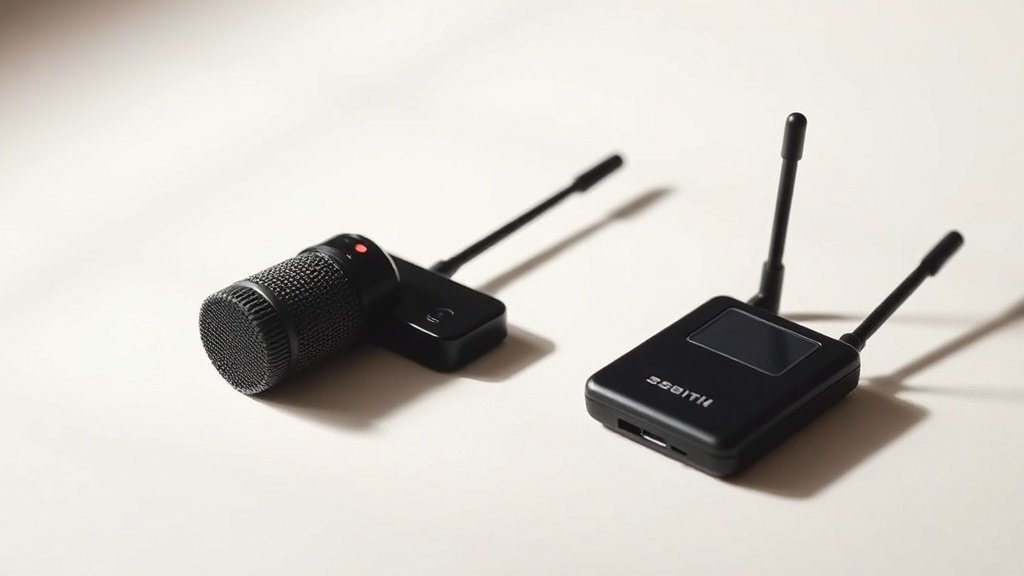
A wireless lavalier system consists of three components: the capsule itself, a bodypack transmitter worn by the talent, and a receiver connected to your recording device or mixer. The capsule connects to the transmitter via a short cable — often with a proprietary locking connector — and the transmitter converts the analogue signal to a digital or analogue radio signal that travels to the receiver. That signal is then converted back to analogue audio for your recorder. Every one of those conversion stages is an opportunity for quality loss or failure.
The transmission frequency band matters enormously and is determined by local regulation. In the UK, the primary legal band for professional wireless audio is 606MHz to 694MHz following the Digital Dividend reallocation, though licence-free UHF options exist in the 863MHz to 865MHz range. Sennheiser, Shure, and Sony all manufacture systems cleared for UK use, but you need to verify the specific frequency band before purchasing — a system tuned for US frequencies is not legal to operate in the UK. The Sennheiser EW 100 G4 and the Shure BLX series are both widely used at the professional and serious semi-professional level and are available in UK-compliant frequency bands.
Digital wireless systems, such as the Rode Wireless Pro and the Sennheiser EW-DP, offer advantages in noise floor and interference rejection over analogue systems but introduce a fixed latency — typically between 2ms and 5ms depending on the system. For video work, that latency is generally manageable and can be compensated in post. For live performance where the talent is also monitoring through a PA system, even a few milliseconds of additional latency can create perceptible issues. It is a consideration most people do not raise until they are standing on a stage with a presenter complaining that something sounds wrong.
Reading the Specifications Without Being Misled
Lavalier microphone specifications are frequently misrepresented in marketing copy, and a basic understanding of what each number means will save you from expensive mistakes. Self-noise, measured in dB-A, tells you how much noise the capsule generates independently of the signal. A figure below 20dB-A is good for a lavalier; the DPA 4060 achieves around 23dB-A which is entirely acceptable for voice work at close range. If a budget lav lists self-noise above 30dB-A, the noise floor will be audible in quiet passages even at normal speaking volume.
Maximum sound pressure level, or max SPL, tells you how loud a source the capsule can handle before it distorts. For a lavalier placed on a presenter or actor, you are unlikely to exceed 110dB SPL at the capsule position unless the talent is singing loudly with the mic concealed very close to the mouth. For theatrical applications or live performance where a capsule might be placed at the hairline near a monitor speaker, a higher max SPL becomes relevant. The DPA 4099 — technically a clip mic rather than a traditional lav — handles up to 144dB SPL and is used in exactly those demanding stage environments.
Frequency response plots are more informative than the headline figures. A lav listed as 20Hz to 20kHz is technically accurate even if the response is 15dB down at both extremes. Look for flat response between 100Hz and 10kHz for voice work, and treat any significant peak in the 6kHz to 8kHz region with suspicion — it tends to introduce a harsh, sibilant quality that is fatiguing to listen to over long recordings and difficult to equalise cleanly without affecting the overall presence of the voice.
Using Wired and Wireless Together on the Same Production
On larger productions — multi-camera documentaries, corporate events with multiple presenters, theatrical productions with a full cast — using both wired and wireless systems simultaneously is common practice and often the most pragmatic approach. Static or seated contributors are placed on wired lavs routed to a nearby recorder or mixer, while mobile talent is given wireless systems from a managed frequency plan. This reduces the number of active RF transmitters in the space at any one time, which directly improves the reliability of the wireless channels you are using.
Frequency coordination is the central technical challenge when running multiple wireless systems. Every active transmitter in a space occupies not just its listed frequency but also generates intermodulation products — spurious signals at mathematically predictable offsets from the transmitter frequencies. Running three or four wireless systems without proper frequency coordination almost guarantees interference. Shure offers a free software tool called Wireless Workbench specifically for this purpose, and Sennheiser provides equivalent functionality in its Wireless Systems Manager application. Both allow you to input the frequencies available in your location and calculate a set of intermodulation-free channels before you arrive on site.
The practical ceiling for amateur or semi-professional users running wireless lavs without dedicated frequency coordination support is roughly four simultaneous transmitters in a typical indoor environment, assuming you are using systems from reputable manufacturers in the correct legal band. Beyond that, the complexity compounds quickly and the risk of dropout or interference during critical moments rises to a level that requires professional RF coordination to manage properly.
Placement and Concealment: Where Most of the Work Actually Happens
The most technically capable lavalier microphone in the world performs poorly if it is placed badly. Clothing noise — the sound of fabric rubbing against the capsule — is the most common problem and the hardest to eliminate entirely once it is present in a recording. The standard professional approach is to use a combination of a soft mounting pouch or medical tape to isolate the capsule from direct fabric contact, and a small overcover windshield to reduce the turbulence caused by air movement between fabric layers.
The Rycote Stickies and Undercovers system is the industry standard for concealed placement under clothing. The adhesive mount holds the capsule steady while the foam overcover prevents the majority of rustle noise. For exposed placements on ties or lapels, the Rode Lavalier II ships with a clip that holds the capsule facing forward at approximately the correct angle for chest-level speech pickup. The correct angle matters — a capsule pointing away from the mouth loses several dB of level at the higher frequencies that carry intelligibility, and that loss shows up immediately when you listen back.
Choosing a wireless system based on channel count alone is a consistent and costly error. A system advertising 60 channels is only useful if those channels are spaced to avoid intermodulation products in your specific RF environment — channel count marketing tells you nothing about real-world coexistence with other systems in the same space.
Using a lavalier capsule at the end of an excessively long cable extension introduces noise that cannot be recovered. Lavalier capsules have high output impedance and are sensitive to cable capacitance — extending the cable beyond the manufacturer specification with a generic extension raises the noise floor visibly on a meter and audibly in quiet recordings.
Assuming omnidirectional means the placement position does not matter is one of the most common technical misunderstandings I encounter. Omnidirectional refers to the polar pattern in free space; proximity to the chest, angle relative to the mouth, and distance from the source all still affect the frequency balance and level of the captured signal in ways that a polar pattern diagram does not show.
Conclusion
The right lavalier microphone is the one matched to your specific operational environment — not the most expensive option and not the one with the longest specification list. Start with the movement requirements of the talent, establish whether the RF environment is manageable for wireless operation, verify frequency legality for your location, and then evaluate capsule quality within the budget that remains. Every other decision follows from those foundations.
FREE DOWNLOAD
Stop Guessing. Start Buying Smart.
The specs that actually matter, demystified.
Headphones, microphones, the spec sheet jargon you can ignore — all in one quick-reference PDF. Free, instant, no fluff.
Send Me the CheatsheetYou'll also receive occasional new guide notifications. Unsubscribe anytime. No spam, ever.