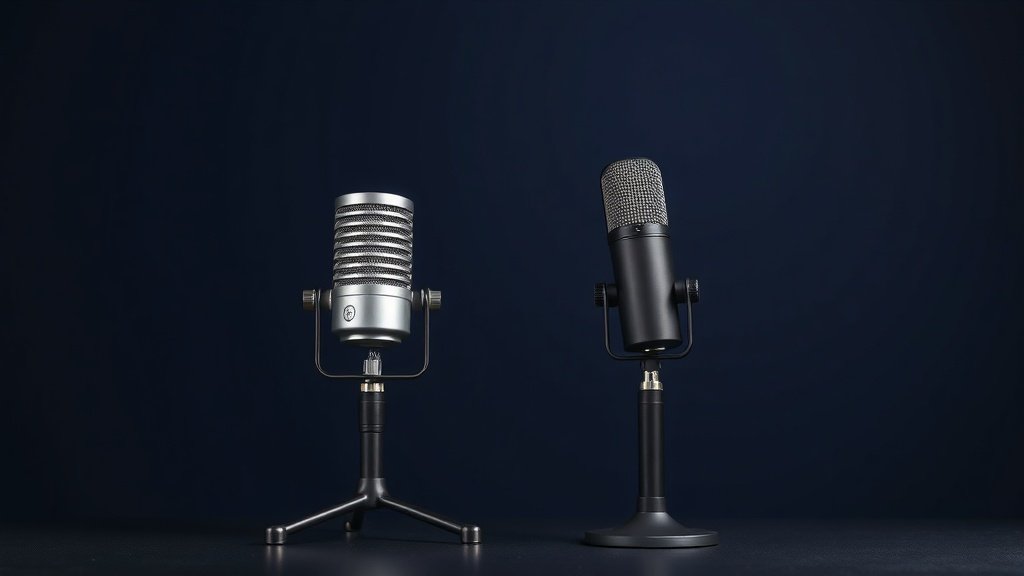
Pick the wrong microphone type for your recording space and the problem will not be on the spec sheet — it will be in every single take you record.
The condenser versus dynamic debate has been running in voiceover circles for a long time, and it has produced more confusion than clarity. Most of the advice leans toward condensers by default, treating them as the professional choice and dynamics as a fallback. After years of obsessively buying, using and comparing audio gear, I can tell you that framing is backwards. The right microphone is the one that suits your room, your voice, and your chain — in that order.
This guide works through the core differences between condenser and dynamic microphones, explains how each type responds to real recording conditions, and gives you a clear framework for making the decision. We will cover frequency response and sensitivity, room acoustics and background noise, polar patterns, gain requirements, and the signal chain implications of each choice. No ranking, no scores — just the information you need to decide confidently.
How Each Microphone Type Actually Works
A condenser microphone uses a thin, electrically charged diaphragm suspended close to a backplate. When sound pressure moves the diaphragm, it changes the capacitance between the two elements and generates a signal. Because the diaphragm is so light and the mechanism so responsive, condensers capture transients with exceptional accuracy and extend cleanly at both frequency extremes. That sensitivity is precisely why they are so widely used in treated recording environments.
A dynamic microphone uses electromagnetic induction. A heavier coil is attached to the diaphragm and moves within a magnetic field to generate voltage. The mechanical mass of that system means dynamics are inherently less sensitive to quiet, detailed sounds and high-frequency transients. They are also far more tolerant of high sound pressure levels and do not require phantom power. For voiceover, the distinction that matters most is not output level — it is how each type interacts with the acoustic environment around it.
Large diaphragm condensers such as the Neumann TLM 103 or the Audio-Technica AT4040 have a wide, detailed frequency response and relatively high sensitivity, often around negative 32 to negative 36 dBV per Pascal. Dynamics such as the Shure SM7B or the Electro-Voice RE20 have lower sensitivity, typically around negative 59 dBV per Pascal. That gap is significant when it comes to how much of your room the microphone hears.
Room Acoustics Are the Deciding Factor
If I had to name the single most important variable in this decision, it would be the room. A condenser microphone does not know the difference between your voice and the low-frequency resonance of a poorly treated room, the air conditioning unit two floors down, or the broadband hiss of a nearby computer. It captures everything with equal enthusiasm. In a professionally treated booth with acoustic panels, a cloud baffle, and good bass trapping, that sensitivity is an asset. In an untreated spare bedroom or home office, it becomes a liability.
A dynamic microphone like the Shure SM7B or the Rode Procaster rejects off-axis sound more aggressively due to its lower sensitivity and typically tighter polar pattern behaviour at lower frequencies. It demands close-microphone technique — working at roughly 15 to 30 centimetres from the capsule — but that proximity means it picks up far more of your voice relative to the room. Engineers often describe dynamics as having a built-in acoustic treatment effect, and that is not an exaggeration. In rooms that cannot be properly treated, a good dynamic will almost always outperform a great condenser.
The practical test is straightforward. Record a minute of silence in your space with each microphone type at your working gain level. Listen back through studio headphones. If the condenser recording sounds like a room, it is telling you something important. A dynamic recording in the same space at the same gain will typically sound noticeably cleaner, because its lower sensitivity means ambient noise sits much further below the noise floor of the recording.
Polar Patterns and Proximity Effect
Most large diaphragm condensers used for voiceover operate in cardioid mode, and some — like the Rode NT1 or the Neumann U 87 Ai — offer switchable polar patterns including omnidirectional and figure-of-eight. The cardioid pattern on a condenser is genuinely wide at mid frequencies, meaning it accepts sound from a broader arc in front of the capsule than the label suggests. That is useful for capturing a natural, open vocal performance, but it also means the microphone is listening to more of the room behind and beside the talent than many people realise.
Dynamic microphones for broadcast and voiceover, including the Electro-Voice RE20 and the Shure SM7B, use a supercardioid or cardioid pattern with built-in internal pop filtering and often a relatively tight off-axis rejection. The RE20 in particular uses a Variable-D design that minimises proximity effect — the bass boost that occurs when a microphone is used very close to the source. That makes it extremely consistent across a range of working distances, which suits talent who move around slightly during a read.
Proximity effect is worth understanding in detail because it affects both types differently. Condenser cardioids exhibit proximity effect but their wide frequency response means the bass boost can sound full and flattering when controlled, or heavy and inconsistent when it is not. Dynamic cardioids like the SM7B have a pronounced proximity effect that many voiceover artists deliberately use to add warmth and weight to their delivery. The RE20 largely eliminates it. Neither approach is wrong — they are tools with different characters, and the best choice depends on the voice and the aesthetic the project requires.
The microphone that flatters your voice in an ideal room is rarely the microphone that serves you best in the room you actually have.
Gain Requirements and Signal Chain Compatibility
Dynamic microphones require considerably more gain than condensers to reach a usable recording level. The Shure SM7B is notorious for this — it needs around 60 dB of clean gain to reach an optimal level for a quiet speaking voice, and some preamps simply cannot deliver that without introducing significant noise. The standard advice is to pair it with a preamp that has a high gain headroom, such as the Focusrite ISA One or the Universal Audio Apollo series, or to use an inline gain booster such as the Cloudlifter CL-1 or the SE Electronics DM1 Dynamite.
Condenser microphones require phantom power at 48 volts, which is standard on virtually all audio interfaces and standalone preamps. Their higher output sensitivity means they reach a usable recording level with far less gain — typically 40 to 50 dB is sufficient for voiceover work. An entry-level interface such as the Focusrite Scarlett Solo or the SSL 2 will handle a condenser like the Rode NT1 or the Audio-Technica AT2020 without difficulty. That same interface paired with an SM7B without a gain booster will often produce a thin, noisy signal that requires heavy processing to salvage.
This does not mean condensers are easier to use — it means the signal chain requirements are different and need to be planned for. If you already own an interface with modest preamp gain, a condenser is the more practical starting point. If you are building a chain with a quality outboard preamp, a dynamic becomes entirely viable and in some rooms, the better choice.
Frequency Response and Voice Character
Condensers designed for voiceover typically have a presence peak between 8 and 12 kHz that adds clarity and air to the upper registers of speech. The Neumann TLM 102 and the AKG C414 XLII both exhibit this characteristic. It makes consonants crisp and intelligible at normal listening levels, which is valuable for commercial, e-learning, and corporate narration where the listener may be on laptop speakers or earbuds. The trade-off is that this extended high-frequency response also captures sibilance and harshness in voices that already trend bright.
Dynamic microphones tend to roll off more gently above 15 kHz and have a warmer, more mid-forward character. The Electro-Voice RE20 is notably flat and honest across its range, making it a reliable choice for voices that do not need flattering — it simply captures what is there. The Shure SM7B has a gentle presence peak and a low-frequency extension that gives voices a broadcast weight that is difficult to replicate in post. For podcast-style narration, documentary voiceover, or any work where a warm, intimate delivery is the goal, that character is a genuine advantage rather than a limitation.
Practical Decision Framework
After working through the variables, the decision usually resolves into one of two situations. If you record in a well-treated space — a purpose-built booth, a heavily padded room, or at minimum a reflection filter combined with a quiet environment — a large diaphragm condenser will give you detailed, extended recordings that translate well across listening systems. Pair it with a capable preamp and a quality pop shield and you have a professional voiceover chain at any budget level. The Rode NT1 at the lower end and the Neumann TLM 103 further up represent two points on that spectrum that are both genuinely excellent.
If you record in an untreated or semi-treated space — which is the reality for the majority of working voiceover artists who record from home — a broadcast dynamic on a short boom arm at close range will give you cleaner, more usable recordings with less post-processing required. The Shure SM7B is the obvious recommendation but it demands proper gain. The Electro-Voice RE20 is a better choice if consistency across working distance matters more than character. The Rode Procaster is a strong mid-budget option that competes seriously with both at its price point.
Budget is real but it is secondary to room acoustics in this decision. A four hundred pound dynamic in an untreated room will serve a voiceover artist better than a nine hundred pound condenser in the same space. Invest in acoustic treatment alongside the microphone, and the condenser option opens up. Skip the treatment, and the dynamic is the rational choice regardless of what the production notes request.
What About USB Microphones for Voiceover
USB microphones occupy a separate category that is worth acknowledging briefly. Models such as the Blue Yeti and the Rode NT-USB Mini use condenser capsules and have built-in analogue-to-digital conversion. The quality of that conversion has improved significantly and for remote voiceover sessions, podcasting, or e-learning production, they are entirely viable. The limitation is that they sit outside the standard XLR signal chain, which means no external preamp options and less upgrade flexibility. If you are building a long-term professional voiceover setup, an XLR microphone into a dedicated interface gives you more control and better long-term value.
Choosing a condenser microphone because it is considered the professional option ignores the most important variable in your signal chain. Room acoustics determine whether a sensitive condenser produces a clean recording or a detailed document of every flaw in your space. Assess your room before you assess microphone specifications.
Pairing a dynamic microphone with an interface that cannot supply sufficient clean gain produces a recording that is worse than using a cheaper condenser. The Shure SM7B requires 55 to 60 dB of clean gain for voiceover work. If your interface cannot supply that without added noise, use an inline booster such as the Cloudlifter CL-1 or upgrade to a preamp with adequate headroom.
Using a reflection filter as a substitute for real acoustic treatment leads many voiceover artists to underestimate how much room sound a condenser is still capturing. Reflection filters reduce rear reflections but do not address low-frequency room modes or lateral wall reflections. A dynamic microphone with close technique will outperform a condenser behind a reflection filter in most home recording environments.
Conclusion
The condenser versus dynamic decision for voiceover is not a quality judgement — it is an acoustic one. Analyse your room honestly, understand the gain requirements of the microphone you are considering, and match the frequency character of the microphone to the voice and the project. Both types are used daily in professional voiceover production. The difference is that one suits the room you have, and one suits the room you wish you had.
FREE DOWNLOAD
Stop Guessing. Start Buying Smart.
The specs that actually matter, demystified.
Headphones, microphones, the spec sheet jargon you can ignore — all in one quick-reference PDF. Free, instant, no fluff.
Send Me the CheatsheetYou'll also receive occasional new guide notifications. Unsubscribe anytime. No spam, ever.