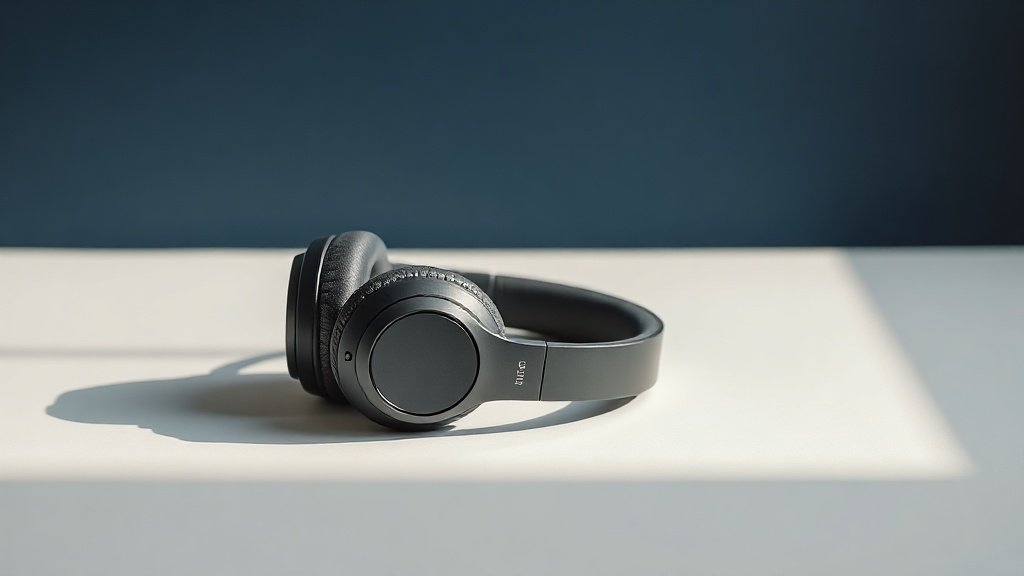
The headphones that sound best in a five-minute shop demo are rarely the ones you will still want on your head at four in the afternoon, six hours into a working day.
Office headphone use is one of the most demanding real-world applications for a pair of cans, not because the audio requirements are technically extreme, but because the variables are relentless. You are wearing them for hours at a stretch, often in shared spaces with unpredictable noise, switching between video calls and focused work and the occasional music session, all while trying to avoid disturbing the people around you. That context shapes every decision you should make when choosing a pair.
This guide covers the four areas that actually determine whether a pair of headphones works in an office environment: fit and comfort over extended wear, passive versus active noise management, the open-back versus closed-back question, and wireless considerations that matter when you are moving between a desk and a meeting room. Where it helps, I will point to real products as illustrations of how these principles play out in practice.
Comfort Over Long Wear: The Factor Most Reviews Underweight
A headphone review that runs for forty-five minutes tells you very little about how a pair will feel at hour five. Comfort over extended wear depends on three physical factors: clamping force, ear cup depth, and headband padding distribution. Clamping force determines how firmly the headband grips your skull. Too loose and the headphones move every time you turn your head. Too tight and you end up with pressure headaches by early afternoon. Most people with average head sizes find that a moderate clamp, firm enough to feel stable but not compressive, is the workable zone.
Ear cup depth matters because shallow cups rest against the outer ear rather than surrounding it. That constant contact with the ear cartilage becomes genuinely painful over a few hours, regardless of how soft the padding material is. On-ear headphones, which sit on the ear rather than around it, are almost universally less comfortable for extended wear than over-ear designs. The Sony WH-1000XM5 and the Bose QuietComfort 45, for example, use generous over-ear cups specifically because their target users are people wearing them through long haul flights and full working days. Those design decisions are not accidental. Headband padding distribution is the third variable: a headband that concentrates pressure at a single point on the crown will cause discomfort before a broad, well-padded band ever would.
Weight is a related consideration that often gets dismissed. A heavier headphone is not always worse, because mass distribution matters as much as total weight. A 300g headphone with a well-balanced design can feel lighter in use than a 250g pair with poor weight distribution. That said, anything pushing above 320g deserves scrutiny for all-day wear. Pay attention to ear pad material as well. Leatherette seals well and isolates better, but it retains heat and moisture. Velour breathes but sacrifices some passive isolation. Some manufacturers, including Beyerdynamic with certain models in the DT line, offer replacement pads in different materials specifically because this trade-off is real and personal.
Passive Isolation Versus Active Noise Cancellation
The distinction between passive isolation and active noise cancellation is one of the most misunderstood areas in office headphone selection. Passive isolation is purely physical: the ear cup forms a seal around the ear and blocks sound from entering. Active noise cancellation, or ANC, uses microphones to sample incoming sound and generates an opposing signal that cancels low-frequency noise. These two mechanisms tackle different parts of the noise spectrum, and understanding that difference changes how you evaluate them for office use.
Passive isolation is highly effective against mid and high-frequency sounds, the sharp consonants of a nearby conversation, a keyboard two desks over, a printer cycling. Closed-back over-ear headphones with a good seal can reduce these frequencies by 20 to 30 decibels without any electronics involved at all. ANC, by contrast, works primarily on low-frequency, predictable, continuous noise: air conditioning hum, road noise through a window, the low drone of an open-plan office ventilation system. It is less effective against the sudden, unpredictable sounds of human speech or random office clatter, because speech varies too rapidly for the cancellation circuit to track accurately.
For most office environments, the most practical approach is a closed-back headphone with good passive isolation and ANC as a supplement for low-frequency background noise. The Sony WH-1000XM5 handles this combination well, as does the Bose QuietComfort 45. Both use multiple microphone arrays that adapt the cancellation level to the ambient environment. If your office is genuinely quiet and your main concern is avoiding disturbing others rather than managing inbound noise, the calculus shifts somewhat, and that brings us to the open-back question.
The headphone that isolates best on paper is not always the one that keeps you focused longest, because isolation and fatigue are connected in ways the specification sheet does not capture.
Open-Back Versus Closed-Back for the Office
Open-back headphones have perforated or mesh ear cups that allow air and sound to move freely between the driver and the outside world. This produces a more natural, spacious sound that causes less listening fatigue over long sessions, because the ear is not pressurised in the same way as with a sealed design. The trade-off is bidirectional: open-backs let outside sound in and let your audio out. In a shared open-plan office, wearing open-back headphones means the person next to you can hear your music or your video call audio at a low but audible level. That is a meaningful social and professional consideration.
Open-back headphones are genuinely worth considering if you have a private office or a home office where you are working alone, or if your environment is quiet enough that you do not need noise isolation and you value reduced listening fatigue above all else. The Sennheiser HD 560S or the Beyerdynamic DT 990 Pro are examples of open-back designs that are comfortable for extended listening and reasonably priced. In a shared office, however, the audio leakage problem is real enough to rule them out for most users. Closed-back designs are the default recommendation for open-plan and co-working environments.
There is a middle category worth mentioning: semi-open designs, which partially vent the rear of the driver. These offer a compromise, slightly less fatigue than a fully sealed cup, and somewhat less leakage than a fully open back. They are less common in the headphone market and the balance they strike tends to satisfy neither goal completely. For office use, the practical recommendation is closed-back with well-designed ear padding for ventilation, rather than relying on acoustic openings to manage fatigue.
Wireless Versus Wired for an Office Context
The wireless versus wired decision is more nuanced for office use than it first appears. The obvious argument for wireless is freedom of movement: you can get up from your desk, walk to the printer, make a coffee, and remain connected to your audio without unplugging and re-plugging anything. Bluetooth connectivity has also improved substantially, and modern codecs including aptX and AAC deliver audio quality that is entirely adequate for music listening and video calls during a working day. Latency on current flagship wireless headphones is low enough that it does not cause obvious lip-sync issues in most video conferencing applications.
The arguments for wired are reliability, zero latency, and the absence of battery management. A wired connection does not drop, does not degrade if someone else in the building is using the same frequency band, and does not run out of charge at an inconvenient moment. If you are in a building with a dense wireless environment, Bluetooth dropouts are a genuine risk, particularly in the 2.4GHz range where Wi-Fi, Bluetooth, and other devices compete. The Audio-Technica ATH-M50x is a widely used wired closed-back option that performs reliably in demanding office environments and connects directly to any standard headphone output or USB audio interface without configuration overhead.
Battery life has become less of a differentiator at the upper end of the wireless market, with most flagship models offering 25 to 30 hours of use per charge. The more relevant wireless consideration for office users is what happens when the battery does run low. Headphones that support wired operation as a fallback, as both the Sony WH-1000XM5 and the Bose QuietComfort 45 do, give you continuity without interrupting your working day. Headphones that only function wirelessly leave you without audio until they charge.
Audio Quality in the Office Context
It is worth being direct about audio quality expectations for office headphones: the sonic standards are different from those of a critical listening or mixing context, but that does not mean sound quality is irrelevant. Headphones with heavily boosted bass, a tuning that many consumer-facing models favour, tend to cause listening fatigue faster than flatter, more balanced tuning. The exaggerated low end requires your auditory system to work harder to separate speech from music, and over a full working day that effort accumulates into genuine tiredness.
A moderately flat or gently warm frequency response is more sustainable for all-day wear than a V-shaped curve with exaggerated low and high frequencies. This is one reason why headphones with a more audiophile-oriented tuning, such as the Sennheiser HD 560S in open-back use cases or the Sony MDR-7506 in wired office environments, often feel less fatiguing over long sessions than consumer headphones with aggressive sound signatures. The MDR-7506 has been a broadcast and studio standard for decades precisely because it is honest, lightweight, and comfortable enough for extended use, even if it was not designed with office aesthetics in mind.
Choosing headphones based on a short listening session rather than an extended wear test is one of the most common errors office buyers make. Five minutes in a shop or a brief home trial does not reveal pressure hotspots, heat build-up, or clamping fatigue. If at all possible, wear a candidate pair for at least two hours before committing, or buy from a retailer with a genuine returns policy that allows you to conduct a proper extended trial.
Assuming active noise cancellation eliminates all distraction in an office environment sets unrealistic expectations that lead to frustration. ANC is highly effective against steady low-frequency noise but does very little against sudden vocal interruptions or unpredictable mid-frequency sounds, which are often the most disruptive elements in a real office. Pair ANC with good passive isolation and set appropriate expectations about what the technology can and cannot do.
Neglecting microphone quality on headphones used for video calls creates a poor experience for everyone else on the call, not just the user. Many headphones include a built-in microphone as a secondary feature with little engineering investment behind it. If video conferencing is a significant part of your working day, test the call-side audio quality explicitly, or consider a dedicated desk microphone alongside your listening headphones rather than relying on an integrated mic that was not designed as the primary input.
Conclusion
Office headphones are a long-duration tool, and the decision criteria are different from those that apply to a pair you are buying purely for critical listening. Prioritise fit and comfort for extended wear above all else, understand what passive isolation and ANC each actually do before relying on either, choose closed-back for shared environments, and match your wireless or wired preference to your actual working pattern. The right pair is the one that is still comfortable and functional at the end of a full working day.
FREE DOWNLOAD
Stop Guessing. Start Buying Smart.
The specs that actually matter, demystified.
Headphones, microphones, the spec sheet jargon you can ignore — all in one quick-reference PDF. Free, instant, no fluff.
Send Me the CheatsheetYou'll also receive occasional new guide notifications. Unsubscribe anytime. No spam, ever.