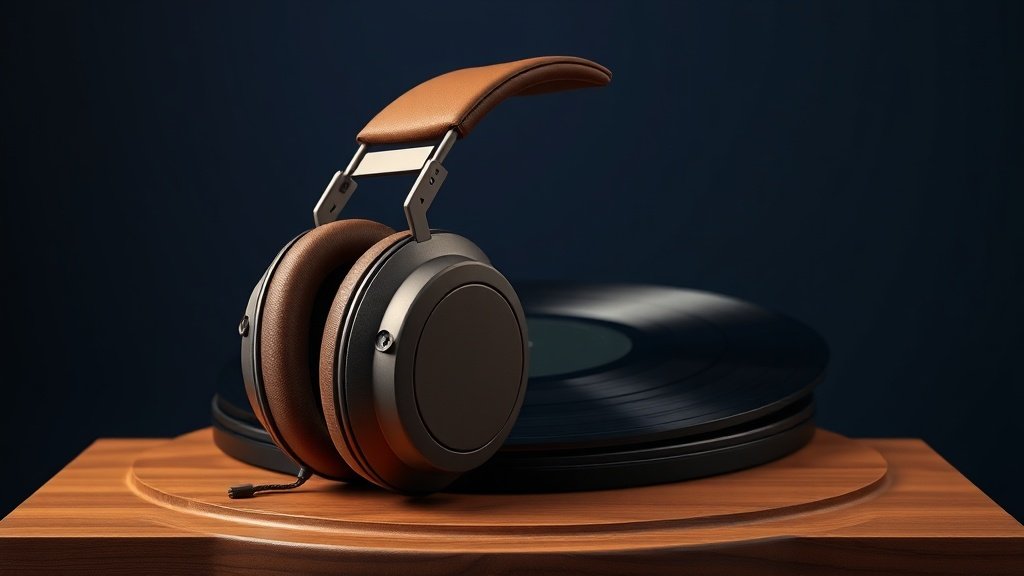
Vinyl listening is one of the most revealing tests for a pair of headphones, and the qualities that make a headphone sound impressive on a streaming playlist can actively work against everything that makes a record worth playing.
After years of obsessively buying, using and comparing audio gear, I have spent a considerable amount of time comparing how different headphones handle analogue source material. Vinyl is not a forgiving format in the way that a compressed digital stream can be. It carries genuine harmonic information, low-level detail, and a noise floor that tells you immediately whether your headphones are doing the music justice or smearing it into something unrecognisable.
This guide covers the specific technical and sonic qualities that matter when you are choosing headphones for vinyl playback. We will look at impedance and sensitivity in the context of phono stages, sound signature and how it interacts with the character of analogue recordings, the open-back versus closed-back decision, and the role of the headphone amplifier in the chain. None of this is abstract theory. Every point here comes from practical experience of sitting in front of a turntable and listening critically.
Understanding the Signal Chain Before You Pick a Headphone
The single most important thing to understand about vinyl listening through headphones is that the signal chain matters enormously. A turntable outputs a signal from a cartridge, which goes through a phono stage or phono preamplifier to apply RIAA equalisation and bring the signal up to line level. From there, the signal goes to either an integrated amplifier with a headphone output, a dedicated headphone amplifier, or occasionally a DAC and amplifier combination if you are also converting the signal digitally at some point.
This means your headphone is at the end of a chain that includes a cartridge, a tonearm, a phono stage, and an amplifier. Every component in that chain shapes what the headphone hears. A budget phono stage with a high output noise floor will make sensitive in-ear monitors reveal every bit of hiss. A valve-based phono stage with a warm character will push certain headphones into territory that sounds coloured rather than natural. Before you blame the headphone for a sound quality problem, audit the rest of the chain. I have heard people dismiss a perfectly capable headphone because it was revealing the limitations of a poor phono stage rather than inventing problems of its own.
Once the chain is solid, the headphone becomes the final filter between you and the record. That is when the choices below start to matter.
Impedance, Sensitivity, and Why They Matter for Vinyl
Headphone impedance and sensitivity are often treated as abstract specifications, but in a vinyl listening context they have very real consequences. Impedance is measured in ohms and reflects how much resistance a headphone presents to the amplifier driving it. Sensitivity, measured in decibels per milliwatt, tells you how loud the headphone will play for a given amount of power.
High-impedance headphones, typically those rated at 150 ohms or above, are designed to be driven by a proper headphone amplifier or the headphone output of a valve integrated amplifier. The Sennheiser HD 600, rated at 300 ohms, is one of the most widely used headphones in analogue listening setups precisely because it pairs well with the output characteristics of valve and solid-state amplifiers that are common in hi-fi systems. It does not do well plugged directly into a phono stage with a passive volume control, and it will sound thin and lacking in dynamics if you try. Similarly, the Beyerdynamic DT 990 Pro at 250 ohms needs a capable amplifier to open up and deliver the bass extension and treble detail it is capable of.
Low-impedance headphones, such as many consumer models rated between 16 and 32 ohms, are built for portable devices and will work with almost any output. The problem is that many headphone outputs in integrated amplifiers have output impedances that interact poorly with low-impedance headphones, causing frequency response shifts. As a general principle, the output impedance of your amplifier should be no more than one eighth of the impedance of the headphone. This is called the damping factor rule, and it applies directly to vinyl listening setups where you are using the headphone output of an integrated amplifier.
Open-Back Versus Closed-Back for Analogue Listening
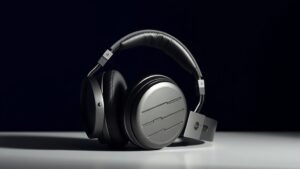
The open-back versus closed-back debate is more consequential for vinyl than for almost any other listening scenario. Open-back headphones, where the earcup housing allows air and sound to pass through freely, tend to produce a wider, more spacious soundstage with a more natural sense of depth. Vinyl recordings, particularly those from the 1960s through the 1980s, were mixed for loudspeaker playback in rooms. The stereo image on a well-pressed record is designed to extend outward, and an open-back headphone does a more convincing job of recreating that sense of space.
The Sennheiser HD 650 and the Audeze LCD-2 are both open-back designs that are widely used in serious analogue listening setups. The HD 650 has a slightly warmer character than the HD 600, which makes it particularly flattering on older recordings that can sound slightly brittle on more neutral headphones. The LCD-2, with its planar magnetic driver, has exceptional low-frequency control and a sense of textural detail in the midrange that suits the character of well-recorded acoustic instruments pressed to vinyl.
Closed-back headphones are better if you need isolation, but they come with trade-offs. The Beyerdynamic DT 770 Pro is a closed-back headphone that many people use in vinyl listening setups because of its availability and reasonable price. It has an elevated bass response and a slightly recessed midrange that suits certain genres but can make classical recordings sound less natural than they do on an open-back design. If you are listening in a quiet room and do not need to block external sound, an open-back headphone will almost always serve a vinyl listening setup better.
Vinyl listening rewards headphones that tell the truth about a recording rather than headphones that make everything sound exciting.
Sound Signature and How It Interacts With Analogue Recordings
The sound signature of a headphone describes how it presents the frequency spectrum. A headphone with a V-shaped signature, meaning boosted bass and treble with a recessed midrange, is popular for bass-heavy electronic music on streaming services, but it works against vinyl. Most of the musical information on a vinyl record, particularly the warmth of strings, the body of a piano, the presence of a voice, sits squarely in the midrange. A headphone that recesses the midrange will rob a record of its character and replace it with an artificial sense of excitement.
What works well for vinyl is a headphone with a relatively flat or gently warm frequency response through the midrange, with treble that is present but not harsh. Vinyl can have a degree of brightness at the top end depending on the cartridge, the record condition, and the phono stage. A headphone that already emphasises the upper treble will push that brightness further and make sibilance on vocals uncomfortable and surface noise more distracting than it needs to be.
Planar magnetic headphones are worth considering here. Designs such as the HiFiMAN Sundara or the Audeze LCD-X have a different driver technology from conventional dynamic drivers, using a thin membrane suspended in a magnetic field. Planar drivers tend to have very low distortion and a smooth, even treble response that works well with the harmonic content of analogue recordings. They also tend to have extended low-frequency response that can reveal bass detail on well-pressed records that a conventional dynamic headphone might blur. The trade-off is that planar magnetic headphones typically require more amplifier power than dynamic driver designs at similar impedance ratings.
The Role of the Headphone Amplifier in a Vinyl Setup
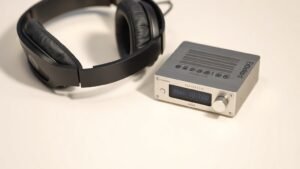
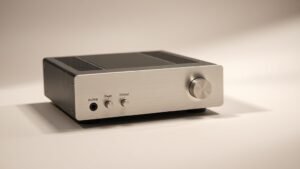
A good headphone amplifier is not a luxury in a vinyl listening setup. It is a functional requirement if you are using any headphone above 80 ohms impedance, and it makes a meaningful difference even with lower-impedance designs. The headphone output on most integrated amplifiers is driven by a tap from the speaker output through a resistor network, which is a cost-saving measure that works acceptably but rarely sounds as good as a dedicated headphone amplifier stage.
Valve headphone amplifiers have become popular in vinyl listening setups because their output characteristics, including a degree of second-harmonic distortion that is benign to the ear, complement the tonal character of analogue recordings. The Cayin HA-6A and the Feliks Audio Euforia are both valve-based headphone amplifiers used in serious hi-fi systems and they pair particularly well with high-impedance dynamic driver headphones. They also have a relatively high output impedance, which means they work best with headphones rated at 150 ohms or above rather than low-impedance designs.
Solid-state headphone amplifiers such as the Schiit Magnius or the Topping A90 offer a more neutral presentation and a much lower output impedance, making them suitable for a wider range of headphones. If your turntable setup is already on the warmer side of neutral, a clean solid-state amplifier can provide a better balance than a valve amplifier that adds further warmth. The key is to think of the headphone amplifier as part of the tonal tuning of the system, not just as a volume control.
Cartridge Character and Headphone Pairing
One aspect of vinyl listening through headphones that is rarely discussed is the relationship between cartridge character and headphone sound signature. Moving magnet cartridges, such as the Audio-Technica AT-VM95E or the Ortofon 2M Red, tend to have a slightly brighter, more forward treble character than moving coil cartridges. If you are using one of these cartridges and you pair it with a headphone that also has an emphasised upper treble, such as a Beyerdynamic DT 990 Pro or certain Grado models, the combination can sound fatiguing over long listening sessions.
Moving coil cartridges, such as the Ortofon Quintet Black or the Hana SL, generally have a smoother, more extended high-frequency response and a more detailed midrange. They pair well with neutral or revealing headphones because the cartridge itself is not adding brightness to the signal. If you use a moving coil cartridge with a warm-sounding headphone, you may find that the warmth accumulates and the result sounds slightly soft or lacking in resolution. Thinking about the cartridge as part of the tonal chain, alongside the phono stage and the headphone, is the approach that produces the most satisfying long-term result.
Choosing a headphone based on streaming performance rather than analogue source compatibility is the most common error. Headphones voiced for modern digital content often have a V-shaped frequency response that flattens the midrange and elevates the bass and treble, which works directly against the warmth and midrange detail that vinyl is prized for.
Plugging a high-impedance headphone directly into the phono stage output without a proper headphone amplifier produces poor results. A phono stage output is at line level and is not designed to drive headphones. The result is thin, dynamically compressed sound that bears no resemblance to what the headphone is capable of with correct amplification.
Ignoring cartridge brightness when selecting a headphone leads to a fatiguing and often harsh listening experience. If your cartridge and phono stage combination already trends toward the bright side of neutral, choose a headphone with a smooth or slightly warm treble character rather than one that adds further emphasis to the upper frequencies.
Conclusion
Choosing headphones for vinyl listening is about understanding the full signal chain and selecting a headphone whose sonic character complements rather than works against the nature of analogue recordings. Prioritise a neutral or gently warm midrange, consider open-back designs for their more natural soundstage, match headphone impedance to a capable amplifier, and factor in the character of your cartridge. The reward is a vinyl listening experience that is genuinely revealing rather than merely loud.
FREE DOWNLOAD
Stop Guessing. Start Buying Smart.
The specs that actually matter, demystified.
Headphones, microphones, the spec sheet jargon you can ignore — all in one quick-reference PDF. Free, instant, no fluff.
Send Me the CheatsheetYou'll also receive occasional new guide notifications. Unsubscribe anytime. No spam, ever.