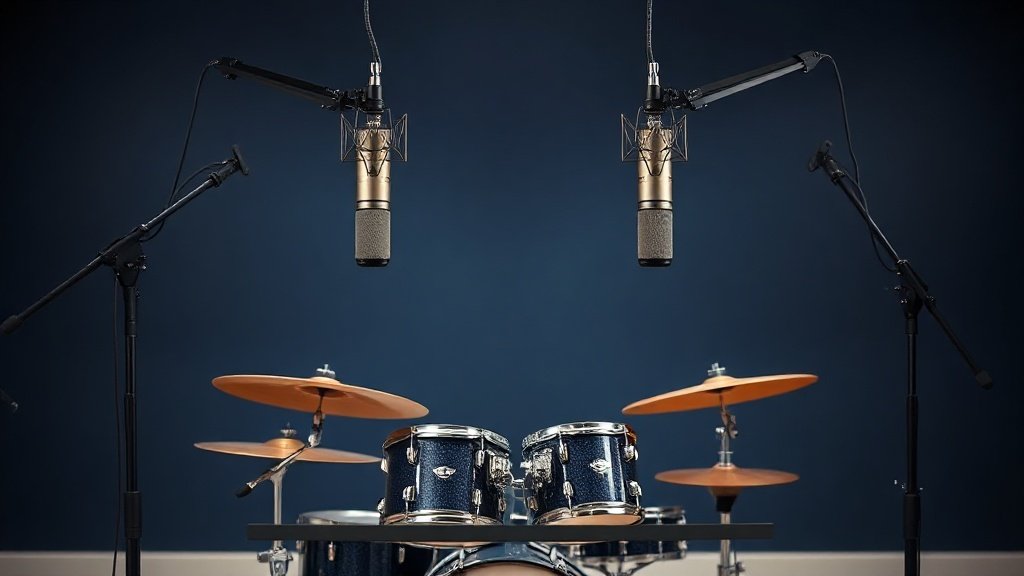
The overhead microphones on a drum kit do not simply capture cymbals — they define the entire spatial image of the kit, and the technique you choose shapes everything from mono compatibility to low-end weight.
After years of obsessively buying, using and comparing audio gear, I have come back to the same conclusion every time: the overhead technique matters more than the microphone choice. A matched pair of Shure SM81s placed correctly will outperform a pair of Neumann KM184s set up carelessly. Placement determines phase coherence, stereo width, and how naturally the kit translates to a mix.
This guide covers the three overhead techniques I use most — the Spaced Pair, the XY configuration, and the Recorderman method. For each one I will explain the geometry, the reasoning behind it, the practical tradeoffs, and when I reach for it on a session. I will also address the common mistakes that consistently appear even among experienced engineers who have just never had them pointed out.
Why Overhead Technique Shapes the Entire Drum Sound
Most engineers think of overheads as a cymbal microphone, then supplement the kit with close mics and a room pair. That is a valid workflow, but it can lead to decisions that undermine the overhead placement entirely. When the overheads are treated as the primary picture of the kit — with close mics filling in attack and detail — the whole recording becomes more coherent. Phase relationships tighten, the snare sits more naturally in the stereo image, and the kick drum retains its body without needing heroic amounts of processing.
The relationship between the two overhead microphones and the snare drum is the central concern of all three techniques covered here. If the snare arrives at both microphones at slightly different times, the result in mono is a comb-filtered, thin snare that no amount of equalisation will fully fix. This is why measurement matters, and it is why I always keep a tape measure on the drum riser, not just a pair of stands and a rough visual check.
Microphone choice does play a role. Small diaphragm condensers are generally preferred for overheads because of their consistent off-axis response and extended high-frequency detail. The Josephson C42, the Oktava MK-012, and the AKG C451 B are all microphones I have used extensively overhead. Large diaphragm condensers can work beautifully — the Rode NT1 has appeared on more than a few of my sessions as a mono overhead — but the matched pair argument applies more strongly to small diaphragm models.
The Spaced Pair — Width at the Cost of Phase
The Spaced Pair, sometimes called AB, is the most intuitive overhead setup: two microphones placed left and right above the kit, typically one metre or more apart, both pointing downward at a slight inward angle. The result is a wide stereo image with a natural sense of space. Cymbal crashes spread convincingly across the stereo field, and the room ambience feels open. On a well-treated or genuinely good-sounding room, the Spaced Pair captures that environment beautifully.
The problem is phase. Because the two microphones are far apart, the snare drum and kick drum reach them at different times. In a stereo mix this is manageable, but when the track is summed to mono — as it will be on countless playback systems, from phones to club PA systems — the phase cancellation can be significant. The snare loses body, the kick loses punch, and the whole kit sounds distant and hollow.
The practical fix is careful positioning. I aim to place both microphones at an equal distance from the snare drum, measured with a tape. If the snare is slightly left of centre on the kit, the left microphone may need to come forward slightly to compensate. This is tedious but essential. Once phase coherence is confirmed, the Spaced Pair rewards you with the widest, most spacious overhead image of the three techniques. For rock, metal, or any genre where the drum kit is supposed to feel enormous, this is often my starting point. I have used a pair of Rode NT5s in this configuration on dozens of sessions and the results have consistently been usable with minimal phase correction needed, provided the measurement work is done first.
XY Configuration — Phase Coherence and Mono Compatibility
The XY technique uses two cardioid microphones with their capsules as close together as physically possible — ideally coincident, meaning the capsules occupy the same point in space — angled at 90 to 135 degrees apart. Because both capsules are at the same point, any sound source reaches them simultaneously. Phase coherence is essentially guaranteed, and the recording collapses to mono without any tonal change.
The tradeoff is stereo width. XY produces a narrower, more focused stereo image compared to the Spaced Pair. For a tight, punchy rock drum sound, or for a drummer playing in a room with less-than-ideal acoustics, this can actually be an advantage. The image is more controlled, the kit stays centred, and you avoid the phasiness that can creep into wide Spaced Pair recordings when the room reflections are not flattering.
Positioning an XY pair overhead requires a stereo bar or a dedicated stereo microphone mount. I position the array roughly 50 to 60 centimetres above the top of the kick drum beater head height, angled so the centre point of the array is aimed between the snare and the kick. The Rode NT5 comes supplied with a stereo bar and matched capsule pair, making it one of the most practical choices for this technique. The AKG C451 B is another microphone I reach for in XY, particularly when I want a slightly brighter, more detailed cymbal response. For engineers working in home studios where room treatment is limited, XY is often the most reliable technique because it is the least dependent on the sound of the room.
Phase coherence is not a mixing problem to solve later — it is a placement problem to solve before you press record.
The Recorderman Technique — Phase and Width in Balance
The Recorderman method was developed and shared online by a home recording engineer in the early 2000s and has since become one of the most widely adopted overhead techniques in project studio recording. It uses two microphones placed using a specific measurement protocol that prioritises equal distance from both the snare and the kick drum, rather than relying on symmetry above the kit.
The setup works like this. The first microphone is positioned directly above the snare drum, roughly two drumstick lengths above the head. The second microphone is positioned above the right shoulder of the drummer — above the floor tom and ride cymbal area — also at a height of approximately two drumstick lengths above the kit. Both microphones must be equidistant from the snare drum and equidistant from the kick drum beater head. This is measured with a string or a tape. When these distances are equal, the snare and kick arrive at both microphones simultaneously, and the recording is phase coherent even in mono.
The resulting stereo image is asymmetric — the kit does not spread evenly left to right as it does with a Spaced Pair — but it feels natural and open, and it handles mono summing far better than most Spaced Pair setups. The kick drum in particular sounds fuller and more centred with Recorderman than with almost any other overhead technique. I first tried it on a session in 2011 using a pair of Shure SM81s and was surprised by how much low-end weight the overheads retained. For pop, soul, or any genre where the kick and snare need to anchor a mix without heavy processing, this technique is genuinely worth the setup time.
Choosing Between the Three Techniques
The honest answer is that the right technique depends on the room, the genre, and what the recording needs to do. I use Spaced Pair when I am in a room that sounds good and I want to capture that space, particularly for live-sounding rock or jazz. I use XY when the room is problematic, when I need guaranteed mono compatibility, or when the drummer plays a compact kit and I want a tight, controlled image. I use Recorderman when I need both reasonable width and strong phase coherence, particularly on sessions where the overheads will carry the weight of the whole kit sound with close mics used sparingly.
Microphone polar pattern matters for all three. Cardioid capsules are standard for all three techniques, and they handle off-axis rejection well enough to keep room ambience manageable. If the room is excellent and you want to capture more of it, hypercardioid microphones can work in a Spaced Pair by narrowing the pickup and focusing more on the kit itself. Omnidirectional capsules are occasionally used in Spaced Pair configurations by engineers who want maximum low-frequency extension and a fully open room sound, though this demands a genuinely good-sounding room and strong monitoring when setting up.
Gain Staging and Interface Considerations
Overhead microphones on a drum kit require clean, high-headroom preamps. Drums are transient-heavy sources, and the peaks from a crash cymbal hit directly overhead can be 20 dB or more above the average programme level. Setting gain by watching the average level on a meter and then getting clipped by a crash is one of the most common mistakes in drum recording. I set gain for the loudest expected hit — ask the drummer to play a full crash — and then pull back a further 3 to 6 dB as insurance.
Audio interfaces with good preamp headroom make a genuine difference here. The Universal Audio Apollo range and the Focusrite Clarett series both offer preamps capable of handling the dynamic range of a live drum kit without distorting on peaks. Dedicated microphone preamps like the Neve 1073 or the API 512c add character that many engineers find complements drum recordings, but clean and transparent preamps are equally valid and often preferable when the room and microphone are already doing the work.
Skipping the tape measure is the single most damaging shortcut in overhead drum recording. Visual symmetry above a drum kit does not guarantee equal distance from the snare or the kick, and even small timing differences cause phase cancellation that becomes audible immediately when the mix is played in mono.
Pointing both overhead microphones straight down produces a flat, unengaging stereo image with poor high-hat and cymbal separation. Angling each microphone slightly inward toward the centre of the kit improves stereo cohesion and gives the image more depth without introducing phase problems.
Using mismatched microphones in a stereo overhead pair creates tonal imbalance that equalisation cannot fully correct. The left and right sides of the kit will have different frequency characters, and the stereo image will feel unstable in a mix — always use a factory-matched pair or at minimum two units of the same model from the same production batch.
Conclusion
Overhead technique is not a secondary consideration — it is the foundation of the entire drum recording. The Spaced Pair offers width at the cost of phase management. XY offers phase coherence at the cost of width. The Recorderman technique offers a practical middle ground with strong low-end phase alignment. Learn the measurement protocols for each, use matched microphones, set gain conservatively, and check your work in mono before the session ends.

FREE DOWNLOAD
Stop Guessing. Start Buying Smart.
The specs that actually matter, demystified.
Headphones, microphones, the spec sheet jargon you can ignore — all in one quick-reference PDF. Free, instant, no fluff.
Send Me the CheatsheetYou'll also receive occasional new guide notifications. Unsubscribe anytime. No spam, ever.