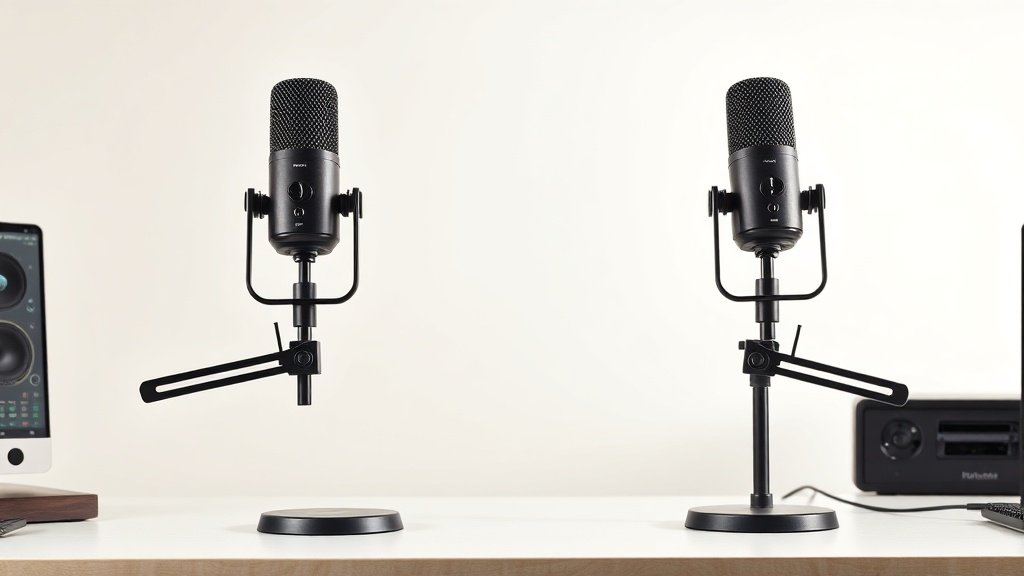
The microphone choice that works perfectly for a solo presenter can fall apart completely the moment a second voice enters the room, and most podcasters only discover this after they have already recorded several episodes.
Running a two-person podcast introduces a specific set of acoustic problems that solo setups simply do not face. You have two voices of potentially different projection and tonal character, two sets of mouth noise and breath sounds, two positions in a room that may behave very differently from each other, and a listening audience that will notice any imbalance in quality between the two speakers immediately. The microphone decisions you make before you record a single word will determine how much of your editing time is spent fixing problems rather than shaping content.
This guide covers the core considerations for selecting microphones in a two-person podcast context: polar patterns and how they relate to room acoustics, the dynamic versus condenser decision, whether both hosts need identical microphones, what interfaces you will need to connect two microphones properly, and the placement principles that make a significant difference to the final result. I will reference real products throughout to give you concrete points of comparison rather than abstract guidance.
Polar Patterns Come First, Not Brand Names
Before you look at frequency response charts or price tags, you need to understand polar patterns, because this single specification will shape everything else about your setup. A cardioid microphone captures sound from the front and rejects sound from the rear and sides. A supercardioid has a tighter front capture with a small lobe of sensitivity at the rear. An omnidirectional microphone captures equally in all directions. For a two-person podcast recorded in the same room with both microphones active simultaneously, cardioid is almost always the correct starting point.
The reason cardioid matters so much in a shared space is bleed. When Host A speaks into their microphone, some of that sound will travel across the table and reach the capsule of Host B’s microphone. With cardioid polar patterns and correct positioning, the rear rejection of each microphone works against the opposite speaker, reducing how much of one voice leaks into the other channel. This gives you cleaner individual tracks and far more control in post-production. If either host uses an omnidirectional microphone, that bleed problem multiplies considerably, and no amount of editing will fully recover the separation you have lost.
Supercardioid patterns can work in a two-person setup if the microphones are positioned carefully, but the rear lobe requires attention. If the hosts are sitting directly opposite each other, a supercardioid aimed at one host may have its rear lobe pointed toward the other. This is manageable with angled positioning but adds a layer of complexity that cardioid avoids entirely. For most two-person podcast setups, I recommend starting with cardioid and only moving to supercardioid if you have a specific acoustic reason to do so.
Dynamic Versus Condenser in a Shared Room
The choice between dynamic and condenser microphones is more consequential in a two-person setup than it is for solo recording, specifically because of how each type responds to off-axis sound and room noise. Condenser microphones are more sensitive across the full frequency range, which means they pick up more of everything, including the ambient noise of your recording space, the air conditioning in the background, and the sound of the other host shifting in their chair. Dynamic microphones are less sensitive and require the speaker to be physically closer to the capsule, which naturally reduces the amount of room sound captured.
In a purpose-built studio with acoustic treatment, a pair of condenser microphones is an excellent choice. The Rode NT1 5th Generation or the Audio-Technica AT2020 are capable large-diaphragm condensers at accessible price points, and in a treated space they will deliver a detailed, extended sound that works beautifully for spoken word. However, if you are recording in a home office, a spare room with hard surfaces, or any space that has not been acoustically treated, the sensitivity of a condenser microphone will expose every flaw in that room.
For untreated or semi-treated spaces, dynamic microphones are the more forgiving and often the more professional choice for a two-person podcast. The Shure SM7dB, the Electro-Voice RE20, and the Rode PodMic USB are all cardioid dynamic microphones that reward close-mic technique and tolerate imperfect rooms considerably better than condenser alternatives. The SM7dB in particular includes an internal preamp that addresses the gain requirements dynamic microphones traditionally impose on audio interfaces, making it a practical choice for setups where interface headroom is limited. The RE20 has been a broadcast standard for decades precisely because its proximity effect behaviour and off-axis rejection suit voice work in non-ideal environments.
In a shared recording space, the polar pattern you choose does more work than the price of the microphone.
Do Both Hosts Need the Same Microphone
This question comes up constantly and the honest answer is: not necessarily, but there are strong practical reasons to use matched pairs. When two microphones of the same model are positioned identically relative to each host, you start from a position of consistency. The frequency response, the off-axis behaviour, the sensitivity, and the character of each channel are predictable and comparable. Matching levels and tonal balance in post-production is straightforward. Two Rode PodMic units, two SM7dB units, or two Audio-Technica AT2035 units will give you a clean, symmetrical foundation.
Where mismatched microphones cause problems is in tonal inconsistency between channels. If one host is using a large-diaphragm condenser and the other is using a small-diaphragm dynamic, the two voices will have noticeably different characters even before you factor in differences in the voices themselves. Listeners register this as an imbalance in production quality, even when they cannot articulate exactly what sounds different. In broadcast and podcast production, listener comfort is closely tied to consistency, and mismatched microphones work against that.
There are situations where mismatched microphones make sense. If one host has a very quiet voice and the other projects strongly, a more sensitive condenser on the quieter host and a dynamic on the louder one can help balance levels at the source. But this is an adjustment for a specific problem, not a general recommendation. Start with matched pairs and address individual voice differences through positioning and gain rather than microphone selection.
Interfaces and Connectivity for Two Microphones
Two microphones means two XLR inputs, and that means you need an audio interface with at least two microphone preamp channels. A single-channel interface will not work for a two-host setup, regardless of how good that single preamp is. The good news is that two-channel interfaces are well represented at every price point. The Focusrite Scarlett 2i2 fourth generation has become a reference point in this category, offering two clean preamps with enough gain for most dynamic microphones, straightforward driver support, and reliable latency performance at 24-bit 48kHz, which is well above the technical requirements of podcast audio.
If you are using high-gain-demand dynamic microphones such as the original Shure SM7B, which requires around 60dB of clean gain to reach optimal levels, you will want to check the maximum gain specification of any interface you are considering. The Focusrite Scarlett 2i2 4th generation provides 56dB of gain per channel, which is borderline for the SM7B without a separate inline preamp booster. Alternatives such as the Universal Audio Volt 276 or the Audient iD4 MkII offer similar channel counts with slightly different preamp characters and gain headroom. The Zoom PodTrak P4 takes a different approach, designed specifically for podcast recording with four microphone inputs and built-in mix capabilities, though its preamp quality is a step below a dedicated studio interface.
USB microphones offer a simpler path: each microphone connects directly to a computer without an interface. The Rode PodMic USB and the Shure MV7 Plus both support direct USB connection. However, running two USB microphones simultaneously introduces a synchronisation challenge, as each microphone presents itself to the computer as a separate audio device. On a Mac, you can aggregate multiple USB audio devices using the built-in Audio MIDI Setup utility. On Windows, this is more complicated and depends on your recording software. For most two-person setups, two XLR microphones through a two-channel interface is the more reliable and controllable approach.
Placement and Distance: Where the Recording Is Actually Made
Microphone selection and microphone placement are inseparable. A well-chosen microphone placed incorrectly will sound worse than a budget microphone placed correctly, and in a two-person podcast the placement decisions compound because you are managing two sources simultaneously. The standard recommendation for dynamic microphones is to position the capsule six to ten centimetres from the mouth, angled slightly off-axis at roughly 45 degrees to reduce plosive energy hitting the capsule directly. This close-mic technique is what activates the proximity effect that gives dynamic microphones their characteristic warmth on voice, and it is what enables the rear rejection of the cardioid pattern to work against the opposite host.
Boom arms are worth the investment for any serious podcast setup because they allow each host to position the microphone precisely without occupying table space or transmitting desk vibration through a stand. The Rode PSA1 Plus and the Elgato Wave Mic Arm are both robust options designed for desktop podcast use. A pop filter or foam windscreen on each microphone addresses plosive sounds, which become more noticeable in close-mic situations. If you are using condenser microphones, a shock mount is also valuable for isolating the capsule from low-frequency vibration transmitted through the desk surface.
Room arrangement matters as much as individual microphone placement. Positioning both hosts so they face each other across a desk, with each microphone aimed inward and slightly away from the other host, gives the rear rejection of each cardioid pattern a useful angle against the opposite source. Avoid positioning hosts side by side, as this puts both microphones parallel and reduces the directional separation between them. Hard reflective surfaces behind each host, such as windows or bare walls, will cause reflected sound to re-enter the capsule from behind and partially defeat the rear rejection of the cardioid pattern. Even a simple acoustic panel or heavy curtain behind each host can make a measurable difference.
Buying two high-quality microphones without considering the interface is one of the most common and costly oversights in two-person podcast setups. An underpowered preamp will force you to record at insufficient gain levels, introduce noise, or clip the signal, none of which editing can fully correct after the fact.
Using omnidirectional or wide cardioid microphones in a shared untreated room causes bleed problems that compound with every episode. Once the signal from one host leaks significantly into the other channel, the separation is gone and phase-related colouration becomes a permanent feature of the recording.
Positioning microphones at speaking height but too far from the mouth negates the directional advantage of a cardioid polar pattern. At distances beyond 30 centimetres, a cardioid microphone begins capturing considerably more room sound relative to the direct voice signal, and the rear rejection that separates the two hosts becomes far less effective.
Conclusion
Choosing microphones for a two-person podcast is a systems decision as much as a product decision. The polar pattern, the microphone type, the interface gain, the physical placement, and the acoustic environment all interact with each other. Getting the polar pattern and placement right in a reasonably controlled space will produce better results than expensive microphones in a poor acoustic environment with inadequate gain. Start with matched cardioid dynamic microphones, a two-channel interface with sufficient headroom, and close-mic positioning, then address room treatment and upgrades from there.
FREE DOWNLOAD
Stop Guessing. Start Buying Smart.
The specs that actually matter, demystified.
Headphones, microphones, the spec sheet jargon you can ignore — all in one quick-reference PDF. Free, instant, no fluff.
Send Me the CheatsheetYou'll also receive occasional new guide notifications. Unsubscribe anytime. No spam, ever.