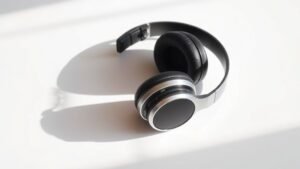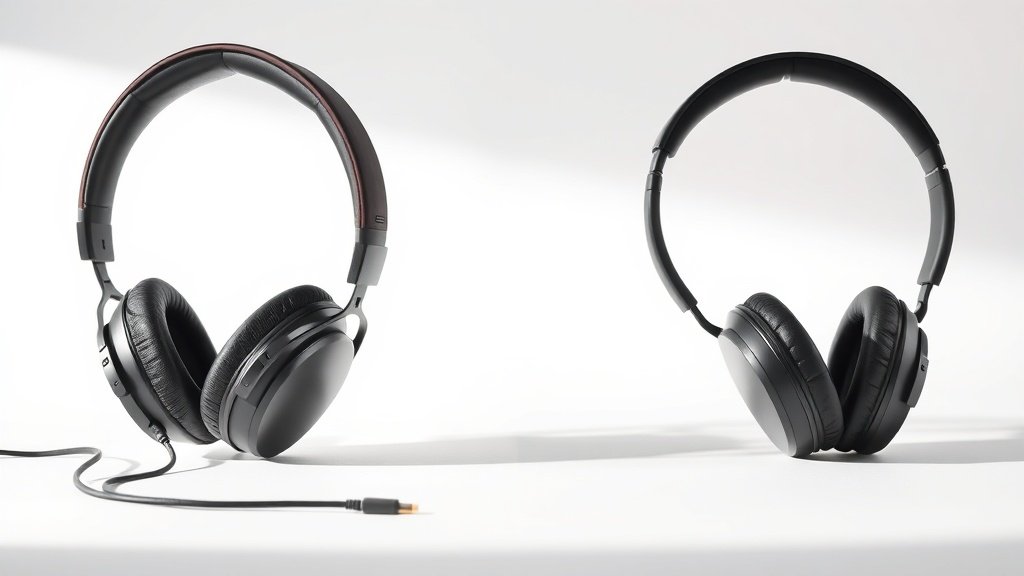
The wireless revolution promised convenience without compromise, yet many audio professionals still reach for wired headphones when quality matters most.
After years of obsessively buying, using and comparing audio gear, I can tell you the wired versus wireless debate is not as simple as audiophiles make it sound. Modern wireless technology has eliminated many traditional weaknesses, but physics still imposes limits that affect what you hear.
This guide examines the measurable differences between wired and wireless headphone audio quality, covering codec limitations, power constraints, and interference factors that determine which connection type serves your needs best.
Digital Audio Codecs Shape Wireless Sound
Wireless headphones compress audio data before transmission, and this compression determines sound quality more than any other factor. Basic SBC codec found in all Bluetooth devices samples audio at 48kHz with significant data reduction. The Sony WH-1000XM5 and Bose QuietComfort 45 both support higher-quality AAC codec, which maintains better frequency response and dynamic range.
Premium models like the Sennheiser Momentum 4 Wireless support LDAC codec, transmitting nearly three times more data than standard Bluetooth. During testing, LDAC maintains detail in complex orchestral passages that SBC codec smooths away. However, LDAC requires strong signal strength and drains battery faster.
Wired headphones bypass codec compression entirely. The audio signal travels as analog voltage or digital data without additional processing. High-impedance models like the Beyerdynamic DT 990 Pro receive the full frequency spectrum and dynamic range your source device provides.
Power Delivery Affects Driver Performance
Headphone drivers need power to move air and create sound pressure. Wired headphones draw power directly from your audio source, while wireless models depend on internal batteries that impose strict power budgets to maintain reasonable battery life.
The planar magnetic drivers in wired headphones like the HiFiMAN Sundara require substantial current to perform optimally. These drivers can reproduce transient details and bass extension that wireless headphones struggle to match due to power constraints. Even high-end wireless models like the Mark Levinson No. 5909 must balance driver performance against battery drain.
Dynamic driver wireless headphones perform better within power limitations. The Audio-Technica ATH-M50xBT2 delivers sound quality very close to its wired ATH-M50x counterpart because dynamic drivers operate efficiently at lower power levels. The difference becomes apparent in demanding passages with deep bass and complex layering.
Codec compression affects wireless audio quality more than driver technology or frequency response specifications.
Interference and Signal Processing
Wireless transmission introduces variables that wired connections avoid entirely. Bluetooth operates in the crowded 2.4GHz spectrum alongside WiFi networks, microwave ovens, and other devices. Signal interference causes audio dropouts, compression artifacts, and reduced connection stability that directly impact listening quality.
Many wireless headphones apply additional digital signal processing to compensate for codec limitations and maintain consistent sound signatures. The Sony WH-1000XM5 uses AI-driven processing to enhance perceived detail and soundstage width. While this processing can improve the listening experience, it also adds another layer between you and the original audio content.
Wired headphones present audio with minimal processing. Models like the Audio-Technica ATH-R70x provide direct connection to your source material without digital manipulation. This direct path preserves the original mix balance and spatial information that producers intended you to hear.
Practical Performance in Real Use
Testing reveals that wireless headphones excel in scenarios where convenience outweighs ultimate fidelity. The Apple AirPods Max delivers impressive spatial audio processing for movie content and maintains good tonal balance for casual music listening. However, critical listening sessions expose compression artifacts in dense mixes and reduced micro-detail compared to equivalent wired models.
Wired headphones remain superior for professional applications where accuracy matters most. Studio engineers mixing on the Neumann NDH 30 can hear subtle EQ adjustments and reverb tails that wireless transmission obscures. The immediate response and zero latency of wired connection also prevents timing issues during recording sessions.
Battery degradation affects wireless headphone longevity in ways that do not impact wired models. After two years of regular use, wireless headphones may exhibit reduced dynamic range and distortion as battery voltage drops. Quality wired headphones like the Grado SR325x can operate indefinitely without performance degradation.
Source Device Compatibility and Output Quality
Your source device significantly influences the wired versus wireless comparison. Modern smartphones often provide adequate power for efficient wired headphones but may lack dedicated headphone amplifiers found in quality audio interfaces. The RME ADI-2 DAC delivers clean, powerful output that reveals the full capability of demanding wired headphones.
Wireless connection bypasses your device output stage entirely, relying instead on internal amplification within the headphones. This can actually improve sound quality when using devices with poor analog output stages. The balanced sound of the Bose QuietComfort 45 often exceeds what you hear from the same source through basic wired earbuds.
High-resolution audio support varies significantly between connection types. Wired headphones connected to capable sources can reproduce 24-bit 192kHz files without compromise. Wireless transmission typically downsamples high-resolution content to fit codec limitations, though LDAC maintains reasonable quality up to 24-bit 96kHz under ideal conditions.
Assuming all wireless headphones sound compressed and lifeless. Modern premium wireless models with advanced codecs can deliver excellent audio quality that satisfies most listeners outside of critical monitoring applications.
Believing wired headphones automatically provide better sound quality regardless of source device. Poor analog output from smartphones and computers can make quality wireless headphones sound cleaner than wired alternatives connected to the same device.
Ignoring codec compatibility when choosing wireless headphones. Your source device must support advanced codecs like LDAC or aptX HD to benefit from their improved quality, otherwise you get basic SBC compression regardless of headphone capability.
Conclusion
Wired headphones maintain advantages in ultimate audio fidelity, power delivery, and signal purity that matter for critical listening applications. However, modern wireless technology has narrowed the gap significantly, delivering satisfying sound quality with unmatched convenience. Choose wired for studio work and analytical listening, wireless for daily use and portable applications where freedom of movement adds value.

FREE DOWNLOAD
Stop Guessing. Start Buying Smart.
The specs that actually matter, demystified.
Headphones, microphones, the spec sheet jargon you can ignore — all in one quick-reference PDF. Free, instant, no fluff.
Send Me the CheatsheetYou'll also receive occasional new guide notifications. Unsubscribe anytime. No spam, ever.