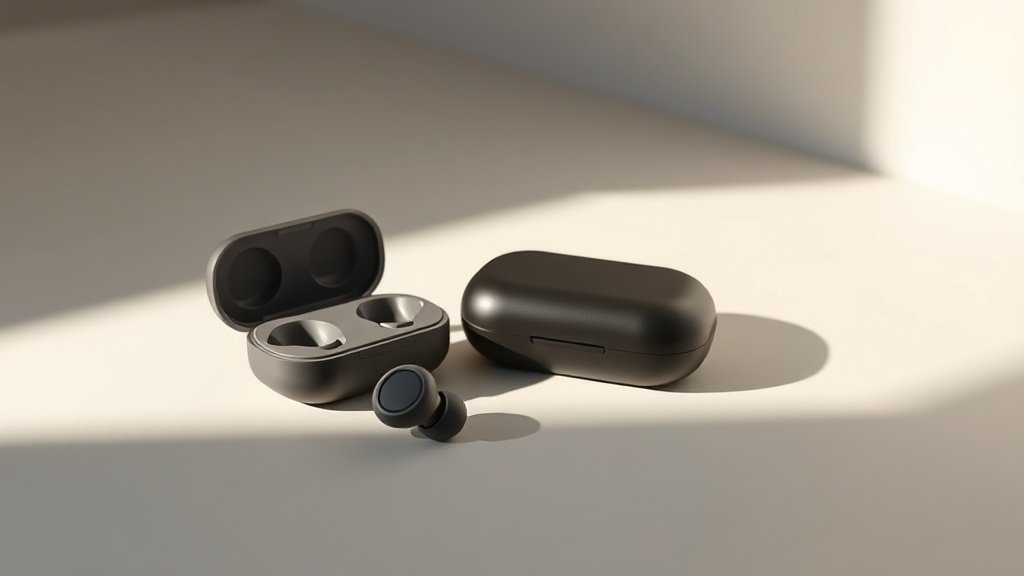
Most wireless earbuds are purchased on battery life specs and brand recognition, yet the single biggest factor determining whether you will enjoy listening to them every day is something almost nobody checks before buying.
After years of obsessively buying, using and comparing audio gear, I have spent more time than I care to admit evaluating earbuds that should sound good on paper but fall flat in practice. The gap between a set of earbuds that costs eighty pounds and one that costs three hundred is real, but it is not always where manufacturers want you to think it is. Knowing what to look for before you spend the money changes everything.
This guide covers the core technical factors that determine sound quality in wireless earbuds: Bluetooth codecs, driver types and tuning, fit and acoustic seal, active noise cancellation as a variable, and the firmware and software layer that sits between the hardware and your ears. None of it requires an engineering degree, but all of it is worth understanding if you want to make a purchase you will not regret.
Bluetooth Codecs: The Bandwidth Your Music Actually Travels Through
The codec is the compression format used to transmit audio wirelessly from your source device to your earbuds. This is the most overlooked specification in mainstream earbud buying, yet it is one of the most consequential. Every wireless earbud uses some form of lossy compression over Bluetooth, and the codec determines how much audio information is preserved in that process. SBC is the universal fallback, present in every Bluetooth device, and it is the lowest quality option. AAC is a meaningful step up and is the best option for iPhone users since Apple devices handle it well at the hardware level. Android users are better served by aptX or aptX HD if their phone supports it, since the implementation of AAC on Android varies considerably between manufacturers and can sound worse than its specification suggests.
Sony has done serious work in this area with its LDAC codec, which transmits at up to 990 kbps compared to SBC at roughly 320 kbps. The Sony WF-1000XM5 and the Sony LinkBuds S both support LDAC, and when paired with a compatible Android device, the audible difference over SBC on compressed music is genuine rather than marginal. More recently, LC3 and LC3plus are emerging as part of the Bluetooth LE Audio standard, and these codecs are worth watching as they promise better quality at lower bitrates with lower latency. If you are buying earbuds in 2024 and beyond, checking whether a model supports LE Audio is a reasonable future-proofing consideration.
Driver Technology and Acoustic Tuning
The driver is the component that converts the electrical audio signal into physical sound waves, and in earbuds you will encounter two main types: dynamic drivers and balanced armature drivers. Dynamic drivers use a moving coil and diaphragm, which is the same fundamental mechanism as a full-size loudspeaker, scaled down. They tend to produce a more natural, extended bass response and a sense of air around instruments. Balanced armature drivers, borrowed from hearing aid technology and refined in professional in-ear monitors, are physically smaller and faster, which gives them excellent detail retrieval in the midrange and treble but often less bass extension unless multiple drivers are combined.
Hybrid designs combine both types, with a dynamic driver handling the low frequencies and one or more balanced armatures managing the mids and highs. The Sennheiser Momentum True Wireless 4 uses this approach and it shows in the listening: the bass has genuine weight without sounding bloated, and the treble has texture that cheap single-driver earbuds simply cannot resolve. The Sony WF-1000XM5 uses a single dynamic driver but with a redesigned V1 processor and significant tuning work, which demonstrates that driver count alone is not a reliable quality indicator. What matters more than the driver type is how the acoustic chamber has been tuned, because the cavity around the driver shapes the frequency response in ways the driver alone cannot control.
Tuning is the most subjective element of this discussion, but there is a useful reference point: the Harman target curve, developed by Sean Olive and his team at Harman International, is the closest thing audio has to a scientifically validated preferred frequency response for earphones. A slight bass lift, a forward presence region, and a smooth, gradually falling treble. Earbuds tuned close to this target tend to be widely liked. Models that deviate significantly, particularly those with exaggerated bass that bleeds into the midrange or harsh, peaky treble around 8 to 10 kHz, tend to cause listening fatigue within an hour. If a manufacturer publishes a frequency response graph, look for a relatively smooth curve without sharp peaks above 6 kHz.
A codec that transmits at three times the bitrate of the standard fallback is not a marketing detail; it is the difference between hearing the recording and hearing a compressed approximation of it.
Fit, Seal, and the Acoustic Foundation
No amount of driver engineering or codec bandwidth will save a pair of earbuds that does not seal properly in your ear. The seal is the physical interface between the eartip and your ear canal, and it performs two jobs simultaneously: it blocks external sound from washing out the bass frequencies your driver is trying to reproduce, and it creates the back pressure that allows the driver to function as its designer intended. An imperfect seal rolls off everything below roughly 200 Hz, which is precisely the frequency range where most listeners feel music lacks body and warmth. This is why earbuds that sound thin and hollow on one person can sound full and detailed on another: the seal is different.
Most earbuds ship with three sizes of silicone eartip, but this is often insufficient. Ear canals vary significantly in diameter and shape, and the angle at which they sit relative to the outer ear adds another variable. Foam eartips, such as those made by Comply, conform to the individual shape of the ear canal and generally produce a more consistent and deeper seal than silicone. They wear out faster and cost money to replace, but for listeners who struggle to achieve a good fit with stock tips, they are worth considering before writing off a pair of earbuds as sounding thin. The Apple AirPods Pro 2 introduced an ear tip fit test via the companion app, which uses a brief audio measurement to confirm whether the current tip size is sealing correctly. More manufacturers should implement something similar because it eliminates guesswork.
Active Noise Cancellation and Its Effect on Sound Quality
Active noise cancellation is now standard in premium wireless earbuds, and it does affect sound quality in ways that are not always discussed honestly. ANC works by using external microphones to sample ambient noise and generating an inverse audio signal to cancel it out. The problem is that this process is computationally intensive and can introduce subtle colouration into the audio, particularly in the bass and lower midrange. Some earbuds sound noticeably different with ANC enabled versus disabled, and not always in a flattering direction.
The Bose QuietComfort Earbuds II are frequently cited as the benchmark for ANC performance in the earbud category, and they achieve a high level of noise reduction without the pumping or pressure sensation that less sophisticated implementations produce. Sony has taken a different approach with its Integrated Processor V2, which handles ANC and audio processing together rather than treating them as separate systems, and the result on the WF-1000XM5 is a more coherent sound. When evaluating earbuds with ANC, always audition them with ANC both on and off. If the tonal character shifts substantially between modes, that is a sign of a less mature implementation. Transparency mode, which uses the external microphones to pass ambient sound through, should be another evaluation point: the best implementations sound so natural that you almost forget it is processed audio.
Equalisation, Companion Apps, and the Software Layer
Hardware is only part of the equation. The software running on the earbuds and the companion app on your phone can meaningfully improve or degrade your listening experience. Most premium earbuds now ship with a companion app that includes a parametric or graphic equaliser, and learning to use it is one of the highest-return investments you can make in audio quality. A modest 2 to 3 dB reduction in the 200 to 400 Hz region can clean up a muddy-sounding pair of earbuds dramatically. A small boost around 3 kHz can bring out vocal presence without making the sound harsh.
The Sony Headphones Connect app offers a detailed equaliser alongside a sound position control and a feature called Speak-to-Chat that is worth disabling if you find it interrupting music unexpectedly. Bose Music similarly offers equalisation and ANC level adjustment. The Sennheiser Smart Control app is more straightforward but includes a useful sound personalisation feature based on hearing assessment. One caution: resist the impulse to turn bass up to maximum because the earbuds sound impressive in a quiet showroom. Bass boost at high levels distorts the driver and causes listening fatigue within thirty minutes of active listening. If the earbuds require heavy bass boost to sound engaging, the tuning is wrong for your preferences and no amount of equalisation will fully compensate for that.
Latency, Battery Life, and Real-World Priorities
Latency is the delay between audio being sent from your device and arriving at your ears. For music listening it is largely irrelevant because there is no visual reference to sync against. For video content it becomes noticeable if it exceeds roughly 40 milliseconds, and for gaming it matters even more. Most modern codecs operating under ideal conditions achieve acceptable latency for video, but aptX Low Latency and the game modes found in earbuds such as the Jabra Evolve2 Buds reduce this further. If video is your primary use case, check whether the earbuds include a dedicated low-latency mode.
Battery life figures published by manufacturers are always measured at moderate volume levels, often around 70 decibels, with no ANC active and in ideal wireless conditions. Real-world battery life is typically 20 to 30 percent lower. The more useful number is the total charging cycles available before the battery degrades to 80 percent capacity, which is rarely published but matters for longevity. USB-C charging with a charging case that holds two to three full charges covers most real-world usage scenarios. Wireless charging of the case is a convenience rather than a meaningful audio feature.
What to Listen For During Evaluation
When you have the opportunity to audition earbuds before buying, bring your own music rather than relying on whatever is playing through the store speakers. Use tracks you know well, ideally something with both low bass content and fine high-frequency detail: acoustic guitar with full pick attack, a well-recorded jazz ensemble, or a vocal performance with clear sibilance. Listen specifically for whether the bass sounds tight and defined or bloated and slow. Check whether voices sound natural in the lower midrange without becoming nasal or thin. Pay attention to whether the treble sounds smooth and detailed or whether it causes you to reach for the volume control after a few minutes. Those three frequency regions tell you most of what you need to know about how a pair of earbuds is tuned.
Trusting total harmonic distortion figures on spec sheets is a mistake that leads buyers toward earbuds that measure well but sound compressed and lifeless. THD figures are typically measured at reference levels far below normal listening volume, so a 0.05 percent THD rating tells you very little about how the driver behaves when you are listening at a comfortable 75 decibels on a commute. Listen for dynamic compression and the loss of transient attack under real conditions instead.
Assuming that a higher driver count always means better sound is one of the most persistent misconceptions in the earbud category. Multiple balanced armature drivers require precise crossover design to integrate smoothly, and a poorly designed three-driver hybrid can sound less coherent than a well-executed single dynamic driver. Driver count is an engineering tool, not a quality guarantee, and should not be used as a purchasing shortcut.
Buying earbuds based on noise cancellation reviews alone without evaluating tonal character is a reliable way to end up with technically impressive but musically unsatisfying earbuds. Outstanding ANC and excellent sound quality do overlap in premium products, but they are separate design achievements. An earbud can lead its category for noise reduction while producing a mid-forward, compressed sound that makes long listening sessions unrewarding. Evaluate both independently before committing.
Conclusion
Choosing wireless earbuds that genuinely sound good means looking past the headline specifications and understanding the factors that shape the actual listening experience: codec support, driver tuning relative to a sensible reference curve, the quality of the acoustic seal you can achieve with the available eartip options, and how ANC interacts with the core sound. Use companion app equalisation as a fine-tuning tool rather than a fix for fundamentally poor tuning. Audition with familiar music before buying when you can, and prioritise coherence and tonal balance over raw specification numbers.
FREE DOWNLOAD
Stop Guessing. Start Buying Smart.
The specs that actually matter, demystified.
Headphones, microphones, the spec sheet jargon you can ignore — all in one quick-reference PDF. Free, instant, no fluff.
Send Me the CheatsheetYou'll also receive occasional new guide notifications. Unsubscribe anytime. No spam, ever.