
A hundred dollars used to buy you mediocre sound and flimsy plastic. That’s no longer true. The sub-$100 headphone market has genuinely grown up, and right now there are options that compete with cans that cost twice as much. The problem isn’t scarcity — it’s knowing which ones are actually worth your money and which are dressed-up disappointments.
This guide cuts through the noise. We’ve selected the strongest performers across different needs: commuters who want a bit of quiet, casual listeners after punchy everyday sound, and anyone who simply wants the most music for their money. If you’re spending under $100 and want to get it right the first time, this is where to start.
All picks sit comfortably under the $100 mark and are available on Amazon. We’ve focused on real-world use — how they feel after an hour, how they sound on a bus, whether the controls actually work — rather than lab measurements that rarely translate to your living room.
Best overall: Sony WH-CH720N


The Sony WH-CH720N is a lightweight over-ear wireless headphone with active noise cancellation — and at this price point, that combination is genuinely rare. Sony’s noise-cancelling tech on the WH-1000XM series is legendary, and while this isn’t that, it inherits enough of the DNA to make a meaningful difference on public transport or in a noisy office. The headphones fold flat, weigh almost nothing, and the headband doesn’t dig in after extended wear.
Sound-wise, Sony has tuned these with a slight bass lift that makes pop, hip-hop, and podcasts all sound fuller without becoming muddy. The mids are clear enough that voices — spoken or sung — come through with good presence. Bluetooth connectivity is solid, and the companion app lets you adjust the noise-cancelling level and tweak the EQ if the default tuning isn’t to your taste.
The honest limitation here is call quality. The microphone does the job, but anyone on the other end will notice you’re on a wireless headset rather than a phone handset. It’s not bad; it’s just not a strong suit. Also, audiophiles chasing ‘reference’ accuracy won’t find it here — this is a consumer-tuned sound, warmish and enjoyable rather than flat and revealing.
Buy this if: you want active noise cancellation and reliable Sony build quality without pushing past your budget.
Best value: Anker Soundcore Q45

Anker’s Soundcore sub-brand has become a genuine force in budget audio, and the Q45 is a strong example of why. This is an over-ear wireless headphone with active noise cancellation and a quoted battery life that would have seemed implausible even a few years ago at this price tier. For anyone who travels regularly or simply forgets to charge things, that longevity is a meaningful practical advantage.
The sound leans into bass — sometimes quite heavily — which suits streaming playlists, gym sessions, and anything electronic or percussive. There’s a companion app that lets you dial back the low end if you prefer a flatter sound, which is a thoughtful touch. Build quality is plastic-heavy but the hinges feel robust, and the ear cushions are generously padded.
Where the Q45 earns its ‘value’ label is the combination of features per pound spent: ANC, long battery, foldable design, decent app support. The trade-off is that the noise cancellation isn’t as refined as Sony’s or Bose’s — it handles low drones like engines well but lets through more mid-range chatter. If silence is your priority above all else, step up; if battery life and versatility matter more, this is your pick.
Buy this if: you want the most features for your money and battery life is near the top of your priority list.
Best for everyday listening: JLab Studio Pro ANC
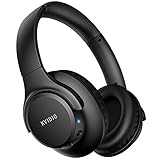
JLab has always been strong at the accessible end of the market, and the Studio Pro ANC represents one of their more complete over-ear efforts. These are wireless, foldable, and include a basic but functional ANC mode that takes the edge off open-plan offices and cafés without pretending to be a luxury noise-canceller. The emphasis here is on ease of use and everyday comfort.
The sound signature is warm and approachable — JLab calls it ‘C3 Sound’ and what that means in practice is a tuning aimed at casual listeners who want their music to sound big and engaging rather than clinical. There are three preset EQ options accessible directly from the ear cup without needing an app, which is a genuinely useful feature for anyone who dislikes fiddling with their phone just to change a setting.
Battery life is respectable, and the headphones fold down into a compact shape for a bag. The limitation is that the soundstage feels a little closed-in compared to the Sony option — there’s less sense of music happening around you and more of it being pressed directly into your ears. It’s not unpleasant, just less spacious. The plastic construction also feels a touch cheaper than the price might suggest.
Buy this if: you want a fuss-free daily headphone with no-nonsense controls and a warm, easy-going sound.
Best budget pick: Soundcore Life Q20+

The Life Q20+ is Anker Soundcore’s entry-level ANC over-ear, and it’s remarkable for how much it delivers at what is consistently one of the more affordable price points in this roundup. This is the pick for anyone who genuinely can’t justify spending more but still wants active noise cancellation rather than passive isolation alone. At its typical street price, the Q20+ undercuts most competitors by a meaningful margin.
ANC performance is basic but functional — it softens background hum on planes and trains noticeably, which is the main ask at this tier. Sound quality is bass-forward and lively, working well for pop and hip-hop. The headphones are comfortable enough for a couple of hours, the controls are intuitive, and the wired backup option (it includes a cable) means you won’t be stuck silent when the battery runs out.
The trade-offs are real and worth naming clearly. The ANC introduces a faint hiss at higher settings that some people find distracting. Build quality is purely plastic — light, but not confidence-inspiring if you’re hard on your gear. And the soundstage is narrow. These are not headphones for someone who values nuance in their music; they’re headphones for someone who wants noise reduced and sound delivered at the lowest possible cost. On those terms, they’re excellent.
Buy this if: your budget is tight and you want ANC at the lowest entry point without sacrificing the basics.
Best for commuters: Jabra Evolve2 55

The Jabra Evolve2 55 is a different kind of headphone in this roundup — it’s aimed squarely at people who spend chunks of their day on calls, in meetings, or hot-desking across noisy environments. While most headphones in this price bracket are built around music listening, the Evolve2 55 prioritises voice clarity and call quality first, with music as a secondary consideration. If your headphones spend more time on video calls than on playlists, this framing matters.
The microphone performance is the headline: Jabra’s call-grade mic array captures voices cleanly and suppresses background noise effectively, which is something the competition in this bracket simply doesn’t match. The noise cancellation is well-tuned for open offices. The build is noticeably more business-like — understated colours, durable plastics, no flashy detailing — and the ear cushions are designed for all-day wearing sessions.
The limitation is straightforward: if music is your priority, this isn’t the pick. The sound tuning favours voice reproduction over musical excitement, and the bass response is modest compared to the Soundcore or Sony options. It’s also typically priced at the higher end of this bracket. But for anyone whose working day involves headphones as a communication tool as much as an entertainment one, the Evolve2 55 earns its place clearly.
Buy this if: you’re working from home or hot-desking and need a headphone that handles calls as seriously as it handles music.
Best premium pick: Sony WH-1000XM4 (refurb / sale tier)

When the WH-1000XM4 dips into the under-$100 bracket — which it does periodically through Amazon deals, open-box listings, and certified refurbs — it becomes arguably the single best audio deal available in this category. This is Sony’s flagship consumer ANC headphone from a recent generation: the noise cancellation is class-leading, the sound is beautifully balanced, and the wear comfort over long sessions is exceptional. If you can find one at this price, it’s a significant step up from everything else here.
The XM4 features Sony’s LDAC codec for higher-quality wireless audio, multipoint Bluetooth for connecting to two devices simultaneously, and Speak-to-Chat — a feature that automatically pauses music when it detects you speaking. These are features that typically live in the $200-300 bracket. The ear cushions are the most luxurious in this roundup, and the folding design travels well.
The caveat is real: availability at this price is not guaranteed, and buying refurbished or open-box means variable condition. Always check the seller rating and return policy before committing. If you’re set on new-in-box, the WH-CH720N is the more reliable choice. But if a deal surfaces and you’re comfortable with certified refurb, the XM4 is in a different league to everything else here.
Buy this if: you want flagship-grade noise cancellation and sound and you’ve spotted one of these at an exceptional price.
How to choose headphones under $100
Decide whether ANC is a must-have. Active noise cancellation is genuinely useful on planes, trains, and in offices, but it adds cost. Every pound spent on ANC circuitry is a pound not spent on drivers and acoustics. If you mostly listen in quiet environments, a headphone without ANC at the same price will often sound better. If you commute or work in open-plan spaces, ANC is worth the trade-off.
Think about how long you’ll wear them. Comfort is wildly subjective, but there are patterns. Over-ear designs (where the cushion surrounds the ear) tend to be more comfortable over long sessions than on-ear designs (where the cushion presses on the ear). Headband padding matters more than most reviewers admit. If you wear headphones for more than two hours at a stretch, weight and cushion material are more important than almost any other spec.
Wired versus wireless: consider your actual use case. Wireless is convenient, but it adds latency (relevant for gaming or video editing), requires charging, and adds cost. If you’re primarily listening at a desk or don’t mind a cable, a wired option at this price will typically give you better pure audio quality for the money. Wireless makes sense for commuting, exercise, and anywhere you’re moving around.
Sound signature: know what you like. Most budget headphones are ‘consumer-tuned’, meaning boosted bass and slightly recessed mids. This sounds exciting with pop and hip-hop but can make classical, acoustic, and jazz feel unnatural. If you listen mainly to bass-heavy genres, lean into it. If you want a more balanced presentation, look for headphones described as ‘flat’ or ‘reference-tuned’, or check whether the EQ app lets you adjust significantly.
Build quality and warranty matter more than specs. At this price tier, a headphone that lasts three years is worth more than one with impressive spec-sheet numbers that fails after eight months. Look for metal headband reinforcement, replaceable ear cushions where possible, and a brand with an accessible warranty process. Reviews mentioning durability issues after six months are a red flag worth heeding.
Frequently asked questions
Can you really get good headphones for under $100?
Yes, genuinely. The sub-$100 bracket has improved dramatically in recent years. You won’t get the very best noise cancellation or the most refined audiophile tuning, but you can absolutely get comfortable, good-sounding wireless headphones with useful features. The key is knowing what to prioritise — this guide is designed to help with exactly that.
Is active noise cancellation worth it at this price?
It depends on where you listen. Budget ANC does a solid job on steady low-frequency noise — engines, air conditioning, train rumble. It’s less effective against irregular mid-range noise like conversations. If your main listening environment is quiet, skip ANC and put that money towards sound quality. If you commute regularly, it’s worth every penny.
What’s the difference between over-ear and on-ear headphones?
Over-ear headphones have cushions large enough to surround your ears entirely, which generally means better passive isolation and comfort over long sessions. On-ear headphones press against the ear rather than around it — they’re typically lighter and more portable, but can feel uncomfortable after an hour or two. For most people buying in this bracket, over-ear is the safer default choice.
How important is Bluetooth codec support?
For most listeners, not very. AAC and aptX provide noticeably better audio quality than standard SBC, and LDAC better still — but the difference is most apparent with high-quality source files and trained ears. If you stream from Spotify or Apple Music at standard quality, the codec matters far less than the quality of the drivers and acoustic tuning. Don’t pay a significant premium for codec support alone.
Are refurbished headphones worth buying?
Certified refurbished units from reputable sellers can be excellent value — you can sometimes get a headphone that’s a full generation above what your budget would normally allow. The risks are cosmetic wear, slightly reduced battery capacity, and variable condition. Always buy from sellers with strong return policies and check whether the manufacturer’s warranty still applies. Amazon’s ‘Renewed’ programme comes with its own guarantee, which helps.
The verdict
For most people, the Sony WH-CH720N is the standout choice: it balances noise cancellation, comfort, and sound quality better than anything else at a consistent price in this bracket. If you want the most features per pound spent and battery longevity is your main concern, the Soundcore Q45 is the best-value pick and earns that label comfortably.
For more, browse all our headphone reviews and roundups.
AudioTechExpert is reader-supported. This article contains affiliate links, and we may earn a commission on qualifying purchases at no extra cost to you.