Finding a decent microphone without spending a fortune used to mean settling for muddy audio and flimsy builds. That is no longer the case. The sub-100 bracket has quietly become one of the most competitive spaces in audio gear, and the options available right now would have seemed remarkable just a few years ago.
This article cuts through the noise — literally. We have taken a closed list of real, currently available microphones and ranked them by use case, so whether you are setting up a home studio, going live on Twitch, recording TikToks, or running karaoke at a wedding, there is a specific pick here for you. No filler, no products we have shoehorned in to pad the list.
Every recommendation below is available on Amazon, covers a distinct need, and comes with an honest word about where it falls short. If you are ready to upgrade your audio without emptying your wallet, read on.
Best overall: FIFINE K688 Podcast Microphone Kit

The FIFINE K688 is a dual-connection dynamic microphone that ships as a complete kit — boom arm included. That matters because buying a mic and then hunting for a stand separately is a hidden cost many budget buyers forget. The K688 handles both USB and XLR connections, which means it works straight into your laptop today and scales into a proper mixer setup later without needing a new microphone.
Its dynamic capsule design is genuinely well-suited to home environments. Unlike condenser mics, a dynamic element is naturally less sensitive to room reflections, background hum, and the general chaos of a non-treated space. Add in the dedicated mute button and headphone jack for zero-latency monitoring, and you have a workstation-ready kit that punches comfortably above its price point.
The limitation worth naming is that the boom arm, while convenient, is entry-level. Heavy hands or a busy desk may find it needs re-tightening over time. That said, as an all-in-one starting point for podcasting, streaming, voice-over work, or gaming comms, the K688 kit is the most complete package in this roundup.
Buy this if: you want a single purchase that covers mic, arm, and dual connectivity without compromise.
Best for streaming and gaming: TONOR TC310+ Gaming Microphone Set

The TONOR TC310+ is built specifically for the streaming and gaming audience, and it wears that identity clearly. It arrives as a set with a boom arm, making desk setup straightforward, and it connects via USB for true plug-and-play simplicity — no audio interface required, no drivers to wrestle with.
The condenser capsule picks up vocal detail well for commentary and Discord calls, and the controllable RGB lighting means the TC310+ doubles as part of your visual setup on camera. The one-tap mute button and physical volume control mean you are never fumbling through software mid-session. For anyone building a streaming corner on a budget, that kind of tactile control is genuinely useful.
The trade-off is that a condenser capsule will also pick up more room noise than a dynamic mic would, so if your space is noisy or untreated, you may notice more background sound in recordings. Positioning close to your mouth will help considerably.
Buy this if: you stream or game and want a mic-plus-arm kit with RGB flair and hands-on controls.
Best USB studio mic: Logitech Blue Yeti

The Blue Yeti needs little introduction in the USB microphone world. This Blackout edition is a large-diaphragm condenser microphone that connects directly via USB to PC or Mac, requiring no additional hardware. It supports four selectable pickup patterns, which is a genuinely rare feature at this price and makes it adaptable across solo recording, interviews, and even small group capture.
The Blue VO!CE effects processing built into the companion software allows streamers and podcasters to add broadcast-style polish — noise reduction, compression, and voice effects — without a separate plugin chain. For creators who want a single mic that can handle podcasting, streaming, studio recording, and gaming commentary, the Yeti covers the full spread.
Its size and weight are the honest limitation here. The Yeti is a substantial piece of hardware that commands real desk space, and its sensitivity to room reflections means it rewards a quiet, reasonably treated environment. In a lively room, you will want to get close to it and keep gain in check.
Buy this if: you want the most versatile USB condenser available and have a decent recording space to put it in.
Best wireless system for events: Wireless Microphone System (2-Mic UHF)
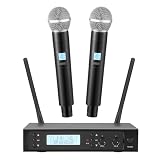
This two-microphone UHF wireless system is aimed squarely at events: karaoke nights, church services, weddings, parties, and PA setups. Each microphone offers 100 selectable channels, which gives you real flexibility to avoid interference in crowded RF environments. The advertised range of 328 feet makes it practical for larger halls and outdoor spaces where a cable would be a liability.
Having two cordless handheld mics in a single system is a significant practical advantage for duets, call-and-response speaking, or simply having a backup on hand. The stable signal transmission claimed in the product title is the core selling point, and for event use where dropouts would be embarrassing, that reliability matters more than almost anything else.
The limitation is that this is a system optimised for live vocal performance and speech rather than studio-quality recording. Expect it to shine through a PA speaker at an event and to be less at home as a podcasting or streaming microphone.
Buy this if: you need two wireless handheld mics for karaoke, weddings, church, or live events with wide-range coverage.
Best wireless lavalier for mobile creators: Mini Mic Pro

The Mini Mic Pro is a wireless lavalier microphone designed for iPhone and Android users who shoot content on their phones. It clips onto clothing like a traditional lapel mic but connects wirelessly, freeing you from the tangle of cables mid-interview or mid-vlog. The product is positioned as the number-one microphone for mobile creators, with noise-cancelling technology to keep the focus on your voice rather than ambient clutter.
For TikTok creators, YouTubers, and anyone who conducts interviews on the go, this kind of compact, phone-native solution removes a major friction point. You do not need a camera rig, an audio interface, or any technical knowledge — it is genuinely plug-and-play in the most literal sense.
The trade-off is range and environment. A compact wireless lavalier is ideal for close-range, run-and-gun scenarios, but it is not the tool for a full band recording or a large-stage performance. Keep your expectations matched to the use case — mobile content creation — and it delivers exactly what it promises.
Buy this if: you create short-form or interview content on your iPhone or Android and want clean, wireless audio without cables.
Best budget wireless for casual use: ALPOWL Wireless Microphone System
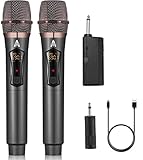
The ALPOWL wireless microphone system is built from metal rather than plastic, which immediately sets it apart from many rivals at the lower end of the price range. It features a rechargeable receiver — no hunting for disposable batteries mid-show — and a stated 50-hour duration that means you are unlikely to run flat during even a long event day. The 200-foot range covers most indoor venues comfortably.
This system suits karaoke singers, DJs, wedding MCs, speakers, and church presenters who want the freedom of wireless without the complexity of multi-channel UHF systems. The metal dynamic microphone capsule is more robust for on-stage handling than a budget plastic equivalent, which matters if the mic is being passed around a crowd.
The honest limitation is that ‘most affordable pick here’ comes with a narrower feature set — there is no multi-channel flexibility, and the system is straightforward by design. For casual, single-performer use that is a feature, not a bug. Over-engineering a karaoke night is rarely worth it.
Buy this if: you want a durable, rechargeable, no-fuss wireless mic for casual singing, speeches, or DJ hosting on a tight budget.
How to choose a microphone under 100
Connection type matters first. USB microphones plug directly into a computer and need nothing else — ideal for podcasters, streamers, and home recorders. XLR microphones offer better quality ceiling and professional flexibility but require an audio interface or mixer. Some mics, like the FIFINE K688, offer both, which is the most future-proof option at this price.
Dynamic vs condenser capsule. Condenser microphones are more sensitive and capture more detail, making them great in quiet, treated rooms. Dynamic microphones reject more background noise and handle untreated spaces better. If your recording environment is anything less than a dedicated studio, a dynamic capsule is usually the safer choice for clean results.
Wired vs wireless. Wireless systems give you freedom of movement, which is essential for live performance, events, and mobile video content. However, they introduce potential RF interference and battery considerations that wired mics avoid entirely. For desk recording and streaming, wired is simpler. For stages and events, wireless is worth the extra consideration.
Intended use case. A mic that excels on a Twitch stream may be a poor choice at a wedding. Consider: are you recording speech or singing? Stationary at a desk or moving around a room? Connecting to a phone, a computer, or a PA system? Matching the microphone type to the actual scenario avoids the most common buyer regret.
Kits vs standalone mics. A microphone that ships with a boom arm, shock mount, or pop filter is better value than a comparable bare mic at the same price, even if the accessories are modest. Factor in what you already own before deciding whether a kit or a solo mic makes more financial sense for your setup.
Frequently asked questions
Can I use a USB microphone for professional podcasting?
Absolutely. USB microphones like the Blue Yeti and FIFINE K688 are used by professional podcasters every day. The convenience of direct computer connection, zero latency monitoring, and improving capsule quality means USB is a perfectly legitimate choice for polished, published podcast audio.
Do I need an audio interface if I buy an XLR microphone?
Yes. An XLR microphone requires either an audio interface or a mixing desk to connect to a computer. However, dual-mode microphones like the FIFINE K688 offer an XLR output alongside USB, so you can start USB-only and add an interface later without replacing the mic itself.
Are wireless microphones reliable enough for live events?
Modern UHF wireless systems — like the two-mic system in this roundup with 100 selectable channels — offer strong, stable signal transmission in most event environments. Choosing a system with multiple channel options helps you avoid interference from other wireless devices in busy venues.
Is a lavalier microphone good for YouTube videos?
Yes, especially for interview-style or talking-head content. A wireless lavalier like the Mini Mic Pro keeps the microphone close to your mouth without appearing on camera, produces clear and noise-reduced audio, and keeps your hands and frame free. It is one of the most practical upgrades a mobile video creator can make.
What is the difference between a dynamic and condenser microphone?
A condenser microphone is more sensitive to sound and captures finer detail, making it suited to quiet, treated environments. A dynamic microphone is more robust, less sensitive to room noise, and performs better in untreated or noisy spaces. For most home users without acoustic treatment, a dynamic mic is the more forgiving choice.
The verdict
The FIFINE K688 Podcast Microphone Kit is our top overall pick — it offers dual USB/XLR connectivity, a complete boom arm kit, and a versatile dynamic capsule that suits streaming, podcasting, and voice recording equally well. For the best value across ratings and review volume, the TONOR TC310+ Gaming Microphone Set delivers a strong condenser capsule with boom arm and RGB controls in a package purpose-built for the streaming generation.
For more, browse all our reviews and roundups.
AudioTechExpert is reader-supported. This article contains affiliate links, and we may earn a commission on qualifying purchases at no extra cost to you.