Miking a guitar amp well is one of those skills that separates a good recording from a great one, yet the microphone choice is often an afterthought. Too many players just grab whatever is lying around and wonder why the tone sounds thin or boxy compared to what they hear in the room. The truth is that the right mic, placed well in front of the right speaker, captures the character your amp was built to produce.
This guide cuts through the noise. We’ve ranked six microphones from the supplied pool that are specifically suited to guitar amp duty — whether you’re tracking in a home studio, gigging on stage, or both. Each pick has a distinct angle, from the workhorse standard to a genuinely clever dual-capsule design. All of them connect easily to standard audio interfaces or PA systems via XLR.
Whether you’re a bedroom guitarist building your first recording setup or a touring musician who needs something road-tough and reliable, there’s a pick here for you. Read through the angles, check the comparison table, and you’ll know exactly which mic suits your situation.
Best overall: Shure SM57
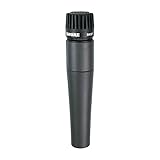

The Shure SM57 is the cardioid dynamic instrument microphone that has appeared on more guitar amp recordings than virtually any other mic in history. It’s a wired, XLR-connected workhorse built to handle the high sound-pressure levels a cranked guitar amp throws out without flinching. The SM57 has a slight presence peak that helps electric guitar cut through a mix — it doesn’t just capture the amp, it flatters it in a way that translates well to recordings and live front-of-house alike.
What makes it the best overall pick here is versatility. It’s equally at home in a professional studio and on a pub stage. You can angle it off-axis for a warmer sound or point it straight at the dust cap for brightness — this mic rewards experimentation. It’s also physically rugged; the housing can take the kind of knocks that happen on tour without affecting performance.
The honest limitation is that it offers no frills whatsoever. There’s no built-in pad, no high-pass filter switch, no bag or clip included in the base version. It’s a pure tool, and beginners occasionally find the lack of guidance on placement frustrating at first. That said, hundreds of tutorials exist precisely because this mic is so universal.
Buy this if: You want the tried-and-tested standard that pros have used for decades and that works straight out of the box for any guitar amp situation.
Best premium: Shure Nexadyne 5

The Shure Nexadyne 5 (NXN5) is Shure’s more advanced take on the dynamic instrument mic concept, featuring their proprietary Revonic Technology and dual-engine transducers. That dual-transducer design is specifically engineered to improve signal clarity and reduce handling noise — two things that matter a great deal when you’re close-miking a loud amp on a busy stage. This is a supercardioid design, meaning it has a tighter pickup pattern than a standard cardioid, which helps reject bleed from nearby sources such as drums or other amps.
The Nexadyne 5 is positioned clearly as a professional amplification tool. Its enhanced noise-rejection characteristics make it particularly appealing for live environments where spill from other instruments is a constant problem. The dual-engine transducer system gives it a different sonic character compared to conventional dynamic mics — generally described as having greater transparency and a more open top end while still being a dynamic mic.
The limitation is that this is a step up in price, and the sonic differences over the SM57 are subtle enough that casual users or home recorders may not notice them in practice. It’s a mic that rewards the player who is already getting good results from a conventional dynamic and wants to push further.
Buy this if: You’re a working professional who wants the latest dynamic technology with tighter rejection and cleaner signal for demanding live or studio environments.
Best value: Sennheiser e 609 Silver

The Sennheiser e 609 Silver is a supercardioid dynamic microphone designed specifically for guitar amplifiers, and its flat, side-address form factor is genuinely clever for this application. Instead of a clip and a boom arm, you can simply drape the cable over the top of the amp and let the mic hang flat against the grille cloth — no stand required. That alone makes it a favourite for live guitarists who want a consistent, repeatable mic position every night without fuss.
Sonically, the e 609 has a warm, full-bodied character that suits crunch and heavy rhythm tones particularly well. Its supercardioid pattern keeps it focused on the speaker in front of it and rejects room reflections from the sides, which is useful both on stage and in a treated room where you want a dry, direct capture. It’s built to Sennheiser’s professional instrument standard and is genuinely road-ready.
The trade-off is that the side-address, hang-over-the-grille method means less flexibility in placement experimentation compared to a mic on a standard clip-and-stand. You’re largely fixed to whatever the cable tension gives you. Engineers who love to tweak placement obsessively may find this limiting.
Buy this if: You want a dedicated guitar amp mic that’s fast to set up live and delivers warm, full tone without needing a mic stand.
Best bundle value: Sennheiser e 609 Silver with Cable

This is the same Sennheiser e 609 Silver in a bundle that includes a Pig Hog PHM10 cable and a polishing cloth — everything you need to get started miking your amp on day one. If you don’t already have a quality XLR cable, this bundle works out as a more practical purchase than buying the mic alone and sourcing a cable separately. The Pig Hog cable included is a recognised name in touring-grade cables, so you’re not getting a throwaway accessory here.
All of the sonic and practical strengths of the e 609 Silver apply here — the flat body that hangs flush against the grille, the supercardioid pattern, the warm and focused character on electric guitar. The bundle angle is simply about convenience and overall spend rather than any difference in the microphone itself.
The limitation worth noting is that if you already own quality XLR cables, this bundle premium adds cost for something you don’t need. In that case, the standalone e 609 Silver listing is the smarter buy. But for someone starting from scratch, this is a sensible package.
Buy this if: You’re buying your first proper guitar amp mic and want a complete, ready-to-use package without hunting for a cable separately.
Best for dual-tonal capture: MXL DX2

The MXL DX2 is a genuinely unusual product in this list — it uses two dynamic capsules in a single microphone body, specifically designed for guitar amplifiers. The dual-capsule configuration means you can capture two distinct tonal perspectives from the same speaker simultaneously. That kind of flexibility is normally only possible by setting up two separate microphones and blending them in your DAW, so the DX2 is a real time-saver for anyone who records frequently and likes to blend their guitar tone after tracking.
The practical benefit is significant for home studio users. You get the ability to mix between a brighter on-axis sound and a warmer off-axis character without ever moving the mic. For guitarists who are still dialling in their recording workflow, this removes a variable and lets you make tonal decisions at the mixing stage rather than committing at source. It’s also a single XLR footprint, keeping your cable runs tidy.
The honest caveat is that the MXL DX2 is a more specialised tool. It’s not the first mic you’d grab for a live gig, and the blending functionality requires an interface or mixer that lets you handle the signal appropriately. It’s a studio-focused piece of gear that rewards users who know what they want from it.
Buy this if: You record guitar regularly and want the flexibility of a blended dual-capsule capture in one mic without the hassle of positioning two separate microphones.
Best budget: Superlux PRA628MKII

The Superlux PRA628MKII is a professional dynamic instrument microphone with a super-cardioid polar pattern, designed explicitly for guitar and bass amps as well as live sound. It comes with a clamp and a carry bag included, which puts it ahead of some pricier rivals in terms of out-of-the-box readiness. Superlux is a Taiwanese manufacturer with a long history of producing affordable microphones that punch meaningfully above their price point, and the PRA628MKII is one of their more capable instrument mics.
The super-cardioid pattern gives it solid rejection of off-axis noise — useful on a loud stage or in a home studio where room reflections might otherwise colour the recording. The road-ready description in its title suggests a build quality that can handle regular use without babying, which matters if you’re taking it to rehearsals and gigs rather than leaving it on a studio shelf. The included clamp means you don’t need to budget separately for an adaptor.
The limitation is that Superlux, despite its quality-to-price ratio, doesn’t carry the brand recognition of Shure or Sennheiser. In a live context where a sound engineer is working fast, they’ll know exactly how to get results from an SM57; the PRA628MKII requires a little more familiarity. That said, for home studio use, the price advantage is compelling.
Buy this if: You want a capable, super-cardioid dynamic mic for guitar amp recording on a tight budget, with clip and bag included from day one.
How to choose your microphone for guitar amps
Dynamic vs condenser for amps: Dynamic microphones handle high sound-pressure levels without distorting, which is exactly what a loud guitar amp produces. Condenser mics are more sensitive and can sound detailed and open, but they can struggle with very loud sources unless they have a pad switch. For most guitar amp work, a dynamic mic is the safer and more practical starting point.
Polar pattern matters on stage: A cardioid mic picks up mainly from the front and rejects the rear. A supercardioid has an even tighter forward focus and rejects more from the sides — useful on busy stages with multiple amps or a loud drummer nearby. For home studio use where bleed isn’t a concern, the difference matters less, but for live work it’s worth considering.
Placement is half the job: The same microphone placed dead centre on the speaker cone sounds brighter and more aggressive than when placed at the edge of the cone, which is warmer and rounder. Moving the mic off-axis — angling it rather than pointing it straight at the speaker — softens the top end further. Experiment before committing to a position, especially when recording.
Single mic vs blended approach: Most guitarists start with one mic and find it completely adequate. The dual-capsule MXL DX2 in this list is an exception — it gives you two perspectives in one housing. Otherwise, if you want a blended sound, you’d use two separate microphones and mix them in your DAW, which requires more inputs and more cable management.
Build quality for live use: If the mic is going to travel, look for something described as road-ready or similar. Included clips and bags are a practical bonus. A mic that lives in a studio can be treated more carefully, but a gigging mic needs to survive transit, temperature changes, and the occasional knock.
Frequently asked questions
Do I need a special microphone for a guitar amp, or will any mic work?
Any microphone will pick up a guitar amp to some degree, but dynamic microphones are specifically suited to the task because they handle the loud, punchy signal levels without distorting or requiring phantom power from your interface. Mics like the Shure SM57 and Sennheiser e 609 Silver are built with guitar amps in mind and will simply sound better and require less fiddling than a general-purpose or vocal mic.
Do I need phantom power for these microphones?
All of the dynamic microphones in this list — the SM57, the Nexadyne 5, the e 609 Silver, the Superlux PRA628MKII, and the MXL DX2 — do not require phantom power. They’re passive dynamic mics that work with any standard XLR input. You only need phantom power (usually labelled ’48V’) for condenser microphones.
Where should I position the mic relative to the speaker?
Start with the mic pointed at the edge of the dust cap, about one to two centimetres from the grille cloth. This gives you a balanced starting point — not too bright, not too muddy. Move it towards the centre of the cone for more attack and presence, or towards the edge for a warmer, more rounded character. Small changes in angle make a noticeable difference, so take your time.
Can I use these mics for anything other than guitar amps?
Yes. Most of these are general-purpose instrument microphones. The Shure SM57, for example, is equally standard on snare drums. The Sennheiser e 609 works well on bass amps and other loud instruments. The Superlux PRA628MKII is described for bass amps and live sound too. The MXL DX2 is the most specialised, being designed primarily for guitar amp dual-capture.
Is a supercardioid mic always better for live use than a standard cardioid?
Not always — it depends on your setup. Supercardioid mics reject more from the sides but have a small lobe of sensitivity at the rear. On a chaotic stage that means positioning matters more. For most guitar amp applications where the mic is sitting right against the grille, either pattern works well, and the difference in bleed rejection is a secondary consideration to how the mic actually sounds on your particular amp.
The verdict
The Shure SM57 is the best overall pick — it’s the industry standard for a reason, and it delivers reliable, professional results on any guitar amp in any context. For the best value in terms of a purpose-built guitar amp design with straightforward live use, the Sennheiser e 609 Silver is the standout choice, with its hang-over-the-grille convenience and warm, focused tone making it a genuine favourite for gigging guitarists.
For more, browse all our reviews and roundups.
AudioTechExpert is reader-supported. This article contains affiliate links, and we may earn a commission on qualifying purchases at no extra cost to you.