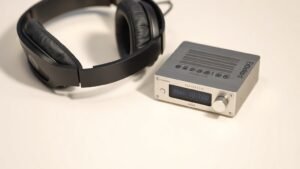
A headphone amp under two hundred pounds can make a genuine, audible difference to your listening experience, but only if you match the amp to your headphones and your actual use case rather than buying on brand name alone.
Years of obsessively buying, using and comparing audio gear have taught me one consistent truth: the amplifier stage is where many people either get great value or waste money entirely. At the sub-two-hundred-pound price point, the gap between a good purchase and a poor one is not really about budget. It is about understanding a handful of measurable factors before you hand over any money.
This guide covers the core technical factors that determine whether an amplifier will actually improve your listening experience: output impedance, gain structure, power output in milliwatts, whether you need a standalone amp or a DAC-amp combination, and how to read specifications honestly. I will reference real products throughout to give you a concrete sense of what these figures look like in practice.
Why Your Headphones Determine the Amp You Need
The single most important variable in choosing a headphone amp is the impedance and sensitivity rating of the headphones you already own or plan to use. Impedance is measured in ohms, and sensitivity is measured in decibels per milliwatt. A pair of Sennheiser HD 650 headphones, for example, sit at 300 ohms and 103 dB per milliwatt. That combination means they need a meaningful voltage swing to reach proper listening volumes, and a cheap portable amp or a laptop headphone socket will leave them sounding flat, thin, and dynamically compressed.
By contrast, something like the Beyerdynamic DT 770 Pro in its 32-ohm version is far more efficient and will reach loud volumes from almost any source, which means spending on a high-gain amplifier would be largely pointless for that particular pairing. Before you read a single amplifier specification, look up your headphone impedance and sensitivity rating and write those numbers down. Every decision that follows depends on them.
The output impedance of the amplifier also matters here. A general rule is that the output impedance of your amp should be no more than one eighth of your headphone impedance to avoid colouration of the frequency response. Many budget amps have output impedances of one or two ohms, which is fine for most headphones. Some cheaper implementations push higher than that, and it creates audible tonal shifts, particularly in the low midrange. The FiiO K7 and the Topping A30 Pro are both examples of amps under or around the two-hundred-pound mark that specify output impedances well below one ohm on their headphone outputs.
Standalone Amp or DAC-Amp Combination
The most common question I get from people setting up a home listening system in this price range is whether to buy a dedicated amplifier or a DAC-amp combination unit. The honest answer is that for most people spending under two hundred pounds, a DAC-amp combination is the more practical and sonically sensible choice, because the digital-to-analogue conversion stage in a modern laptop, phone, or streaming device is often the weakest point in the chain.
Products like the iFi Audio Zen DAC V2 and the FiiO K5 Pro ESS represent genuine value in this category. The FiiO K5 Pro ESS includes a desktop DAC and amplifier in a single unit for well under two hundred pounds, offers balanced and single-ended outputs, and supplies enough power to drive demanding headphones like the Sennheiser HD 6XX or the Hifiman HE400SE planar magnetic headphones. You are not simply paying for convenience when you buy a combination unit at this price point. The DAC implementation in these products is measurably better than what most consumer electronics provide natively.
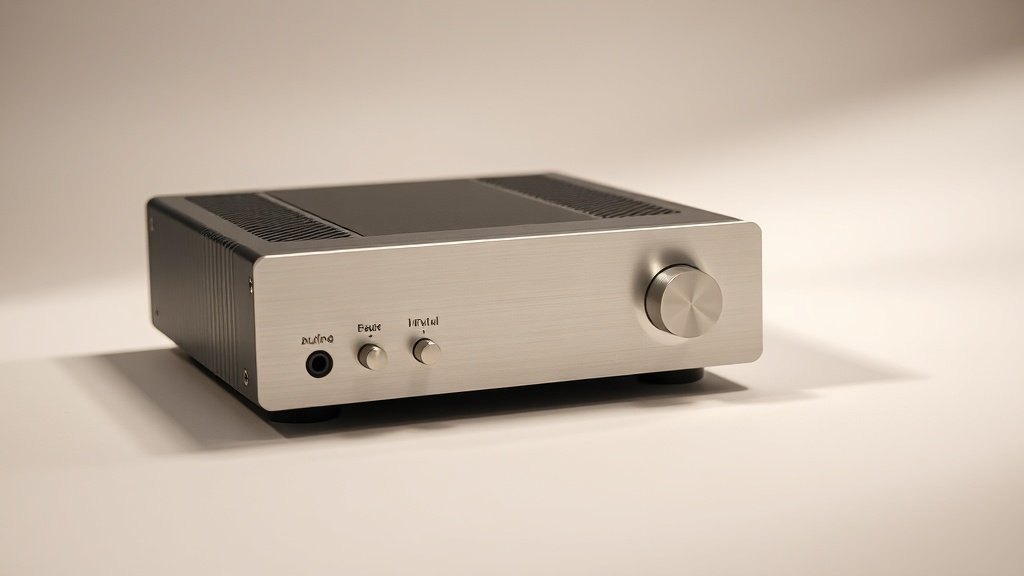
A standalone amplifier makes more sense if you already have a high-quality external DAC or an audio interface with a clean line output, and you simply want more power or better volume control for a specific pair of headphones. In that situation, something like the Schiit Magni Plus or the JDS Labs Atom Amp Plus offers a clean, high-output amplifier stage without the added cost of a second DAC stage you do not need. Both products measure extremely well for their price, with low noise floors and distortion figures that would have cost significantly more a decade ago.
Matching an amplifier to your specific headphones matters far more than choosing the most expensive unit within your budget.
Understanding Power Output and Gain Settings
Manufacturers quote power output in milliwatts at a given impedance, and this is one of the most misread specifications in the category. A figure of 1000 milliwatts at 32 ohms sounds impressive, but if your headphones are 250-ohm dynamic drivers, the relevant figure is the output at 250 ohms, which will be considerably lower due to the relationship between voltage, current, and impedance. Always look for the power specification at the impedance closest to your headphones.
Gain settings matter more than most buyers realise. Many desktop amps in this price range offer switchable gain, typically a low gain setting for sensitive in-ear monitors and a high gain setting for harder-to-drive over-ear headphones. If you use sensitive IEMs on a high-gain amplifier with no volume control precision at low levels, you will likely sit the volume pot at the seven or eight o-clock position, which is a region where channel imbalance in the potentiometer is most audible. The iFi Audio Zen CAN and the Topping A30 Pro both offer gain switching, which makes them genuinely versatile across different headphone types rather than optimised for just one.
What the Measurements Actually Tell You
The measurement community, led by resources like Audio Science Review, has done a significant amount of work making objective measurements of budget audio gear accessible to ordinary buyers. Total harmonic distortion, noise floor, channel separation, and frequency response are all measurable, and products in this price range vary considerably on these metrics. A high signal-to-noise ratio, typically quoted in decibels, tells you how quiet the amplifier background is. For a desktop headphone amp, anything above 110 dB signal to noise ratio is genuinely quiet in practical use. Many products in the sub-two-hundred-pound category now achieve this figure, which represents a real step forward from the budget gear available ten years ago.
That said, measurements are not the complete picture. A low-distortion amplifier will not fix a poor DAC upstream of it. It will not correct a mismatch between output impedance and headphone impedance. And it will not manufacture dynamics that the recording itself does not contain. The measurements tell you the floor of performance. What you actually hear is determined by the whole chain, from the source file quality through the DAC, through the amplifier, and through the headphone drivers themselves.
Frequency response at the amplifier stage should be flat within a fraction of a decibel across the audible range. Most competent implementations at this price point achieve this without difficulty. Where budget designs sometimes fall short is in dynamic headroom, particularly at high volumes, and in the quality of the volume control implementation. A stepped attenuator, as found on some higher-end units, gives more precise channel matching than a continuous potentiometer. At under two hundred pounds you will mostly encounter continuous pots, but the quality of those components varies, and it is worth reading user reports on channel tracking at low volumes before purchasing.
Balanced Output: Worth It at This Price Point?
Balanced headphone outputs, typically on four-pin XLR or 4.4mm pentaconn connectors, have become increasingly common on amplifiers under two hundred pounds. The theoretical benefit of a balanced output is rejection of common-mode noise and, in a fully balanced amplifier topology, doubled voltage swing and improved channel separation. In a well-designed listening environment with quality cables, the audible difference over a good single-ended implementation is often subtle. However, if your headphones already have a balanced cable termination, or if you are buying new cables anyway, choosing an amplifier with a balanced output gives you the option to explore it without additional cost.
The FiiO K7 and the Topping A30 Pro both offer 4.4mm balanced headphone outputs within the two-hundred-pound range. The iFi Audio Zen CAN provides a 4.4mm balanced output as well as a 6.35mm single-ended socket. These are genuine implementations, not marketing additions, and they do provide measurably lower noise in balanced mode. Whether that translates to an audible improvement for you specifically depends on your source quality, your headphones, and how sensitive you are to noise at your listening volumes.
Connectivity and Practical Considerations
Volume control feel, input switching, and physical build quality are worth considering alongside the technical specifications. A heavy, well-damped volume knob with smooth rotation is a small pleasure that you interact with every single session. The Schiit Magni Plus has a notably solid volume pot for its price. Input options also matter: if you need both an optical or coaxial digital input and an analogue line input, a DAC-amp combination like the FiiO K5 Pro ESS or the iFi Audio Zen DAC V2 covers both without requiring external switching.
Think also about whether you need a pre-amplifier output. Some desktop headphone amps include a variable line output that allows you to connect a pair of powered speakers and control the volume for both headphones and speakers from a single knob. The Topping A30 Pro and several iFi Audio units include this feature. If you are setting up a dual-use desktop system with headphones and small monitor speakers, this can replace an additional piece of equipment and simplify the whole setup considerably.
Buying an amplifier before knowing your headphone impedance and sensitivity is the most common and most avoidable error. The amp that transforms a 300-ohm dynamic headphone will be entirely the wrong choice for a 16-ohm planar IEM, and no amount of brand reputation corrects that mismatch.
Assuming a higher price always means a better result for your specific use case is a mistake that wastes money in this category. A clean, high-output amplifier at one hundred pounds can outperform a feature-laden unit at one hundred and eighty pounds if the simpler product is better matched to your headphone load and has a lower output impedance for your specific driver.
Ignoring the quality of the source signal going into the amplifier undermines any benefit the amp provides. If you are feeding an amplifier from a compressed streaming service at low bitrate or from a device with a noisy USB power supply, the amplifier cannot recover that lost information. Address the source quality first, then consider the amplifier stage.
Conclusion
Choosing a headphone amp under two hundred pounds is a question of matching, not simply of spending. Identify your headphone impedance and sensitivity, decide whether a DAC stage is also needed, check the output impedance and power figures at your specific load, and consider whether features like balanced output or pre-amplifier outs are relevant to how you actually listen. The products that represent genuine value in this range, from the FiiO K5 Pro ESS to the Schiit Magni Plus to the iFi Audio Zen CAN, all reward informed buyers who know what they are looking for before they purchase.
FREE DOWNLOAD
Stop Guessing. Start Buying Smart.
The specs that actually matter, demystified.
Headphones, microphones, the spec sheet jargon you can ignore — all in one quick-reference PDF. Free, instant, no fluff.
Send Me the CheatsheetYou'll also receive occasional new guide notifications. Unsubscribe anytime. No spam, ever.