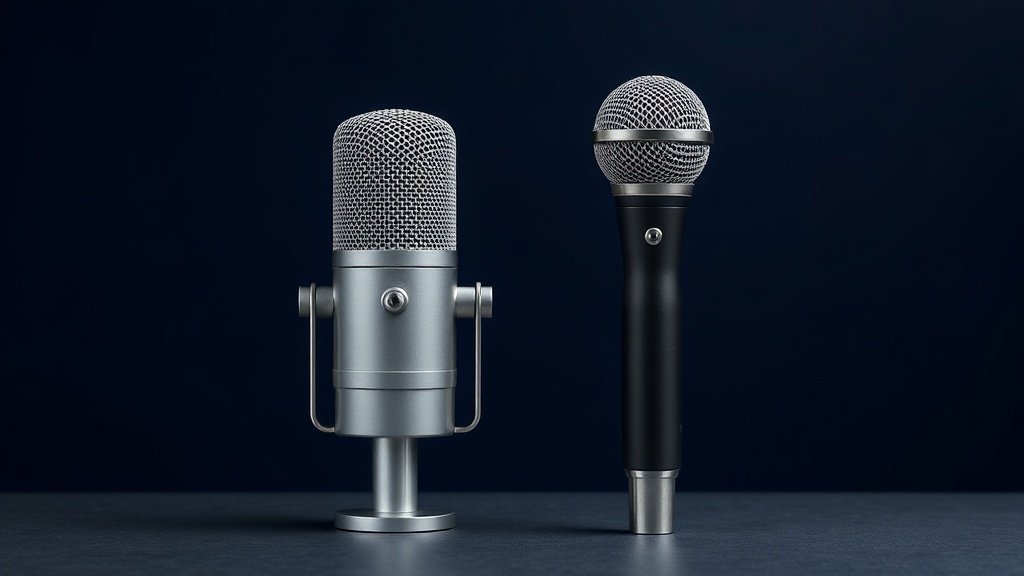
The microphone you use on stage will likely ruin your studio recording, and the microphone you use in the studio will almost certainly cause problems when you point it at a live audience. Understanding why is the foundation of every good vocal sound.
After years of obsessively buying, using and comparing audio gear, one pattern repeats itself more than any other: a vocalist arrives with a microphone that is completely wrong for the context. Not because they did not care, but because the categories look similar on paper. A microphone is a microphone, right? In practice, the differences between a stage vocal microphone and a studio condenser are so significant that using one in place of the other does not just produce a suboptimal result. It can make a good performance sound genuinely bad.
This guide covers the core technical differences between stage and studio microphones for singing, explains the acoustic and practical reasons those differences exist, and gives you a clear framework for making the right choice based on your actual situation. We will look at transducer types, polar patterns, proximity effect, feedback resistance, self-noise, and what all of that means when your voice is the source.
Transducer Type: Dynamic vs Condenser
The most fundamental divide between stage and studio vocal microphones is the transducer technology inside them. Dynamic microphones use a moving coil attached to a diaphragm. When sound waves hit the diaphragm, the coil moves within a magnetic field and generates a voltage. This mechanism is physically robust, handles extremely high sound pressure levels without distortion, and requires no power supply. For a vocalist moving around a loud stage, holding a microphone close to their mouth and competing with a drum kit and guitar amplifiers, these characteristics are not luxuries. They are requirements. The Shure SM58 has been the de facto standard for live vocals for decades precisely because it combines all of these properties in a durable, affordable, predictable package.
Condenser microphones use a different mechanism entirely. A thin conductive diaphragm is suspended close to a backplate, and sound pressure variations cause the capacitance between them to change, producing a signal. Condensers require phantom power, typically 48V, supplied by a mixing desk or preamp. More importantly for vocalists, they are far more sensitive than dynamics. They capture a wider frequency range with greater detail, including the fine harmonic texture of a singing voice and the nuanced air and breath control that define a great studio performance. A large diaphragm condenser such as the Neumann U87 or the Audio-Technica AT4050 will reveal things about a vocal that a dynamic microphone simply does not capture. In a controlled acoustic environment, that sensitivity is a profound advantage. On a loud stage, it is a liability.
Polar Patterns and Why They Dominate the Decision
Polar patterns describe the directions from which a microphone accepts sound. For live singing, a cardioid or supercardioid pattern is essential. These patterns focus pickup to the front of the capsule and reject sound arriving from the rear and sides. The practical consequence is resistance to feedback: when monitor wedges, front-of-house speakers, and amplified instruments surround a vocalist, a tightly focused polar pattern is what separates a clean signal from a howling feedback loop. The Sennheiser e945 uses a supercardioid pattern specifically because its tighter off-axis rejection performs well in demanding live environments where the standard cardioid might struggle.
In the studio, polar pattern choice becomes a creative and technical tool rather than a survival mechanism. Many large diaphragm condensers offer switchable patterns including cardioid, omnidirectional, and figure-of-eight. An omnidirectional pattern captures room ambience and gives a natural, open sound when the recording space is acoustically treated. A figure-of-eight pattern is the basis of mid-side recording and coincident stereo techniques. The key difference is that in a studio with no live monitors and a properly treated space, you have the luxury of choosing a pattern for sonic reasons rather than practical ones. On stage, that luxury disappears entirely.
The proximity effect is closely linked to polar pattern choice and matters enormously for vocalists. Directional microphones exhibit proximity effect: bass frequencies increase substantially as the microphone is brought closer to the source. Stage vocalists working close to a dynamic microphone get a natural low-mid warmth from this effect that fills out the voice in a live mix. Engineers often rely on it. In the studio, however, a vocalist moving toward and away from a large diaphragm condenser will create noticeable and often unwanted low-frequency variations in the recorded signal. Studio technique therefore involves maintaining a consistent distance from the microphone, typically with the help of a pop shield positioned at a fixed distance from the capsule.
The polar pattern of a microphone does more to determine whether it belongs on stage or in a studio than any other single specification.
Feedback Resistance and Stage-Specific Design
Feedback is the defining acoustic challenge of live vocal performance. It occurs when amplified sound from speakers re-enters the microphone, is amplified again, and creates the familiar howl or squeal that every sound engineer works to prevent. Microphone choice is one of the primary tools for managing it. Dynamic microphones have a lower sensitivity and a tighter polar pattern response, which together reduce the likelihood that sound from monitors and front-of-house systems will cause a feedback loop at usable gain levels.
Several microphone manufacturers build stage dynamics with additional internal engineering to improve feedback rejection. The Shure Beta 58A, for example, uses a supercardioid capsule with a very consistent off-axis response, meaning that sound arriving from the rear and sides is attenuated predictably rather than inconsistently. This consistency is what allows a live engineer to use graphic equalisers and parametric EQ to notch out feedback frequencies reliably. A microphone with poor or unpredictable off-axis behaviour makes that task much harder because the feedback frequency shifts as the performer moves.
Condenser microphones fail in this context not just because of sensitivity but because their frequency response is typically flatter and more extended. That flat response, which is a major asset in the studio, means they have no natural high-frequency rolloff to reduce the contribution of cymbal splash, amplifier hiss, or monitor spill. Attempting to use a studio condenser on stage is not just impractical. It is a different kind of tool being asked to perform a task it was not designed for.
Self-Noise, Sensitivity, and Studio Performance
In the studio, the acoustic challenges are inverted. Feedback is not a concern. Isolation is managed by the room design. The challenge instead becomes capturing every nuance of a vocal performance with the lowest possible noise floor. This is where condenser microphones earn their place. A large diaphragm condenser with a self-noise rating of 8 to 12 dB-A, such as the Rode NT1 or the AKG C414 XLII, will resolve the quietest passages of a sung performance with a clarity that no dynamic microphone can match at equivalent signal levels.
Self-noise matters most in soft passages. A vocalist who drops to a near-whisper in a verse and then rises to full volume in a chorus is asking a microphone to cover an enormous dynamic range. Low self-noise ensures that the quiet sections do not sit in a bed of electronic hiss. High sensitivity means the preamp can operate at a lower gain setting, which typically reduces the noise contribution from the preamp itself. The combination of a low-noise condenser and a transparent preamp such as the Universal Audio Apollo or the Focusrite ISA One gives a vocalist the cleanest possible signal path from performance to recording.
Small diaphragm condensers are less commonly used for lead vocals but have their advocates. They exhibit a more consistent polar pattern across a wider frequency range and can give a tighter, more present sound to certain voice types. A microphone like the Neumann KM184, more often seen on acoustic instruments, occasionally suits a vocalist with a naturally warm, full tone who would be overwhelmed by the flattering low-mid emphasis of a large capsule. The point is that studio microphone selection for singing is genuinely nuanced and worth spending time on with proper A and B comparison sessions in the recording room.
Wireless Systems and Stage Considerations
A significant proportion of live vocalists now use wireless handheld or clip-on microphone systems rather than wired dynamics. The microphone capsule in a wireless handheld transmitter such as the Shure ULXD2 or the Sennheiser EW 500 G4 is still a dynamic or, in some cases, a condenser capsule specifically tuned for stage use. The capsule design principles remain exactly the same: tight polar pattern, controlled proximity effect, high SPL handling. What changes is the signal path. Instead of a cable, the signal is transmitted via radio frequency to a receiver connected to the mixing desk.
Wireless systems introduce their own considerations for vocalists. RF interference, battery management, and latency are all variables that do not exist with wired microphones. For the purposes of capsule selection, however, the acoustic principles are identical. A vocalist choosing a wireless system should pay as much attention to the capsule characteristics as to the transmitter specifications. Many professional wireless systems allow capsule swapping, which is a feature worth using to find the right combination for a particular voice and venue.
Using a studio condenser microphone in a live setting is one of the most common and costly errors a vocalist can make. The high sensitivity and flat frequency response of a condenser will almost certainly cause feedback problems at stage volume levels, and the microphone is at risk of physical damage from handling and high sound pressure levels from nearby amplified sources.
Assuming one microphone will work equally well for every voice is a mistake that wastes both time and money. Polar patterns, frequency responses, and capsule sizes interact differently with different voices, and the only reliable method for finding the right microphone for a particular singer is direct comparison in the actual acoustic environment where it will be used.
Neglecting the acoustic treatment of a recording space when using a sensitive studio condenser will undermine every other investment in the signal chain. A large diaphragm condenser captures the room as faithfully as it captures the voice, and a poorly treated room will produce recordings full of flutter echo and comb filtering that no amount of post-processing will fully correct.
Conclusion
The choice between a stage microphone and a studio microphone for singing is not a matter of preference or budget. It is a matter of acoustic physics. Dynamic microphones with tight polar patterns handle the feedback, handling noise, and high SPL of live performance. Sensitive condenser microphones with low self-noise serve the controlled environment of a studio. Understanding that difference, and choosing accordingly, is the single most reliable step toward a better vocal sound in either context.

FREE DOWNLOAD
Stop Guessing. Start Buying Smart.
The specs that actually matter, demystified.
Headphones, microphones, the spec sheet jargon you can ignore — all in one quick-reference PDF. Free, instant, no fluff.
Send Me the CheatsheetYou'll also receive occasional new guide notifications. Unsubscribe anytime. No spam, ever.