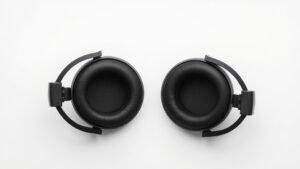
The holes in the back of your headphones determine whether neighbours hear your music and whether you hear theirs in return.
Open-back and closed-back headphones represent fundamentally different approaches to driver housing design. The decision between perforated or sealed ear cups affects sound isolation, tonal balance, and spatial presentation in ways that make each design suitable for distinct applications.
This guide examines the acoustic principles behind each design, compares their practical advantages and limitations, and identifies which scenarios favour open versus closed construction for mixing, monitoring, and recreational listening.
How Open-Back Design Affects Sound
Open-back headphones feature perforated or grilled rear cups that allow air movement behind the driver diaphragm. This design prevents pressure buildup that would otherwise restrict driver excursion and create resonant peaks. The Sennheiser HD 600 exemplifies this approach with its distinctive honeycomb grille, allowing the 40mm dynamic drivers to operate without rear chamber interference.
The open design typically produces a more natural tonal balance because the driver operates in acoustic conditions similar to a loudspeaker in free space. Bass response tends to roll off more gradually without the pressure reinforcement of a sealed chamber, whilst midrange frequencies often sound more open and less coloured by internal reflections.
Soundstage presentation generally benefits from the open architecture. Models like the Audio-Technica ATH-R70x demonstrate how the acoustic transparency creates a sense of space and separation that makes individual instruments easier to locate within a stereo mix. The sound appears to originate from outside the headphones rather than directly inside your head.
Closed-Back Acoustic Properties
Closed-back headphones use sealed ear cups that create an isolated acoustic environment around each driver. This design approach offers significant advantages for bass response and external noise isolation. The Sony MDR-7506 has maintained its studio standard status partly because its closed design provides consistent low-frequency response and effective isolation from control room bleed.
The sealed chamber behind the driver can extend bass response and provide more controlled low-frequency behaviour. However, this same enclosure can create internal reflections and standing waves that colour the midrange if not properly damped. Quality closed designs like the Beyerdynamic DT 770 Pro use acoustic foam and careful internal geometry to minimise these resonances.
Closed headphones excel in applications requiring sound isolation. Recording artists need to prevent headphone bleed from contaminating microphone captures, whilst mixing engineers working in untreated rooms benefit from the external noise rejection that closed designs provide.
Open-back headphones trade isolation for spatial accuracy, whilst closed designs prioritise containment over acoustic transparency.
Practical Applications and Use Cases
Open-back headphones work best in quiet, controlled environments where sound leakage poses no concerns. Home listening rooms, dedicated mixing suites, and mastering environments favour the natural presentation and reduced driver colouration. The AKG K701 series demonstrates why many mastering engineers prefer open designs for their ability to reveal spatial information and tonal subtleties.
Closed designs become essential when isolation matters more than absolute accuracy. Tracking sessions require headphones that prevent click tracks and reference mixes from bleeding into live microphones. The isolation also works in reverse, blocking external studio noise from reaching the performer. Commuting, office work, and shared spaces all demand the containment that only closed-back designs can provide.
Gaming and virtual reality applications often benefit from open designs due to their superior spatial imaging, provided the environment allows for sound leakage. The wider soundstage helps with positional audio accuracy, though this advantage disappears in noisy environments where isolation becomes necessary.
Comfort and Thermal Considerations
Open-back designs typically run cooler during extended listening sessions because air circulation prevents heat buildup around the ears. The perforated cups allow moisture to evaporate rather than accumulating inside the ear chambers. This thermal advantage becomes significant during long mixing sessions or extended gaming periods where comfort affects concentration and performance.
Closed headphones trap heat and moisture, though modern designs like the Audio-Technica ATH-M50x incorporate breathable padding materials to mitigate this issue. The sealed environment also creates slight pressure changes with head movement that some listeners find fatiguing over time. However, the superior external noise rejection often compensates for these comfort compromises in appropriate applications.
Weight distribution and clamping force affect comfort regardless of back design, but closed models often require stronger clamping to maintain their acoustic seal. This necessity can increase fatigue during extended wear, though proper adjustment and break-in periods usually resolve excessive pressure points.
Frequency Response Differences
The acoustic loading differences between open and closed designs create predictable frequency response variations. Open-back headphones typically exhibit more linear bass response that rolls off naturally below the driver resonance frequency. This characteristic often produces tighter, more controlled bass that some listeners initially perceive as lacking impact compared to closed alternatives.
Closed designs can extend bass response through acoustic coupling with the sealed chamber, though this extension sometimes comes at the cost of bass accuracy. The resonant behaviour of the closed volume can create peaks and nulls that colour the low-frequency presentation. Well-engineered models like the Shure SRH840 use careful port tuning and internal damping to control these resonances whilst maintaining extended response.
Midrange presentation often differs between the designs due to internal reflection patterns. Open headphones generally exhibit fewer midrange resonances because acoustic energy escapes through the rear grille rather than reflecting within the cup. Closed models must rely on absorptive materials and careful acoustic design to achieve similar midrange clarity, though the best examples successfully match open-back neutrality whilst providing superior isolation.
Choosing open-back headphones for noisy environments defeats their primary acoustic advantages. The external noise forces higher listening volumes that can cause hearing damage, whilst the superior spatial presentation becomes irrelevant when masked by background sound. Select closed designs when isolation matters more than absolute accuracy.
Assuming closed-back headphones cannot provide accurate monitoring leads to poor mixing decisions. Quality closed models like the Focal Spirit Professional offer sufficient accuracy for professional work when acoustic isolation takes priority. The key lies in understanding their specific frequency response characteristics and compensating accordingly.
Ignoring sound leakage from open-back headphones creates problems in shared spaces. Open designs project sound outward at levels that disturb others and compromise privacy. Always consider the listening environment before choosing between open and closed architectures, as the wrong selection affects both performance and social dynamics.
Conclusion
Open-back headphones excel in controlled environments where their superior spatial presentation and natural tonal balance provide clear advantages for critical listening and mixing applications. Closed designs become essential when isolation requirements outweigh absolute acoustic accuracy, making them indispensable for recording, commuting, and shared workspace scenarios. Understanding these fundamental trade-offs ensures the right choice for each specific application rather than pursuing one design philosophy over practical requirements.

FREE DOWNLOAD
Stop Guessing. Start Buying Smart.
The specs that actually matter, demystified.
Headphones, microphones, the spec sheet jargon you can ignore — all in one quick-reference PDF. Free, instant, no fluff.
Send Me the CheatsheetYou'll also receive occasional new guide notifications. Unsubscribe anytime. No spam, ever.