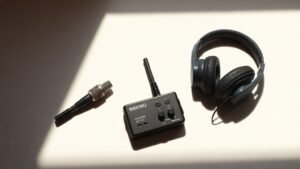
Two headphones can measure identically on paper yet create completely different spatial experiences that separate satisfying audio from truly immersive sound reproduction.
Soundstage and imaging represent the spatial characteristics that determine whether music feels like performers arranged in a believable acoustic space or sounds compressed into your skull. After years of obsessively buying, using and comparing audio gear, these qualities matter more than frequency response charts suggest.
This guide explains how soundstage width, imaging precision, and spatial depth work together in headphone design. We examine the acoustic principles behind spatial reproduction, compare open-back versus closed-back performance, and identify the design elements that create convincing three-dimensional audio experiences.
Understanding Soundstage Fundamentals
Soundstage describes the perceived width, height, and depth of the audio field that headphones create around your head. Wide soundstage places instruments across a broad horizontal plane extending beyond your ears. Narrow soundstage keeps everything contained between your temples. The Sennheiser HD800S creates famously expansive width that can extend instruments well outside the physical boundaries of the ear cups themselves.
Depth perception proves equally important but harder to achieve. Forward soundstage pushes vocals and lead instruments toward your face. Recessed soundstage pulls them back into apparent distance. The Audio-Technica ATH-AD2000X demonstrates excellent depth layering where background vocals sit clearly behind lead vocals rather than competing for the same spatial plane.
Height represents the most challenging dimension for headphone reproduction. Most designs struggle to create convincing vertical separation between floor toms and cymbals or between bass lines and soprano vocals. The HIFIMAN Arya manages respectable height through careful driver positioning and open-back acoustics that reduce the sealed chamber effect.
Imaging Precision and Instrument Placement
Imaging refers to the precision with which headphones place individual sound sources within the soundstage. Accurate imaging lets you point to specific instrument locations as if performers occupied physical positions in space. Poor imaging creates a vague wash where instruments blend together without distinct placement.
Driver matching between left and right channels proves critical for imaging accuracy. Manufacturing tolerances that seem insignificant can destroy spatial precision. The Beyerdynamic DT 1990 Pro maintains tight driver matching that places a snare drum exactly center rather than wandering left or right depending on the frequency content.
Phase coherence between drivers also affects imaging sharpness. Multi-driver designs like the Audeze LCD-5 must align the acoustic output timing perfectly or spatial cues become blurred. Single dynamic drivers avoid this complexity but face their own challenges in reproducing the full frequency range with consistent spatial characteristics.
Accurate imaging transforms recorded music from background noise into a convincing illusion of performers occupying real space around your listening position.
Open-Back Versus Closed-Back Spatial Performance
Open-back designs typically excel at soundstage width because the rear acoustic chamber connects to room air rather than forming a sealed enclosure. This connection reduces internal pressure buildup that can compress spatial cues. The Focal Clear demonstrates how open-back architecture creates breathing room that allows instruments to spread naturally across the stereo field.
Closed-back headphones sacrifice some spatial width for isolation and bass extension. However, well-designed closed models like the Audio-Technica ATH-M70x can still achieve respectable imaging through careful internal damping and chamber shaping. The trade-off becomes worthwhile when external noise would otherwise interfere with spatial perception.
Semi-open designs attempt to balance these characteristics by controlling rear ventilation rather than sealing completely. The AKG K701 uses this approach to maintain reasonable isolation while preserving much of the spatial openness that makes orchestral recordings feel appropriately grand rather than compressed.
Driver Technology and Spatial Reproduction
Dynamic drivers excel at creating natural soundstage proportions because single diaphragms avoid the phase complications of multi-driver arrays. The Sennheiser HD660S demonstrates how a well-executed dynamic driver maintains consistent spatial characteristics across the frequency range without the discontinuities that can fragment imaging precision.
Planar magnetic drivers offer different spatial qualities through their distributed drive force and lower distortion characteristics. The HIFIMAN HE6se creates exceptionally clean imaging where individual instruments maintain distinct edges rather than bleeding into adjacent spatial positions. However, planar designs often require more amplifier power to achieve their full spatial potential.
Electrostatic drivers represent the ultimate in spatial precision through their virtually massless diaphragms and linear response characteristics. The STAX SR-L700 delivers imaging sharpness that can seem almost hyperreal, placing percussion strikes with surgical precision that exceeds what most recordings actually contain. This precision can initially sound unnatural until your ears adjust to the enhanced spatial information.
Amplification Effects on Spatial Performance
Inadequate amplification compresses soundstage width and reduces imaging precision even from capable headphones. Underpowered drivers cannot reproduce the subtle level differences between channels that create spatial illusions. The difference becomes immediately apparent when connecting demanding headphones like the Beyerdynamic DT 880 600-ohm to proper amplification rather than smartphone outputs.
Output impedance matching affects spatial reproduction through damping factor control. High output impedance sources can blur imaging by reducing driver control, particularly in the bass frequencies where spatial cues depend on precise transient reproduction. The iFi ZEN DAC demonstrates how proper impedance matching preserves the spatial capabilities that headphone manufacturers designed into their products.
Clean power delivery also matters for maintaining the dynamic range that supports convincing spatial reproduction. Compressed dynamics flatten the amplitude variations between direct sound and room reflections that recordings use to convey spatial information. Quality amplification like the Schiit Magnius preserves these subtle cues that separate recorded acoustics from artificially processed sound.
Expecting identical spatial performance from all headphone designs leads to disappointment. Closed-back models optimised for isolation cannot match open-back soundstage width, while open designs sacrifice the controlled bass response that supports rhythm section imaging.
Confusing soundstage width with audio quality creates misplaced priorities. Artificially wide soundstage can actually harm imaging precision by spreading instruments beyond believable positions, making intimate recordings sound unnaturally expansive.
Ignoring amplification requirements limits spatial potential from capable headphones. High-impedance models need adequate power to reproduce the dynamic contrasts and frequency balance that support convincing three-dimensional audio reproduction.
Conclusion
Soundstage and imaging transform headphone listening from mechanical sound reproduction into convincing spatial experiences. Open-back designs generally excel at width while proper amplification unlocks the spatial potential that manufacturers engineer into their drivers. Focus on the spatial characteristics that match your listening priorities rather than chasing specifications that look impressive on paper.

FREE DOWNLOAD
Stop Guessing. Start Buying Smart.
The specs that actually matter, demystified.
Headphones, microphones, the spec sheet jargon you can ignore — all in one quick-reference PDF. Free, instant, no fluff.
Send Me the CheatsheetYou'll also receive occasional new guide notifications. Unsubscribe anytime. No spam, ever.