A mobile recording rig built without a clear signal chain in mind will cost you more in failed sessions than any gear upgrade ever could.
Setting up a mobile recording rig is one of those tasks that looks deceptively simple on paper. You bring a microphone, an interface, a laptop, and a pair of headphones. What could go wrong? Quite a lot, as it turns out. After years of obsessively buying, using and comparing audio gear, I have learned that a portable rig lives or dies on the decisions you make before you ever leave the house.
This guide covers the full chain from microphone choice to monitoring, with a focus on gear that travels well, performs reliably under real-world conditions, and does not require a flight case the size of a wardrobe. I will walk through each element of the signal path in order, explain the trade-offs worth understanding, and flag the common mistakes that even experienced engineers make when they first go mobile.
Choosing the Right Microphone for Location Work
The microphone is where your recording either starts strong or starts compromised. For mobile work, the question is rarely which microphone sounds best in isolation — it is which one sounds best given the acoustic environments you are likely to encounter. A large-diaphragm condenser like the Rode NT1 is a magnificent studio microphone, but its wide cardioid pickup pattern and sensitivity to room reflections make it a difficult choice when you are recording in an untreated bedroom or a noisy venue back room.
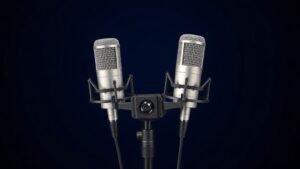
For most location recording tasks — voiceover, podcast interviews, acoustic instruments, field capture — a small-diaphragm condenser or a dynamic microphone gives you far more control. The Shure SM7dB is a dynamic microphone with a built-in preamp that handles a wide range of sources and is remarkably forgiving of imperfect acoustic spaces. If you are recording dialogue or solo instruments in quiet environments, the Rode VideoMic NTG offers genuine broadcast quality in a form factor that fits in a jacket pocket. For stereo field recording, a matched pair of small-diaphragm condensers like the Rode M5 gives you a portable XY or ORTF option that is genuinely capable.
Polar pattern matters enormously on location. A supercardioid pattern rejects more off-axis sound than a standard cardioid, which helps in reverberant rooms or environments with ambient noise at the sides and rear. Understanding that trade-off — tighter rejection but with rear lobes that pick up sound directly behind the capsule — means you can position yourself and the microphone deliberately rather than hoping for the best.
Audio Interfaces That Actually Travel Well
The portable audio interface market has matured significantly, and there are now several units that offer genuinely professional preamp quality in a bus-powered form factor. The key criteria when selecting an interface for travel are: preamp quality, bus power reliability, physical durability, and driver stability across operating systems.
The Universal Audio Volt 2 is one of the more capable options in this space. Its vintage mode adds subtle transformer-style saturation that works well for vocals and acoustic instruments, and it powers cleanly from USB-C on both Mac and Windows. The Focusrite Scarlett 2i2 in its fourth-generation form remains a strong benchmark — the preamps are cleaner than they have ever been, phantom power is stable, and the unit is small enough to fit in any laptop bag. For engineers who need more than two inputs, the Focusrite Scarlett 4i4 adds direct monitoring flexibility without growing significantly in size.
If you are working with a single microphone and need the most compact possible chain, the Universal Audio Apollo Solo USB is worth considering. The onboard UAD processing allows you to run high-quality plugin emulations with near-zero latency during tracking — genuinely useful when you are recording in a room with no acoustic treatment and need to apply light compression or EQ at source to keep the talent on track. One thing I always check before trusting any interface on a new job: confirm that it operates correctly from bus power alone, without a mains adapter, before you rely on that in the field.
The interface is not the glamorous part of a mobile rig, but a poor preamp or unstable driver will ruin a session faster than any acoustic problem.
Headphones and Monitoring on Location
Monitoring on a mobile rig presents a different set of challenges than studio work. You cannot use open-back reference headphones in a noisy environment because the bleed contaminates what you are hearing and, if you are tracking a vocalist, what the microphone captures. Closed-back headphones are the practical standard for location recording, but not all closed-back designs are equal in terms of isolation or accuracy.
The Beyerdynamic DT 770 Pro has been a standard on location rigs for decades for good reason. The 80-ohm version pairs comfortably with most portable interfaces without needing additional amplification, the isolation is genuine rather than merely adequate, and the low-frequency extension lets you catch rumble problems early. The Sony MDR-7506 remains a viable alternative — lighter, more compact when folded, and with a character that experienced engineers learn to compensate for in their monitoring judgement.
For engineers who also need to do critical mix checks while travelling, the Audeze LCD-1 is a planar magnetic open-back that folds flat and fits in a small case. It is not suitable for tracking — the isolation is minimal — but paired with a capable DAC and amplifier it gives you a reference listening option that can genuinely inform mix decisions. In practice, I carry both a closed-back set for tracking and a second pair for reference listening, accepting that this adds a small amount of weight for a significant gain in reliability.
Cables, Power, and the Accessories That Are Easy to Forget
Every experienced location engineer has a story about a session that nearly collapsed because of a missing cable or a flat battery. Accessories are the unglamorous infrastructure of a mobile rig, and they deserve the same level of planning as the headline gear. At minimum, carry two XLR cables of different lengths — a short one for close-mic work and a longer one for situations where the interface cannot sit directly beside the microphone stand. Redundancy in cables is not paranoia; it is professional practice.
Power management becomes critical when you are working away from a reliable mains supply. A quality USB-C power bank — the Anker 737 Power Bank is a reliable choice — can run a bus-powered interface and charge a laptop simultaneously, which gives you meaningful independence from wall sockets. Check the power delivery specification of any bank you consider: you need genuine 65W or higher output to keep a modern laptop charged while running an interface in parallel. A power bank that drops to 45W under load will slowly drain your laptop battery across a long session.
Microphone stands for travel deserve specific consideration. Standard tall stands are not practical for most location work. A short desk stand like the Rode DS1 or a compact boom stand with a folding base gives you flexibility without requiring a dedicated case. I also carry a portable acoustic panel — the sE Electronics Reflexion Filter Pro is the recognised benchmark here — which attaches to the microphone stand and reduces room reflections significantly when recording in untreated spaces. It adds weight but it consistently makes the difference between a recording that requires heavy post-processing and one that sounds controlled at source.
Organising Your Chain Before You Leave
The signal chain for a mobile rig should be mapped out in writing before every session, particularly when you are working in a new environment or with unfamiliar talent. Write down: microphone model, cable run length, interface input gain setting, phantom power on or off, monitoring path, and recording software session template. This sounds excessive until the moment you arrive at a location, the session is delayed by twenty minutes, and you need to set up quickly without thinking through the chain from scratch under pressure.
Software matters as well. Reaper is a highly capable digital audio workstation that runs on low-spec laptops, accepts a portable licence on a USB drive, and has a remarkably small install footprint. Logic Pro is macOS-only but performs extremely well on Apple Silicon hardware and is the right choice if you are already in that ecosystem. Whatever you use, carry a session template configured with your standard input routing, monitoring setup, and basic processing chain so that the first minutes of every session are spent checking levels rather than rebuilding the project from scratch.
Relying on a single cable for the entire session is the most common cause of avoidable session failure. Cables fail without warning and often at the worst possible moment. Carry at minimum two XLR cables and one spare USB-C data and power cable for your interface.
Skipping acoustic treatment because you are on location leads to recordings that are difficult or impossible to rescue in post. Even a single portable reflection filter makes a measurable difference in reverberant rooms. The sE Electronics Reflexion Filter Pro is compact enough to be worth the additional weight in your bag.
Assuming bus power will work reliably from any USB port on any laptop is a mistake that causes dropouts and gain instability mid-session. Always test your full signal chain from the power source you intend to use on location before you trust it in a real session. Laptop USB ports vary significantly in the current they can deliver.
Conclusion
A well-built mobile recording rig is not about carrying the most gear or the most expensive gear — it is about having a carefully chosen, tested, and understood signal chain that you can deploy confidently in imperfect conditions. Prioritise preamp quality, microphone appropriateness for the environment, reliable power delivery, and acoustic control. Everything else is a refinement built on top of those foundations.
FREE DOWNLOAD
Stop Guessing. Start Buying Smart.
The specs that actually matter, demystified.
Headphones, microphones, the spec sheet jargon you can ignore — all in one quick-reference PDF. Free, instant, no fluff.
Send Me the CheatsheetYou'll also receive occasional new guide notifications. Unsubscribe anytime. No spam, ever.